
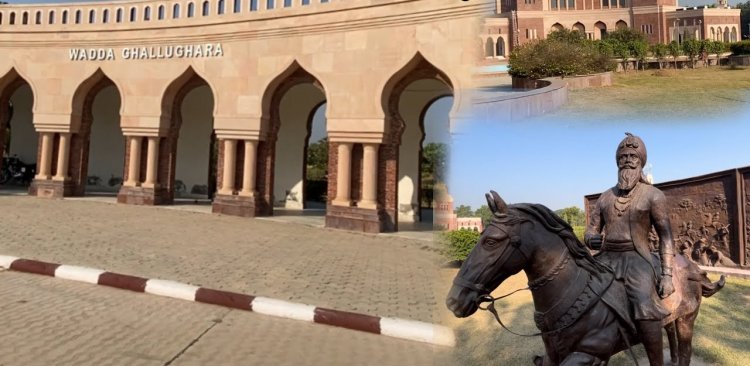
Principal Satbir Singh has shed light on the great Ghalugharah in great detail from pages 239 to 246 of his book Sikh History, Part I. Ahmed Shah Abdali had launched five attacks on India from 1748 to 1761. The fifth attack was against the Marathas exclusively. Abdali gave a heavy defeat to the Marathas in the third battle of Panipat. After defeating the Marathas on 13 January 1761, Abdali returned in the month of March. When he was returning, the Sikhs distributed a large portion of his wealth to Abdali. According to one account, he was followed till Attock. He declared that now he would rest only after suppressing the Sikhs. He did not know that no one could defeat the Sikh nation.
Now two forces – the Sikhs and the Afghans – were fighting for the possession of Punjab. All the other forces had either disappeared or had become weak. The Sikhs were the de facto masters of the Punjab in 1762. Abdali’s appointed governors Khwaja Mirza Khan Chahar Mahal Wala, Abid Khan (Lahore), Sadat Khan and Sadaq Khan Afridi could not stop the growing power of the Sikhs. Ahmad Shah Abdali killed and imprisoned Nur-ud-Din. The governor of Lahore, Abid Khan, also fled. The Sikhs, led by Sardar Jassa Singh Ahluwalia, captured Lahore and Akaldas persuaded Abdali to attack. The Sikhs were informed. The Sikhs concentrated on getting their families to safety and all began to gather in Maler Kotla.
Ahmad Shah reached Lahore on 3 February, contrary to expectations. According to the Sikhs’ estimates, it would have taken him at least ten days to reach Lahore. The Sikhs were confident that they would be able to return and prepare to fight by taking the families to a safe place, but the Sikhs were surprised to see Kasam Khan attacking on 5th February. Abdali was so confident of victory that when Raja Hari Sahai wrote to Shah Wali Khan for help, he replied that he would hunt the Sikhs for some time after rooting out the Sikhs. Where the Sikh families would stay, they would hang clothes on spears and build barracks. The route was being told by Bhai Sangu Singh Ji, Kotwal Bai Sakhu Singh Ji of Hambhalwal and Bhai Budha Singh (Kanthal) of Bhai Ke. Both the Birs of Guru Granth Sahib were with Damdami and Amritsari.
According to the statement of Giani Gian Singh, it was morning. The Sikhs were not even ready yet. Abdali surrounded them. Abdali’s forces started a massacre as soon as they arrived. The Singhs made hasty preparations. Although the attack was unexpected, the Sikhs were determined to fight back. Thousands of Singhs were martyred in the first attack. The Sikhs formed an idea to save the tribes and at that moment the thought of the tribes came to mind. All those innocent people would be martyred. So it was quickly decided to build a chowkhata (round fort) around the Wahirs and confront the enemies. Sardar Jassa Singh took command. Sardar Sham Singh’s group was also with him. They had only walked three miles when Bhikhan Khan, Zain Khan and Shah Wali Khan arrived. They could not succeed in breaking the round fort. The Sikh soldiers erected a wall of living men. The troops continued to resist Abdali’s army and the Wahirs advanced towards Barnala. The Wahirs went a long way from Zain Khan. The Sikhs were losing a lot of lives while fighting on foot, but the Singhs were attacking resolutely.
When the Singhs fought resolutely, Abdali’s troops also started to cry out in ‘Toba te Allah’ in fear. The Singhs were protecting Waheer like a hen protecting her chicks by spreading her wings. Ahmed Shah and his generals were shocked to see this kind of battle.
Ahmed Shah encouraged Wali Khan, Bhikhan Khan Maler Kotle Wale and Zain Khan to attack strongly. Out of the 48 thousand army, eight thousand soldiers were separated and attacked together. Abdali succeeded in separating Waheer and ‘Dal Khalsa’. In this attack, the Singhs were routed and many Singhs were martyred. This attack broke the fence of the Sikh chiefs and groups. Families of families were killed. The Wahir suffered a lot of damage. Now it seemed that Abdali wanted to reach the middle of Wahir and carry out such a big massacre that the Sikhs would not be able to rise again. Understanding Abdali’s trick, the Sikhs organized themselves firmly. All the groups, Bhangis, Ghanais, Shukerchakias, Dalawali, Shaheed, Karori, Ramgarhi, Nishanwali Sardars gathered together and started fighting with a new plan. The way the Sikh Sardars defended themselves amidst sudden attacks and then continuous attacks is an indelible memory in the history of war. The enemy was almost annihilated on the side where the Singhs ran and fell.
Sardar Jassa Singh Ahluwalia, Sardar Siam Singh and Sardar Charat Singh Shukerchakia showed strong hands. Sardar Jassa Singh Ahluwalia barely escaped death many times. Seeing himself covered in blood, the bodyguard Bhai Gurmukh Singh had just lifted the whip to make the horse heel and move it aside when Sardar Jassa Singh Ahluwalia, the epitome of courage, shouted, “It is better to die than to live like this.” Sardar Jassa Singh Ahluwalia received 22 wounds on his body and Sardar Charhat Singh Sukerchakia received 19 wounds. Sardar Jassa Singh was fighting while bleeding. It is said that he told a Sardar Charhat Singh that you said that you would directly confront Abdali. Now what are you doing here! As soon as he heard this, Abdali gave a higher speed to his horse. The bravery with which Sardar Charhat Singh saved many Sikhs of Waheer was praised and glorified by the entire Panth. When the horse got tired, Sardar Charhat Singh would change a new one. He always kept five horses with him. Wherever there was a call, the horse would rush there immediately after hearing it. No one was injured.
They would put a wounded Singh on their back and reach a safe place and then fight. Seeing a Singh showing a good hand, they would attack and go further. Their clothes were all covered with blood. As if they had just come from playing Holi.
The entire Panth praised Sardar Charat Singh Ji so much that they blessed him saying, “I will establish the kingdom, kill Lahore, capture Multan. The orders will be issued till Kashmir is able to reach Kabul.” The Durrani was also attacking with full force. The only aim of Abdali’s army was to destroy the Singh army and martyr all the Wahirs. During this time, the Wahirs had moved about five miles. According to the statements of Hussain Shahi, Tarikh Ahmed, Sohan Lal, Ali-ud-Din and Bhai Rattan Singh, thirty thousand Singhs were martyred in this battle.
This entire incident is remembered in Sikh history as the Great Ghallughara. The Small Ghallughara was carried out by Yahya Khan and Lakhpat Rai on June 1746. About 10 thousand Sikhs were martyred in the Small Ghallughara. According to the statements of historians Hussain Shahi, Tarikh Ahmed, Sohan Lal, Ali-ud-Din and Bhai Rattan Singh, thirty thousand Sikhs were martyred in this Ghallughara. This was an indelible blow to the Sikh nation. Half the nation was martyred in one day, but the world read with astonishment and historians wrote that the Sikhs not only remained in the best of times but also showed gratitude.