
This experiment began with coalition governments formed in 10 states in 1967 and reached its peak with the Janata Party coming to power at the Centre in 1977. In the nineties, when the communal politics of the BJP gained momentum, this debate began to take place under the possibilities of non-BJPism. The SP-BSP government formed in Uttar Pradesh was a clear manifestation of this kind of politics. After that, in 2004 and 2009, the Congress formed an alliance and defeated the BJP led by Atal Bihari and then the BJP led by Lal Krishna Advani twice. This was a new development. Before this, the Congress used to stay away from coalition politics. Alliances were formed against it. Today, the situation has completely changed. The ball is in the Congress’s court to form a national alliance against the dominance of the BJP. The problem is that the Congress is reluctant to play it.
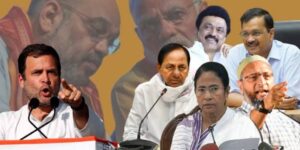
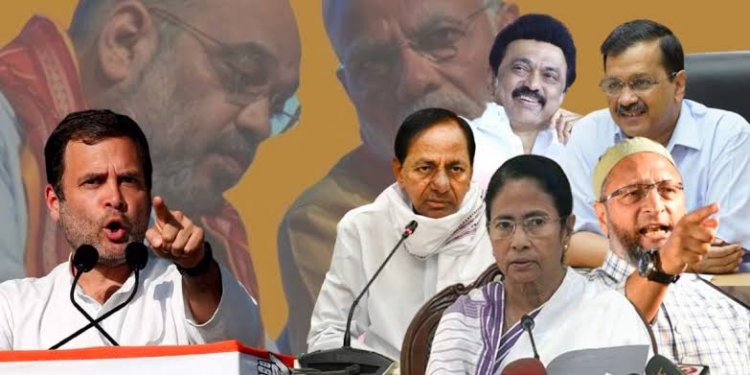
It cannot be said that the unity of the opposition is a topic that has been worrying our politics since the 60s. Since independence, under the sway of the Congress, the party system of India was running on the lines of ‘one party-mahaprabal’. It always seemed that if there was no unity among the opposition, democracy would become completely Congress-based and weak. But when the era of coalition governments came in between, this concern started to be heard very less. About 35 years passed from 1989 to 2014, every party was enjoying the closeness of power by being in some coalition or the other, but as soon as the Bharatiya Janata Party started emerging as a ‘one party-mahaprabal’ on the pattern of the Congress after the 2014 elections, the concerns about opposition unity started gaining strength once again. The attempts to form an ‘India’ alliance before the 2024 elections indicated that now the BJP may also have to go through a tough democratic competition. The special thing is that a national alliance of the opposition could never be formally formed from an organizational point of view, but its discussion and its idea itself turned out to be enough that the BJP could not form a government with a majority for the third time. It is obvious that the BJP was facing a 10-year ‘anti-incumbency’ (anti-incumbency sentiment), but the claims of the ‘India’ alliance (no matter how scattered the opposition party may have been) were necessary for the opposition to benefit from it.
Today, if the BJP has 240 seats, then the ‘India’ alliance has only 6 less than it, i.e. 234 seats, but the BJP is united and is achieving electoral successes in the north. The ‘India’ alliance is more fragmented than ever. In a way, it has become a helpless mass of people, with neither a centre nor a political direction. At present, it has become more and more a coordinated group of non-NDA forces in Parliament. It was seen on the Adani issue that this coordination also keeps breaking down. The politics of the opposition is currently facing a double question: Is the future of the ‘India’ alliance in darkness and who is responsible for its failure to get a formal shape before the Lok Sabha elections?
Broadly speaking, the ‘India’ alliance is an alliance of extremely powerful regional powers in their respective states, which can claim a share in the power in Delhi through a national party (Congress). On the other hand, the Congress intends to oust the BJP from power in Delhi with the help of these regional powers. Why has this alliance not been able to take a formal structure when both their interests are aligned? I have a direct answer to this. If the Congress had wanted, the structure of this alliance would have been in place at the beginning of last year itself. In fact, the day the Congress wants, within a week or ten days, the ‘India’ alliance will have an office, a convener will be created, a secretariat will be formed, its team of spokespersons will be appointed and its minimum common programme will be ready on paper.
The question arises here that if this could have happened, why did the Congress not allow it to happen earlier and why is it still avoiding such initiatives? Here it is necessary to identify a major contradiction. At a time when Nitish Kumar was roaming around the country and rallying opposition leaders to come together on a platform, he had the silent hand of Rahul Gandhi, Sonia Gandhi and Mallikarjun Kharge at his back. Clearly, the Congress high command wanted to form such a front at that time and Nitish was working as its unannounced ambassador. Nitish had declared Tejashwi as his successor in Bihar and was looking for his own role in central politics. Therefore, he was ready to take on the responsibility along with the Congress.
It seems that as soon as the Congress suffered a crushing defeat in the assembly elections, the Congress high command started to change its mind. It must have started to feel that now it would not be able to control this alliance of regional powers on its own terms. The first major sign of his retreat came when Rahul Gandhi himself backed down on the proposal to make Nitish Kumar the convener on the pretext that Mamata Banerjee and Arvind Kejriwal had not yet agreed to it. This incident broke Nitish’s heart in a way and he once again went for a u-turn. In this situation of non-cooperation from the Congress, it was almost impossible for him to enter national politics.
Since the Congress’s ability to lead regional forces has become weaker than before due to repeated defeats in the assembly elections,Therefore, it is not ready to form any national front of the opposition at the moment. The saying goes, ‘Nah Nau Maan Tel Hoka, Na Radha Nachegi’. The elections in Haryana and Maharashtra show that the Congress is losing the elections despite its initial lead. The slight taste of success it had in the Lok Sabha has now ended. In a way, it has reached the situation it was in before Rahul Gandhi’s Bharat Jodo Yatra. In such a situation, it is not possible for it to lead the unity of the opposition at the moment.