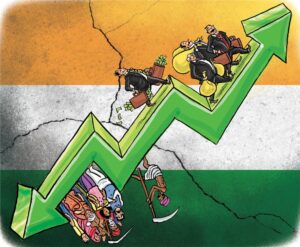

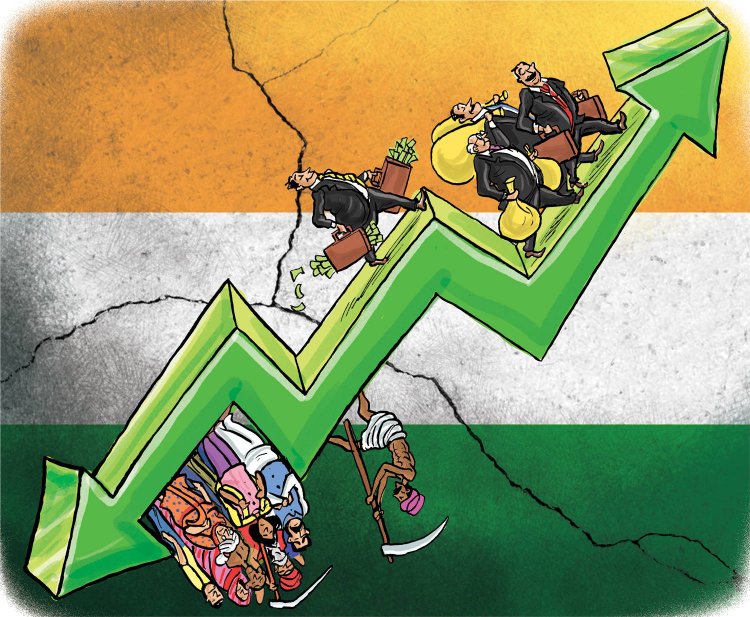
Airports, ports, highways are being modernized rapidly in our country, but what is the benefit of it to the common people? In those circumstances, when the basic facilities in the country are in a bad condition! When we are celebrating the “Amrit Kaal” of Independence, after completing 75 years, but the common people also yearn for water.
What the common people suffered in the recent Corona period, they died after taking medicines, instead of cremating the bodies after death, they had to throw them into the rivers. The common people did not get oxygen in the hospitals. Wasn’t it shameful?
Recently, an incident took place in Bihar. A badly injured 10-year-old girl arrived outside the Patna government hospital, she lay outside the hospital for hours, because there was no empty bed in the hospital. The girl was raped. Some beast tried to cut her throat after raping her. The Patna government hospital staff did not treat her in an emergency. She was referred from Muzaffarpur. Her condition had become critical even before the girl was treated. This Patna government hospital in Bihar is the largest hospital in this state. The “CAG” report on this hospital was presented in the Bihar Legislative Assembly, in which it was said that more than half of the oxygen machines in this 100-year-old hospital are not working. More than 94 percent of the hospital’s facilities are in a dilapidated condition. There is a 36 percent shortage of doctors and nurses.
In another similar Muzaffarpur hospital in Bihar, more than 150 children died in 2019, due to encephalitis, simply because there was neither medicine nor a doctor in the hospital.
Such conditions are not limited to Bihar in terms of health facilities, but there is a severe shortage of health facilities in the entire country. Lakhs of people die every day due to lack of treatment. According to a report by the Economic Times, there is a shortage of 82 percent specialist doctors in the community health centers of Indian villages. According to the report of the National Medical Journal of India, 10 percent of community centers do not have doctors.
On the other hand, the spread of ‘cancer’ has completely frightened the country. The number of cancer patients is increasing day by day, the treatment of which is not even a question of the poor man. The government’s Ayushman and other schemes seem helpless for the common man, because first of all, the common man does not have access to these schemes, but if a common man tries to take advantage of these schemes, then there are constant reports of its misuse in private hospitals.
Poverty-richness has widened the gap in health facilities. Expensive treatments in five-star hospitals are within the reach of the financially capable person, but the common man does not have access to even the minimum facilities available in government hospitals.
The same situation is in the field of education. The common citizen of the country has the constitutional right to education for everyone, but where is equal education for all missing, which is beyond his reach. The common man’s child cannot get education in five-star public schools, expensive big professional universities. Government schools are devoid of teachers, subject teachers and basic facilities. Where will the children of the common people get good education? How will they compete with the children of big public schools? A big gap is also increasing in the education sector, just as the gap between the rich and the poor has increased in the country from an economic point of view.
The rulers of the country are oriented towards making India a big economy. They are eager to become a world guru. But does the ruler keep in mind that the common man’s per capita expenditure limit in the country, according to the World Bank, is only three dollars per day. Can he meet better education, health facilities, food and other expenses with this per capita expenditure in this time of inflation? Is it possible to live a good life?
The World Bank has set the expenditure limit of lower-middle-class income earners in India at $3.65 per person per day. Can India become a developed country with this small expenditure-income ratio and can any country be called developed without providing education, health to every citizen?
In terms of education level, 35.1 percent of people above the age of 16 without any schooling were below the poverty line in 2022-23. While in the year 2022-23, poverty among the few educated lower middle classes is 14.9 percent. But the real facts come to light when it is officially accepted that under the “Food for All” scheme, more than 80 crore people out of the total population of about 140 crore are provided free food grains by the government. According to another estimate, 20 crore people get barely one bite of food every day. Bread, clothes and housing are beyond the reach of everyone, which are the basic needs of man.
There is constant talk of progress and change in the country. As a change, the construction of roads and other infrastructure in the country is seen, tested and implemented. But basically, the efforts made to raise the standard of living of man and provide him with comforts and facilities appear to be in vain. Half of the population, women, who contribute a large share in the construction of the country, are still badly neglected. They are not getting their due rights, they are still victims of domestic violence. Housewives are locked within the four walls. Conservative thinking is still prevalent in the country. Religious discrimination and caste system have entangled the thinking of the people of the country.
Politicians, who are considered the axis of bringing change in the society, are using the policy of ‘pressure’ instead of ‘change’ due to their vested interests. People’s participation is undoubtedly necessary for change, but this change can be reversed by creating divisions in society.
Bringing forward the conservative thinking of the old is an important phenomenon today. Push, bully, money have become the main factors. All these three are a big obstacle to change.
The change in the rulers of the country is undoubtedly due to the voting system in a democracy, but the voting system has become contaminated. That is proving to be a big obstacle to change. Along with politics, a special role for social change is possible due to the basic wise people of the country or region, but how will they come forward for change with the way they are living their lives under fear and pressure? The atmosphere of fear, restrictions on ideas are undoubtedly proving to be a big obstacle to change.
In the real sense, only that country can be developed, which can give a happy life to its citizens, which can provide education, health, environment, food facilities. Today there is neither complete agriculture nor complete employment in the country! Today the country is forced to eat food that is devoid of nutritious food and is full of poison. Pollution is rampant in the country. There are heaps of garbage. Chemicals are commonly used. In such a situation, change seems like “the camel’s lip has fallen even now or has fallen even now”.
People seek change. Every political party is eager to become the ruler by giving the slogan of change. People get trapped in a trap of illusion with the concessions offered by politicians. Small concessions may give them some satisfaction or mental peace, but when a person reaches old age, where is his social security? Some part of the population gets government pension, some population gets a meager old age pension. (Rs. 500 per month to Rs. 2000 per month), but a large population is deprived of these facilities.
Human life is becoming complicated in the present era. Joint families are breaking up. Technology has tried to bring the world on a platform, but human isolation has increased, humans may not even be able to become the charioteer of such a change in the near future.
But the real change is not the skyscrapers built in some parts of the metropolis. Nor can we call the mobile in every hand a change. The real change is in making human life equal. The governments have a big role in this. The governments are indifferent to this. There is no change in the manners of the administrative officials who run the governments in the country India. They sit in AC offices and devise schemes, please their “masters” corporates, develop big slogans. They get them promoted morning and evening and people are cheated by this propaganda.
Change will come in the country when the ‘leader of the country’ is honest towards the people. There will be good governance in the country. People will get the necessary amenities. There will be equal education for everyone and employment for everyone. There will be freedom of speech, reading, writing. There will be Swaraj.