
Bodh Gaya, the holy land where Siddhartha Gautama became the Buddha, where on the banks of the Niranjana River, under the shade of a peepal tree, the world received the message of equality, compassion and non-violence. The Mahabodhi Temple is not just a building, but a living dream, a centuries-old philosophical historical saga, created by the Tathagata Buddha, which is under the control of non-Buddhists.
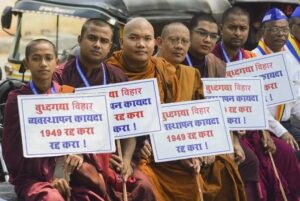
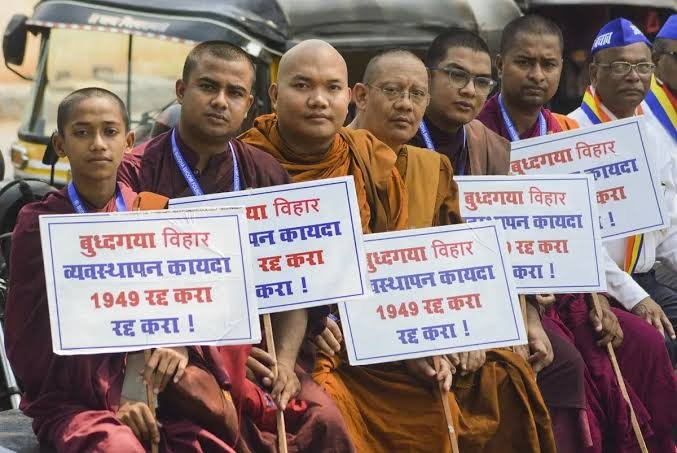
The prayer of the Buddhist monks, the cry of their hearts, that the management of the Mahabodhi Temple be handed over to the Buddhist community only, has today taken the form of a mass movement. This struggle is not just a matter of a temple, but a fight for equality, cultural heritage and freedom of religion. 2600 years ago, when Siddhartha Gautama lit the light of knowledge under this peepal tree, the world received a Dhamma that launched a movement to break the bonds of caste, gender and social inequalities.
The management of the Mahabodhi Temple, which is being run under the Bodh Gaya Temple Act of 1949, .According to this Act, the temple management committee consists of 9 members—4 Hindus, 4 Buddhists, and the ninth member is the District Magistrate, who is the head as the presiding officer. If the District Magistrate is a non-Hindu, then the government is required to appoint a Hindu head. This arrangement is a symbol of injustice to the Buddhist community. The demand of the Buddhist monks and their supporters is that this temple is ours, our Buddha, our Dhamma. Why is it not in our hands to manage it?”
Buddhism and Brahmanism: A centuries-old struggle
Gautama Buddha raised his voice against casteism, inequality, and the Brahmanical system in the 6th century BCE. The Mauryan emperor Ashoka carried this message to Southeast Asia, and the foundation of the Mahabodhi Temple was laid during this period. But, like a storm in the ocean, the stormy waves of Brahmanism also arose during the golden age of Buddhism. Pushyamitra Shunga, who founded the Shunga dynasty after the Mauryan dynasty, burned Buddhist monasteries, demolished stupas, and massacred monks and declared bounties on their heads. Then in the 8th-9th centuries, Shankaracharya reorganized Brahmanism. He rejected the Buddha’s anti-God and anti-soul ideas, and called the world Maya and Buddhism almost wiped out from the land of India. But, just as the dry trees revive in spring, in the 19th century, the Sri Lankan citizen Dharmapala started a campaign to return the Mahabodhi Temple to the Buddhist community. His light shone with the establishment of the Mahabodhi Society. However, the 1949 Act again left a dull haze in this light.
Current controversy: The cry of the Buddhist movement
Since February 2025, the land of Bodh Gaya has once again become a witness to struggle. Buddhist monks and their followers, through indefinite hunger strikes and demonstrations, are trying to make their prayers reach the ears of the government. They demand that the 1949 Act be repealed, and that the full control of the Mahabodhi Temple be handed over to the Buddhist community. The voice of protesters like Akash Lama. “This temple is our heritage, our faith, “Our Buddha’s message is this. It cannot be bound in the chains of Brahmanism.”
Why Ambedkarites are silent:
The activity of Ambedkarite organisations on the issue of Mahabodhi Temple seems limited. Organisations like Bhim Army have recently raised their voice. The Rashtriya Swayamsevak Sangh and its affiliates of Hindutva are trying to Brahmanise Buddhist and minority religious places. This influence can also be seen in the Sufi shrines (like Baba Budangiri and Haji Malang) and the tradition of Sai Baba. The Mahabodhi Temple controversy, the story of the occupation, is being considered as part of the strategy of the ‘Hindu Rashtra’. This struggle is a cry to save India’s diverse cultural heritage.
Legal position and government’s stand
A writ petition (Civil No. 0380, 2012) challenging the Bodh Gaya Temple Act of 1949 regarding the management of the Mahabodhi Temple, filed by Buddhist monk Bhante Arya Nagarjuna Surai Sasai and Gajendra Mahanand Pantawane, is still in court process. According to the latest information, the Supreme Court has fixed the final hearing of this matter on 16 May 2025 for 29 July 2025. No concrete action is available regarding its hearing on 24 March 2025. The government’s position is not clear yet. The government has not taken any concrete step on this issue, due to which the protestors are increasing their anger. The government should review the 1949 Act and consider the possibility of handing over the management of the temple completely to the Buddhist community.