
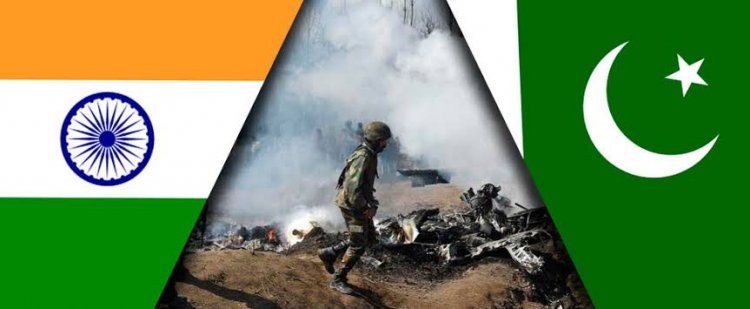
After the Pahalgam terrorist attack, the possibility of war between India and Pakistan is being raised. However, six years ago in 2019, a study had said that there could be a war between India and Pakistan in 2025. This study made many assumptions, but the main focus was on what would happen if there was a nuclear war?
Pakistan has been threatening war with India for the past several days. From Pakistan’s defense minister to the information minister, India has been threatening nuclear war. Meanwhile, India has so far exercised restraint and avoided rhetoric. According to a report by WION News, this study was led by scientists from the University of Colorado in collaboration with researchers from Rutgers University. It was published in the journal Science Advances. The study used inputs from the US National Center for Atmospheric Research, the Federation of American Scientists, the Natural Resources Defense Council, the University of Texas Rio Grande and the University of California at Los Angeles. The main objective of the study was to warn against nuclear war and emphasize the importance of global conventions against it. In particular, it shed light on the importance of the UN Treaty on the Prohibition of Nuclear Weapons in 2017. The authors estimated, based on the data available at the time, how devastating a nuclear war between the two South Asian countries could be, not only for the region but also for the entire world.
What would be the consequences of an India-Pakistan nuclear war?
According to the study, 100 million people would die immediately in the event of a nuclear war. Using computer simulations, the study estimates that if India uses 100 strategic nuclear weapons and Pakistan uses 150, the aftereffects of the war could kill 50 million to 125 million people. This could lead to widespread starvation around the world, leading to even more deaths.
“Such a war would not only endanger the places where the bombs could be targeted, but would also threaten the entire world,” Alan Robock of Rutgers University’s Department of Environmental Sciences, a co-author of the study, said at the time. The 2019 study estimated that India and Pakistan could have 400 to 500 nuclear weapons by 2025. India and Pakistan have traditionally been described by security analysts as two nuclear-armed countries that are close to each other. According to estimates from a 2019 study, India could have a total of 400 to 500 nuclear weapons by 2025. The explosive power of these weapons could exceed 15 kilotons. This is equivalent to 15,000 tons of TNT, which is the same as the American bomb dropped on Hiroshima in 1945.
‘According to the study, if India and Pakistan’s nuclear weapons were used, it could cause a fire, which could release 16 million to 36 million tons of soot, or black carbon. This smoke would go into the Earth’s upper atmosphere and cover the entire globe in a few weeks. According to the study’s estimates, the soot would absorb solar radiation and heat the air. The spreading smoke will result in a 35 percent reduction in sunlight. This will cool the Earth’s surface by 5 degrees Celsius. Rainfall will decrease by 30 percent.
According to the study, vegetation growth will decrease by up to 30 percent. Ocean productivity will decrease by up to 15 percent. It has been said that it will take at least 10 years to recover from these effects, as the smoke will remain in the atmosphere.
Is war likely according to this study?
A 2019 study had presented the possibility of war between India and Pakistan in 2025 as a possible scenario, which was specifically intended to highlight the devastating consequences of nuclear war. The study was not a definitive prediction, but a warning, which shed light on the dangers of nuclear weapons and their global consequences. The recent Pahalgam terrorist attack (22 April 2025) and the subsequent escalation of tensions between the two countries have brought the possibility of war back into the discussion. Despite threats of nuclear war by Pakistani ministers and a subdued response from India, the situation remains precarious.
Although, based on the news and the study, the possibility of war cannot be completely ruled out, it does not directly confirm war. The study had emphasized the possible war scenario, which could be possible in the event of escalation of tensions due to issues like Kashmir and incidents like terrorist attacks. US intelligence reports (declassified from the 1980s and 1990s) also suggest that the likelihood of war is low, but that a conventional conflict could escalate into a nuclear conflict due to “miscalculation or irrational response”. In the current context, India has suspended the Indus Waters Treaty and closed the borders following the Pahalgam attack, reflecting the seriousness of the tensions. However, with India’s policy of restraint and the global community’s focus on the issue, the likelihood of immediate war seems low, although the situation remains volatile.
Perspectives of global newspapers
Global newspapers and media organisations have provided extensive analysis on the rising tensions between India and Pakistan and the possibility of war, especially nuclear war. Below are some key analyses, based on various sources and current information:
Bulletin of the Atomic Scientists: This weighed in with a 2019 study
Discussed the global consequences of a nuclear war between Pakistan and India. According to it, a nuclear war could devastate not only South Asia but the entire world in terms of environmental and human damage. It reiterated the demand for nuclear disarmament.
The New York Times and Washington Post: These newspapers have reported on the rising tensions between the two countries after the Pahalgam attack. They stressed that the Kashmir issue and terrorist activities are the main reasons for the tension between the two countries. They cited US intelligence reports, which suggest that miscalculations or sudden decisions can lead to a nuclear conflict.
BBC and Al Jazeera: These international media organisations reported on India’s restrained approach and Pakistan’s threats. They stressed that the world community, especially the UN and the US, should help prevent a conflict. They also put forward the data of a 2019 study, which shows the devastating consequences of a nuclear war.
The Guardian: It emphasized the environmental impacts, as the study mentioned that the black carbon released by a nuclear war could cause a global climate crisis, which could have long-term impacts on agricultural and marine productivity.
India Today and WION (Indian media): The Indian media, while describing Pakistan’s threats as “jackal babbling”, emphasized India’s restrained and robust security policy. They expressed concern over the human and environmental toll of a nuclear war, citing the study’s data.
The world media agrees that the likelihood of a nuclear war between India and Pakistan is low, but the situation could suddenly deteriorate due to terrorist attacks, the Kashmir issue, and miscalculations. Most media organizations have called for nuclear disarmament and mediation by international organizations like the United Nations. The 2019 study is often cited as a reference, highlighting the devastating consequences of nuclear war. The current situation is volatile, and the eyes of the world media are fixed on it. International pressure and restrained political decisions are needed to prevent conflict.