
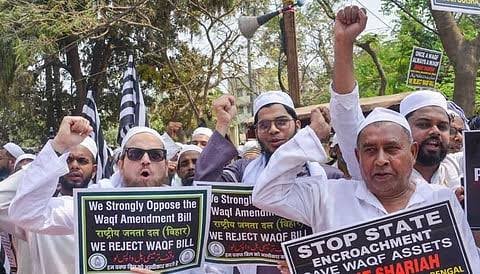
Protests and arson incidents took place in West Bengal. West Bengal Chief Minister Mamata Banerjee has categorically refused to implement this law in West Bengal. Thus, a political conflict has been started.
Congress leader and Leader of Opposition in the Lok Sabha Rahul Gandhi claimed that the Waqf Amendment Act passed by Parliament is an attack on religious freedom and an unconstitutional step. He also said that other minority communities will also be targeted in the coming time.
Petitions have also been filed in the Supreme Court against the Waqf Amendment Act. The way political and social conflict against Waqf is seen to be happening is not good for the health of democracy.
It would have been better if a general consensus had been formed before passing the Waqf Amendment Bill in Parliament. Neither would petitions have been filed in the Supreme Court, nor would people have taken to the streets in Jammu and Kashmir and Manipur. The images of stone pelting and tear gas being fired in Murshidabad district are frightening. The ruling and opposition parties in the Jammu and Kashmir Legislative Assembly came into conflict over this issue and the dispute in the Assembly escalated to the point of a scuffle.
The opposition party is constantly alleging that the points raised by them on the Waqf Amendment Bill were not taken into account. Although the government constituted a joint parliamentary committee in this regard, but in the meeting, since the majority was on the government side, the points raised by the opposition were ignored.
Even during the discussions in both the Houses, if all aspects were considered, then perhaps there would be no controversy, but when any law, even if it is in the interests of the general public, is made keeping in mind political victory and defeat, then such disputes are bound to arise.
It is being alleged that the Waqf Amendment Act has been passed with ill will towards Muslims. It is also alleged that no amendment has been made in the original law under the Waqf (Amendment) Act 2025, but rather an attempt has been made to erase its identity by cutting corners on the existing law.
In the past, especially if we look back over a decade, it has started being said that all religions are no longer equal in India. However, in a multi-religious democratic country, the first principle is that all religions are equal. The management of religious institutions should be in the hands of religious institutions.
In India, the majority of the people are Hindus, this principle will also apply to Hindu religious places and institutions. This principle is also applicable to minorities, according to the Constitution. According to Article 26 of the Constitution, people of the same religion have the freedom to manage religious matters. The management of movable and immovable property has to be done by the same institution. The management of religious matters has to be done by the same religious institution. According to the law, Hindu religious institutions are managed by Hindus and only Hindus.
No one can suggest or accept that Hindu temples and religious institutions should be managed by a non-Hindus. The same view would be held by millions of people of other religions. At present, the laws of any religious place of worship or religious institution of Hindu, Christian, Sikh or Buddhist faith do not allow followers of any other religion to play any role.
This principle has been fully followed under the Waqf Act 1995. Waqf means a permanent donation of property by a person for the purpose of any sacred religious or religious observance recognized by Muslim law. The courts have also recognized a waqf that has been given by a non-Muslim. According to the law, all members and chief executive officers of the existing Waqf Boards must be Muslims.
But under the Waqf Amendment Act 2025, the old principles and practices have been reversed. The clause in the law that the members of the State Waqf Board will be Muslims only has been removed. The demarcation rule in Waqf property was not applicable, but now, it will be applicable.
Now questions are being raised that if non-Muslims are appointed to the Waqf Board under this law, will non-Hindus be appointed in Hindu religious or religious institutions as well? Doubts are also being expressed that the law will be amended on the same model in other religious institutions i.e. Christians, Sikhs etc.
Under this Waqf Amendment Act, the authorities have been given the authority to interfere in the functioning of the Waqf. However, wherever the reins of religious institutions have been handed over to government officials, even if they are Hindu religious places, the results have not been good. The Mahant has been removed from the Vishwanath Temple. The Mahant complains that the government has not done anything good by taking away the administration of the temple. Because the government officials do not know anything about the traditions that they have preserved from generation to generation.
By getting the Waqf Amendment Act passed, the BJP has hit big targets and has tried to gain political advantage. It has hit many targets with one arrow. It has defeated Bihar Chief Minister Nitish Kumar and Andhra Pradesh Chief Minister Chandrababu Naidu, who won with the votes of the Muslim community. Muslims will now be against both of them and their power will decrease in Bihar and Andhra Pradesh. Due to these parties, the central government is currently ruling. In the future, the BJP is trying to reduce its dependence on these regional parties. Anyway, from time to time, the BJP first forms an alliance with regional parties. Then it goes on the path of eliminating them. Shiromani Akali Dal in Punjab and Hindu Shiv Sena in Maharashtra are big examples.
The biggest question is that when the trust of Muslims has already been lost, the Modi government
If it is true, then what does it want to gain by tampering with the work of the Waqf? In fact, there is already unrest among Muslims across the country. Love jihad, land jihad, bulldozer policy, attacks on Muslims by cow vigilantes, the actions of dividing the Muslim-majority state of Jammu and Kashmir and making it a Union Territory have created fear and resentment among Muslims. The very poor Muslims are already considering themselves second-class citizens. In the Lok Sabha, BJP ministers have repeatedly tried to prove that Modi is making these laws only for the benefit of the poor and destitute Muslim community. But is this really the case? Is there really an agenda behind this with the sentiment of Hindu, Hindi, Hindustan?
Distrust is increasing among minorities across the country. A budget of Rs 18,274 crore was kept for minorities in the five years from 2019-20 to 2023-24, but out of this amount, Rs 3574 crore was not spent. The Modi government has continuously launched an attack on minorities by bringing laws like NRC/CAA. A similar attack is also being seen under the Waqf Amendment Act. A glimpse of the negative sentiment is clearly visible in this act.
Such negative sentiment will cause unrest in the minds of all minorities. In fact, the country is facing economic problems. The Modi government wants to divert people’s attention from real issues by focusing on religion.