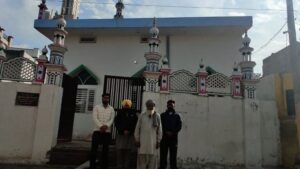

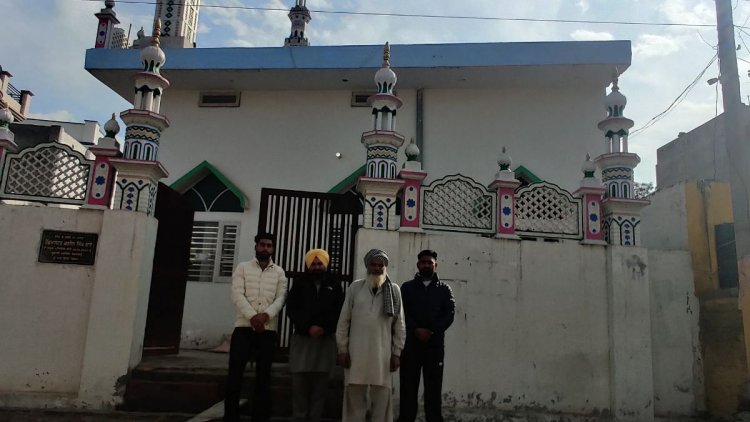
The Masjid Umar Bin Khattab in Bakhtgarh village, Punjab, took a year to build, costing over Rs 12 lakh. This gleaming new mosque with white minarets adorned with blue and pink stripes has become a spiritual haven not only for the village’s 15 Muslim families, but also for new Muslim migrant workers from Uttar Pradesh and Bihar.
Punjab’s population structure is slowly changing. And with it, so is Punjab’s situation. The trend began in 2022 when a Sikh resident donated eight marlas of land to the Muslims of Bakhtgarh, understanding their need for worship. Earlier, the Muslim residents of the village had to travel four kilometres to another village to offer prayers. The mosque was built through the collective efforts of the Muslims of the village, residents of other religious communities and Muslims from outside Punjab. Moti Khan, a local veterinarian, says that many Muslim migrants come here to work seasonally, but now it feels great to have our own place of worship. According to Khan, Muslim families from Uttar Pradesh and Uttarakhand contributed about Rs 6 lakh towards the construction of the mosque.
Now, efforts are underway across Punjab, from the farms to the industrial suburbs of Ludhiana, to revive or build new pre-Partition mosques. A representative of the state unit of Jamaat-e-Islami Hind said on condition of anonymity that 165 such mosques have been built or reconstructed in the last five years. This is both a sign and a response to the changing migration patterns in Punjab. These Muslim migrant workers have now slowly started to take root here.
Inter-state seasonal migration has been on the rise since the 1990s. But now a big change is that workers are bringing their families with them. Punjab’s changing social fabric has sparked a debate about whether this trend is a result of the growing labour shortage in the state or whether there are political reasons behind it. Sikh circles are saying that this is a government conspiracy to reduce the number of Sikhs.
Meanwhile, more mosques are being built in Punjab – and the local Sikh community is also supporting it. Maulvi Mohammad Nizamuddin of Bakhtgarh Masjid says that many farm labourers come to Punjab for four to five months and offer prayers in this mosque. I myself am from Purnia in Bihar.
There is no official data available on the socio-economic or religious background of migrants and businessmen in Punjab. But it is gradually becoming clear that Muslims, who were the largest population in the state before partition, are settling here again. This change is not limited to agricultural labourers in rural areas but is also visible in industrial hubs, textile manufacturing units and factories in cities like Ludhiana, Chandigarh and Jalandhar. They have bought out Hindu shops in the markets. They are also doing big business.
Mazhar Alam, Jalandhar district president of Jamiat Ulema-e-Hind and president of Masjid Quba in Khambra, said that many labourers, self-employed and small-medium businessmen are now settling with their families, whereas earlier they used to go back after work. Their number must have almost doubled in the last five years.
34-year-old Mohammad Ahid inspects an e-waste recycling plant with his staff at a migrant centre in Sahnewal in Ludhiana district. Ahid spent his childhood in Ludhiana, his father having settled here from Saharanpur. Ahid has been living in Ludhiana for the past 25 years and it is here that he set up his e-waste business.
Many in Ahid’s network have either come to Punjab in recent years or are planning to come. He knows at least five Muslim families from Varanasi who have moved to Ludhiana – all involved in the furniture business. But business is not the only reason. Some families are also coming because they were facing communal tensions there in UP.
Ahid’s father, Mohammad Irfan (65), came to Punjab in the early 2000s when he was a sugar mill contractor. Today, all three of his children have settled here. Ahid is also married to a woman from a migrant family from Ludhiana.
According to Irfan, “at least 10 other families” like him had come from western UP and have now settled in the Tajpur Road area. Dilshad, 29, who works in an e-waste plant, also came to Ludhiana from Nanauta town in Saharanpur about a decade ago. His wife and children are still in UP, but he plans to bring them to Ludhiana soon. He says Ludhiana is better for children’s education. There is nothing in Saharanpur.