
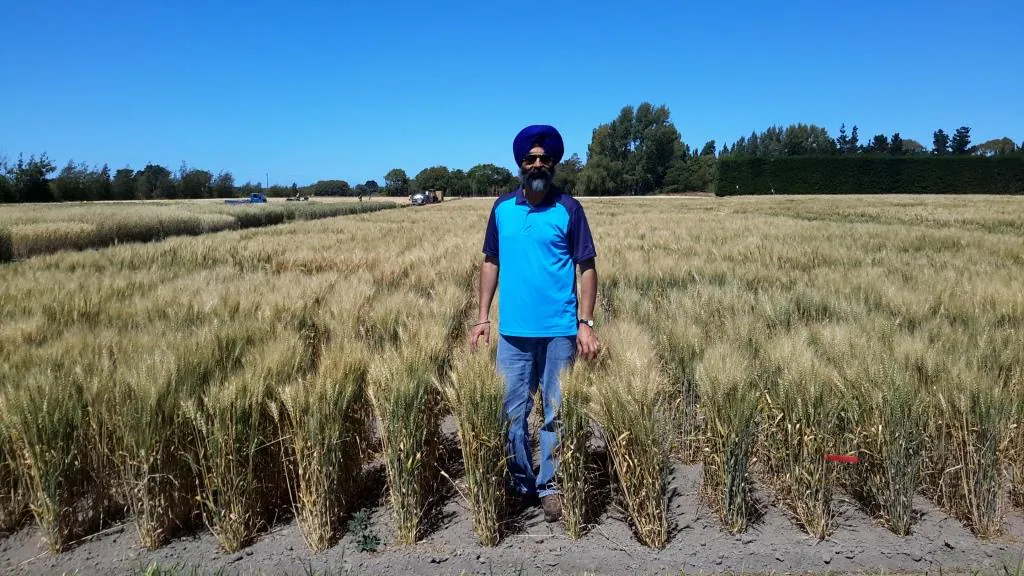
Harpinder Singh Randhawa, who studied at Punjab Agricultural University and University of Saskatchewan, has helped Canadian farmers solve various problems by developing about a dozen varieties of wheat. Randhawa is currently serving as a senior research scientist in the Canadian Department of Agriculture in Lethbridge, Alberta.
Harpinder Randhawa, who belongs to Gurdaspur district of Punjab, after completing his master’s degree in agriculture from Punjab Agricultural University, Ludhiana, worked in Punjab for some time and moved to Canada in 1997. Harpinder Randhawa said that after coming to Canada, he had to search a lot for a good job and he thought of doing a PhD.
Randhawa did his PhD from the University of Saskatchewan in Saskatchewan province. After working in the US for some time, Randhawa started working in the Canadian Department of Agriculture from 2007.
Developing a dozen varieties for farmers Pride
Harpinder Randhawa said that wheat production in Canada is more than the requirement and wheat is sent to other countries. Randhawa said that Canada sends wheat to about 100 countries, where it is eaten in various ways including bread, pasta, flour. Therefore, we continuously prepare different varieties of wheat according to the above countries. Explaining about his work, Randhawa said that he has solved many problems of farmers with his varieties. We prevented the fungus that affects wheat with the Westlock variety. Apart from this, we prepared varieties that do not have the problem of yellow rust.
In response to the question about working on wheat itself, Randhawa said that being from a farming family, I was interested in agriculture. Even during my studies, I worked on wheat varieties, due to which my interest in this crop continuously increased. Harpinder Singh Randhawa said that while preparing a new variety is a challenging task, naming it is not an easy task. I Randhawa said that we have to have a name that no one else in the world has given. Randhawa said that I name my developed varieties after different qualities of wheat, cities and regions of Canada.
Harpinder Randhawa named one of his varieties Indus, which is taken from the Indus Valley Civilization. Apart from this, names have also been given to the cities of Alberta, Crossfield and Westlock.
Harpinder Randhawa said that when farmers face any problem, financial assistance is given to scientists to solve it. He said that after many years of hard work, scientists prepare a new variety of seeds, after which private companies buy the seeds by bidding and produce more, which is ready for sale. By selling the seeds, the companies give some part to the government agriculture department and farmers’ organizations. Harpinder Randhawa said that any new variety takes a decade to be ready, but we are trying to reduce the time. We use many techniques. Randhawa said that for research, they choose Canada as well as other countries. He said that wheat is available only once a year in Canada and in such a situation, to reduce the time for developing a new variety, we test the same variety in other countries as well.
According to agricultural scientist Harpinder Singh Randhawa, wheat is sown in countries like New Zealand and Chile at a time when it is snowing in Canada and this saves time.