
Shri Guru Gobind Singh Sahib Ji sent Baba Banda Singh Bahadur from Nanded to Punjab and sent responsible Singhs with him as assistants and advisors. But during the rise of Baba Banda Singh Bahadur, the Mughal government succeeded in creating a division within the Khalsa. As a result, Baba Banda Singh Bahadur was arrested from the fort of Gurdas Nangal, expecting help from outside for eight months, and in 1716 AD, he was tortured and martyred in Delhi along with seven hundred companions. The Singh who, in the Guru’s will, punished the tyrants and the Guru’s traitors and expressed the resolve of a lenient rule and gave his martyrdom, was propagated as a national traitor by a group of Sikhs. The conspiracies of the Mughal government divided the Sikhs into two groups, Bandai Sikhs and Tat Khalsa. Tat Khalsa also did not get anything.
Now it was the turn of Bhai Mani Singh Sardar Darbara Singh. Bhai Mani Singh also had to be martyred. The matter moved forward as a group of Khalsa, whose total number of members was less than five thousand. But the target was clear, the Khalsa used to sit together, make a Gurmata or decision, and pray for its fulfillment at the feet of the Guru, that the Khalsa would establish the rule of justice and uproot the roots of the Mughal Empire. After the appointment of Nawab Kapur Singh, the common decision was taken under one leader, so no one was left behind when it came to making sacrifices. The decisions were made unanimously in the presence of the Guru, but there was only one leader. Eleven Misls also appointed Baba Jassa Singh Ahluwalia as Sultan-ul-Qaum and under his leadership occupied the thrones of Lahore, Sirhind and Delhi.
To avoid mutual discord, Baba Jassa Singh Ahluwalia, after winning the throne of Delhi in 1783 AD, returned it to Emperor Shah Alam after imposing taxes.
After Baba Jassa Singh Ahluwalia, the misls also started clashing with each other, no one could become a unified and universally accepted leader. The Khalsa, which ruled over Kanpur, Terai and Rajasthan, was limited to Punjab due to the lack of a single leader.
Now it was the turn of Ranjit Singh, the grandson of Sukerchakia Sardar Charat Singh, who, along with Sardarni Sada Kaur, tried to gather Khalsa power again, but the self-formed misl Phulkiya and some other Sikh sardars became allies of the British.
At that time, Maharaja Ranjit Singh Ji established a large kingdom from Khyber Pass to Ropar, whose borders were adjacent to China and Sindh, but a faction loyal to the British government also emerged in the community. The Maharaja was not only forbidden from moving towards Delhi, but he also had to vacate some of the conquered areas. If there was unity in the nation, it would have been a trivial matter to recapture the throne of Delhi as in 1783.
With the death of Maharaja Ranjit Singh in 1839, the spies and associates of the British started conspiring in the Lahore court. In the next six years, three kings Kharak Singh, Naunihal Singh, Sher Singh were killed and after the first Anglo-Khalsa war of 1845-1846, the British government took control of Lahore.
During the battle of Ferushahr, explaining the reason for the defeat of the Khalsa, Shah Muhammad writes:
Pahara Singh was a friend of Farangia
He was with Singha and he was disloyal
He went and informed Farangia
He told the whole secret
That’s where the Khalsa got killed
The four-handed killings were a massacre
Take care of the artillery, Muhammad
The Singhs left the field empty
Pahara Singh did not become the companion and leader of the Khalsa army.
Instead of coming together as a nation, the matter was limited to mutual discord, taking the title of Raja and some land from the opponents, and committing national treason.
The capture of the Lahore Darbar in 1849 was a ruse, the real capture had already taken place, when Maharani Jindan was imprisoned in her own kingdom.
After 1849 AD, the British government destroyed the religious and political power of the Khalsa through the Sikh chiefs. They took over the management of the Guru houses in religious terms. The government started appointing a Sarbarah or manager. Some kings and royal families became Christians. The rest adopted the English way of life. The propagation of the Nirmal Panth was stopped, some became military leaders and became separate Deredars and Taksalis. Campaigns were launched to return the families who had converted to Sikhism from other religions to their previous religion.
The work of dividing the Punjabi society in which Sikhs were born was also done by policy. The British government also assigned the task of creating division to writers and they succeeded in that. Cunningham, Macauliffe, Lapel are still considered accepted historians. After the Guru’s time, no effort was made to research Sikhism and history as an institution and to make it accessible to the common man. The history written by Sohan Lal Suri during the reign of Maharaja Ranjit Singh is also neither being taught for further research nor has it reached the common man.
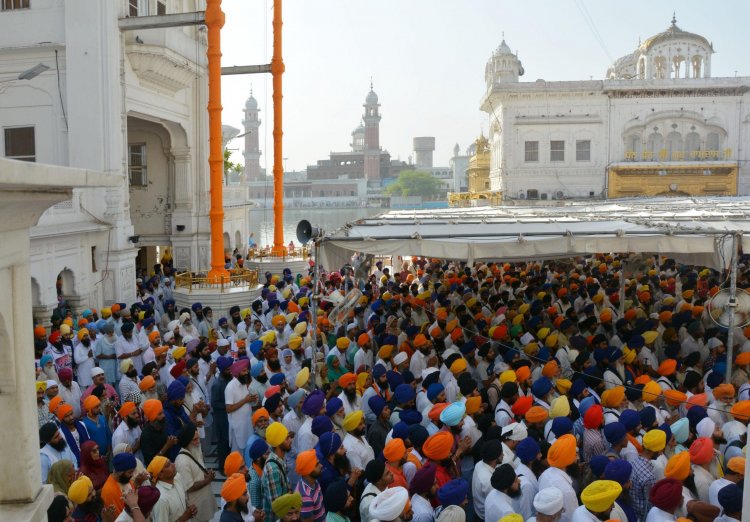
Near Sri Darbar Sahib, in front of Sri Akal Takht Sahib, Khalsa Sardars used to gather, pray for their success, and start work for the next steps. In the eighteenth century, major successes and national decisions were made in this way. No Hukamnama was issued by the priests or administrators of the Guru Ghars.
According to historians, Hukamnama started being issued by the priests after 1864 AD, but national unity, propagation of religion, education or restoration of political power were never the subject of these orders.
After 1849 AD, no strong Sikh leader or organization could stand against the British from within the Sikh community. The British suppressed the Kuka movement and Singh Sabha movement by creating divisions and harshly suppressing them. In order to become Sikh supporters, they formed the Chief Khalsa Diwan and brought in the pro-British Sikhs.
Fears started work for education, but these great leaders were far from the common man.
In 1920, the nation was awakened again by the Gurdwara Reform Movement, after making sacrifices, the management of the historical Gurdwaras was obtained through the Sikh Gurdwara Management Act of 1925. This was the time to work for the propagation of Sikhism. But Mahatma Gandhi’s message that the Sikhs had won the first war of independence led the leaders who had come forward to reform the Gurdwara management to active politics.
The discussions of the combination of Sikhism and politics started from here. Before this, Baba Banda Singh Bahadur, Nawab Kapur Singh, Sardar Jassa Singh Ahluwalia, Maharaja Ranjit Singh, even when they had state power, did not issue any Hukamnama against other brothers nor did they make state policy through Gurudwaras.
The leaders of the Gurdwara Management Committee, who were engaged in politics, got an opportunity to plan the spread and propagation of the religion in 1936, when Dr. Ambedkar’s tendency was towards adopting Sikhism, and it was decided to establish propaganda centers in South, West and Central India. The Chief Khalsa Diwan Wale also joined, but this time too with Ambedkar’s withdrawal, the Sikh leaders sat back at home.
After independence, the Akali political leaders, who had first studied abroad and elsewhere with the Gurdwara money, later found it beneficial to join the Congress party and oppose the Punjabi language and the state, and they became staunch Congressmen. Others started fronts from Gurudwaras to gain a seat in democracy. The presidents of the Shiromani Gurdwara Management Committee had already been active political leaders. Now religion and Sikh politics became firmly dominant.
During the British rule, instead of the Sarbat Khalsa or the Panj Pyares, the power to give orders and teachings to the nation came to the priests of the Takht Sahibs, which is still in effect today. The only difference is that the institution registered as a priest in the Act has started being called Jathedar. Being an employee, if the Hukam Nama is of the will of the ruler, then it is fine, otherwise there is a fear of losing the job. In such a situation, the propagation of religion has never been on the agenda, this new world scripture should have been Sri Guru Granth Sahib. Sikh philosophy and history should have been in front of the people in every language of India and abroad.
In the eighteenth century, the Singhs have been working to protect themselves, then to establish the state and for the last two hundred years to show each other down.
In one hundred and five years, the Shiromani Gurdwara Parbandhak Committee has built only one hundred educational institutions. The Chief Khalsa Diwan has opened less than fifty educational institutions in 123 years. Sikhs are not in need of resources, they are donors, there is a lack of intention and policy.
In this way, the fusion of state policy and Sikhism has eclipsed the propaganda, spread and politics of Sikhism after 1849 AD. The point is that the Gurus had taught politics, not done it. The Singhs including Baba Banda Singh Bahadur had established the state by following the path shown by the Guru Sahib but had not occupied the religious places.
It is necessary to have a hero or a hero for the leadership of any religion, institution and society. A hero is one whose achievements have been magnificent. Worship of Akal ki, Parcha Shabad ka te Didar Khalsa ka, worship of Akal, for gaining knowledge, the command is clear to look towards Shri Guru Granth Sahib Ji. But for the Didar Khalsa, individuals with outstanding qualities and achievements can be considered ideals. The ideal life of Baba Banda Singh Bahadur, Nawab ul Qaum Jassa Singh Ahluwalia, Sardar Charat Singh, Sardar Jassa Singh Ramgarhia, Maharaja Ranjit Singh, Sardar Hari Singh Nalwa etc. can be a guide, who expressed the philosophy of the Gurus and worked to establish and protect the rule of justice.
To move forward, following the orders and teachings of the Gurus, taking guidance from the lives of the ancient heroes, politics should be conducted, but religious leaders need to move in Gurmat, society, outside the forbidden rituals, only for the propagation of Gurmat, in society. But the shame of the Guru’s house should be spent on creating means of education and employment for the nation and for the propagation and research of religion.