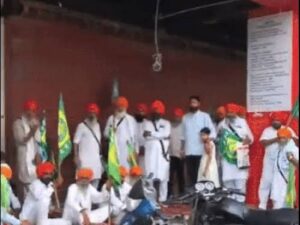

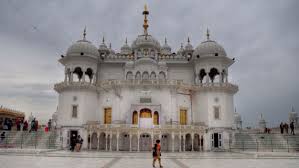
Today, 1 Chet 557 Nanakshahi, the Guru Khalsa Panth is celebrating the Hola Mohalla Jor Mela. The multifaceted objectives of celebrating the Hola Mohalla Jor Mela have been set by Dasmesh Pita Ji. On the occasion of Hola Mohalla, where the Gursangatta gathers to search for the Supreme Truth, to know the soul, to gain the color of the soul and to understand Gurmat, the purpose of this gathering is to see the common Panthic power and the glory of the Khalsa in battle and to fill the Panthic spirit, to achieve the Panthic goal of the Khalsa that the Khalsa will rule and live by its words and to pray for the advancement of all the Singhs, women and Bhujhangis who are waging religious war. Similarly, on Hola Mohalla, it has also been a tradition to hold policy discussions for the future guidance in the light of history in order to solve the common Panthic challenges and crises within the Guru Khalsa Panth. Today, when Panthic institutions and organizations are going through a period of disintegration and decline, mutual dialogue becomes even more necessary. So, with this spirit, we are sharing some thoughts with the Gursangati.
In the phenomenon of the continuous deepening crises of Panthic institutions and organizations for the past several decades, the action taken on Siri Akal Takht Sahib on 17 Maghar 556 Nanakshahi (2 December 2024 AD) is an important stage. Without a doubt, the five sins that have been admitted by the Badal faction are correct, but the decisions made on 2 December without any study about this entire decline, disintegration and revival and without the participation of various groups and organizations of the Gursangati, instead of creating a system in the Panth, disintegration and confusion have increased even more. After this, the arbitrary retirement of the Jathedars of various Takhts and the resignation of the President of the Shiromani Gurdwara Parbandhak Committee during the last three months are a clear example of this phenomenon of fragmentation.
On December 2, 2024, various active political leaders of the Badal Dal, office bearers of the Shiromani Gurdwara Parbandhak Committee and Jathedars of the Takhts jointly confessed to the Sangat five crimes, the following are the main scopes of these crimes:
a) Keeping company with and supporting the traitors of Sri Guru Granth Sahib and those who commit gross sacrilege of the Shabad Guru (such as the hypocrites of Sirsa).
b) Giving administrative and political positions to the traitors of the Guru Khalsa Panth and the cruel police officers who commit genocide of the Sikhs and supporting them.
c) To undermine the authority and reputation of Sri Akal Takht Sahib.
c) To undermine the religious reputation, autonomy and impartiality of the Shiromani Gurdwara Parbandhak Committee.
e) To change the character of the Sikh organization Akali Dal and make it a Punjabi party.
For a long time, many sectarian groups and personalities were continuously alerting the Guru Khalsa Panth about these crimes. Now, when the Badal faction’s own reputation has fallen a lot and internal divisions and discord have increased a lot in it and they have had to face continuous defeat in the elections, they have confessed to the above five crimes in the presence of Sri Akal Takht Sahib on December 2, 2024.
It is worth noting here that this matter is not about the religious reform of some leaders, but in fact this issue is about the revival of the reputation and glory of Siri Akal Takht Sahib, Shiromani Gurdwara Parbandhak Committee and Akali politics.
The decisions of December 2 also need a comprehensive study because this process does not meet the Panthic criteria and has many fundamental flaws in it.
There was an absence of a comprehensive study of the causes of the crimes: The Badal Dal had already been given political punishment in the form of a crushing defeat by the Gursangat during the last four elections. But the Jathedars have failed to conduct a comprehensive study of the political crimes. It was necessary to conduct a study of this point whether these crimes were personal mistakes or policy mistakes or did they arise from structural shortcomings? It is difficult to cure the disease without finding its root cause. Due to the absence of a comprehensive study, the accountability of the past could only be determined at a superficial level. Therefore, the path shown for the future is also not solid.
Deficiencies in the decision-making process: The method of making Gurmata in the Khalsa Panth is transparent, based on Sangat and Panch Pradhani system, for which the participation of religious and Panthic political groups, sects and administrative institutions operating in the Panthic area was mandatory for taking such a decision, but it seems that this was not done by the Jathedars under the influence of political parties. Therefore, the method of paying salaries to Badal Dalis was not in accordance with the Panthic tradition of Gurmata.
Inadequacies and mistakes in the salary system: The entire leadership of the Badal Dal, including Sukhbir Singh Badal, have admitted their ‘crimes’, which they have done for a long time, by betraying the Guru Granth and the Guru Panth. But the salary that has been imposed on them in return is for the disregard of personal integrity by a Sikh and not for the betrayal committed in the name of state pride.
Secondly, the Jathedars’ making criminals like Sukhbir Singh and Sukhdev Singh wear the blue banner and provide them with the honorable service of the spearmen of the court of Satguru Nanak Sache Patsah is in itself a violation of salary and Panthic traditions and is a sign of contempt for the blue banner bestowed by the Tenth Patshah Ji and a lack of understanding of Gurmat.
So, the inability to punish according to the spirit of the Gursanghat is a sign of the inability of the SHR.G.P.K. Under the Takht Sahiban’s service system and the limitations of this system’s practices are revealed.
The entire action centered around the two factions of the Badal Dal: This entire action has been presented as if the beginning of the process of guiding and organizing the Sarbat Khalsa Panth has been initiated. But in reality, this seems to be just the beginning of the exercise of uniting and re-establishing the two factions and making a Punjabi party more aligned with the BJP.
Ambiguity regarding the revival of the Shiromani Akali Dal: After 1947, two forms of the Akali Dal have been prevalent in the politics of the Indian electoral system. First, the politics of Panthic issues based on the independence and independent identity of the Guru Khalsa Panth and the second is the Punjabi party after the 1995 Moga Conference.
So now the new recruitment order is an exercise to revive which form of the Akali Dal? No clarity has been made in this regard.
Fundamental contradiction in the order: In his order number A 3/206, the Jathedar himself admits that due to his sins, this leader has lost the moral right to lead the political leadership of the Gursangati, but in the next point of this order, a committee of leaders of the Badal Dal has been formed for the revival of the Akali Dal instead of neutral Panth Dardis, which is fundamentally contradictory.
Personal impartiality of Jathedars and commitment to the Panth: The Jathedars appointed by the SGPC are not Jathedars appointed by taking the entire Panth into confidence, but they are beneficiaries of the fabric created by the Badal Dal.
The crimes confessed by the Badal Dals are centered around the militant movement, the movement against the hypocrites in Sirsa and the movement for the desecration of Guru Granth Sahib.
By keeping the groups, institutions and personalities who performed important services in these three movements, thanks to the grace of the Dasmesh Pita Ji, away from all this process, the Jathedars have proven their loyalty only to the Badal Dal instead of their commitment to the Sarbat Khalsa Panth.
One Jathedar has been a victim of criticism for maintaining direct contact with the ministers of the Delhi Throne and for keeping a commando of the Delhi Throne for his own protection.
Thus, both the impartiality and incompetence of the Jathedars appointed by the SRGPC are under question.
Although now the SRGPC has also changed these Jathedars, the above points are still valid and worth keeping in mind.
Arbitrariness is pushing the situation towards bloodshed: The situation is very sensitive at present. At this time, the use of Sikh institutions for a method without Panthic wisdom or for personal interests can have serious consequences and the situation will escalate towards bloodshed. Earlier, the Jathedars pushed the situation towards bloodshed by giving decisions without Panthic participation and now the Badal party is pushing the situation towards this direction again by changing the Jathedars arbitrarily and using the thrones arbitrarily.
What should have been done: Instead of focusing on a political party operating under the Indian electoral system, the action taken from the Akal Takht Sahib should have focused on the revival of the complete Panthic organizational system.
The main areas of the complete Panthic organizational system are the creation of a Panthic system for the maintenance of the Takht Sahib for the restoration of the supremacy of the Takht Sahibs of the Khalsa Panth, establishing autonomy in the management of the Gurdwara, formulating the struggle to create a country-state in accordance with the Khalsa Panth’s claim to sovereignty, and formulating the electoral politics going on under any worldly throne, including the Indian system.
In this entire exercise, the exercise of calling Gurmata according to the traditional Panthic system should have been started by including the active groups and institutions of the Guru Khalsa Panth and Gursangati in various regions around the world.
We are of the opinion that first a dialogue should be initiated to examine the reasons for the crimes admitted by the Badal parties from a common Sangat platform. Only after this examination can meaningful solutions be drawn. For the examination of the situation and further activities, it is necessary to keep in mind that we should see and understand this phenomenon in its entirety. It is necessary to be alert in this regard that keeping the guilty Badal faction away from Panthic institutions and organizations is the heartfelt sentiment of the Sangat, but in the exercise of removing the Badal faction, we should not throw Sikh institutions and organizations directly into the lap of BJP and other Hindutva forces. The current policy of the present Hindutva regime does not seem to be to establish a strong leadership among the Sikhs that will act as a pawn in their hands, rather the intention of the Indian state is to create more than one class among the Sikhs that aspire to enjoy power and to fuel factionalism. A large part of the leaders and the aspirants of the Guru Sangat are unconsciously following the state.
So, at this time, it is a great need that a thorough dialogue should be initiated between the Guru Khalsa Panth and all the active organizations and groups of the Gursangat for a comprehensive study of the causes of the current crisis. Since the permanent platform of the Panth for dialogue is in the process of reducing the credibility of the current system of the Akal Takht, the Khalsa Panth spread all over the world will have to form a temporary group based on important personalities of the Panth to take initiatives in this regard. The sincere sections should recognize their duty and take initiatives in this regard.