
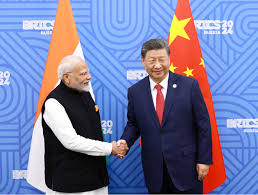
The outcome of the meeting between Prime Minister Narendra Modi and Chinese President Xi Jinping in Russia last week turned out to be very important. On October 23, Prime Minister Narendra Modi and Chinese President Xi Jinping, during their bilateral meeting on the sidelines of the BRICS summit in Kazan, Russia, endorsed an agreement on patrolling and redeployment of troops along the Line of Actual Control in eastern Ladakh. .
India then announced that it had reached an agreement with China to patrol along the Line of Actual Control (LAC) in eastern Ladakh, ending four-and-a-half-year long tensions between the two countries. It will be a great success in finishing and will also pave the way for further meetings.
Chinese forces reached LAC till Depsang. along with had forcibly occupied the areas of Eastern Ladakh four years ago, regarding which a decision has now been taken. Sources said patrolling will begin at both the tens ion points after the agitation ends and both sides will withdraw their respective forces and demolish temporary structures. Thus the pre-April 2020 situation will be restored.
Relations between the two Asian giants rose to their highest level in decades after a deadly clash in the Galwan Valley in June 2020.
On the meeting between the two leaders, Foreign Secretary Vikram Misri, in a press address in Kazan, said that both Modi and Xi emphasized that while showing mutual respect for each other’s sensitivities, interests, concerns and aspirations. India and China can firmly and wisely build a ‘peaceful, stable and beneficial bilateral relationship’.
China also said Wednesday’s meeting between Prime Minister Narendra Modi and Chinese President Xi Jinping in Kazan, Russia, was “very important” as they reached “significant mutual understanding” to improve bilateral relations. Chinese spokesperson Lin Jian has also said that China is ready to work with India to view and deal with bilateral relations from a strategic perspective and a long-term perspective. China is also willing to enhance communication and cooperation, enhance mutual strategic trust, properly handle differences and bring bilateral relations on the path of stable development as soon as possible.
The Special Representative Mechanism held 22 meetings in 2003 to resolve the border issue. India’s National Security Adviser Ajit Doval and China’s Foreign Minister Wang Yi have played a key role in the past to develop and improve ties, but the process has not progressed since the last meeting between Doval and Wang in 2019. Relations between the two countries soured in May 2020 after the incursion of the Chinese army into eastern Ladakh, in which the People’s Liberation Army (PLA) deployed a large number of practicing troops to the LAC. sent on, after which a fierce clash took place in Galwan. It was the most serious military conflict between the two sides in the valley in the past decades.
Lt. Gen. Vinod Bhatia, P.V. S. M., A. Also S. M., S. M. says, that ‘China did not expect that India would show such a strategic resolve to protect its territorial integrity.’
The border separating India and China on the Line of Actual Control has not yet been clearly defined and L. A. C. There is no general agreement about their and our perception of it. Both sides will patrol the places where their conflict arose. They stopped the Indian army at the Rakhi canal, through which the Indian army used to reach the 972 square kilometer plains of Depsang. With the clearing of Rakhi canal by China, now we will be able to reach patrol points 10, 11, 12, 13, 14, 15. Protocols for patrols, observations and measures should be mutually agreed upon on the ground, but we must be careful. We must maintain our vigilance and intelligence surveillance. We must have a means of monitoring their movements. “Armies should be open in their decision-making so that new problems arising in time can be solved by taking timely decisions.
Lt Gen Vinod Bhatia said ‘It is a slow and careful process, which needs to be monitored and re-monitored. For a long step we need to make a pattern, need to be vigilant!’, the general added, adding, we should not rely on China. We know what happened in 1962, what happened in April and May 2020. Therefore, we must continue to invest in infrastructure development, capacity building and capacity building, so that we can speak from a position of comparative strength with China. China respects strength and we have to show strength to China. China is known to read and interpret agreements in its own way. He doesn’t care about rules. We should not be complacent about the terms of any agreement, as China has brutally violated five agreements, which stood the test of time for three and a half decades.
China’s strategy is to constantly make new claims, occupy and justify them, exploit and annex the territory. They have already claimed the Demchowk and Depsang area since September 1959 and will not give up their claim so easily to maintain peace as before May 2020. Even after the implementation of the agreement, we have to keep the forces on alert. We have to keep a reserve position for emergencies, because there is a lack of trust. BhRati Army LAC Continue to strengthen, over time we have reserves and contingency plans.