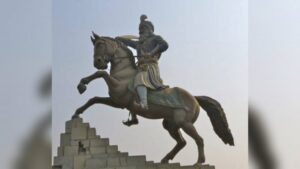

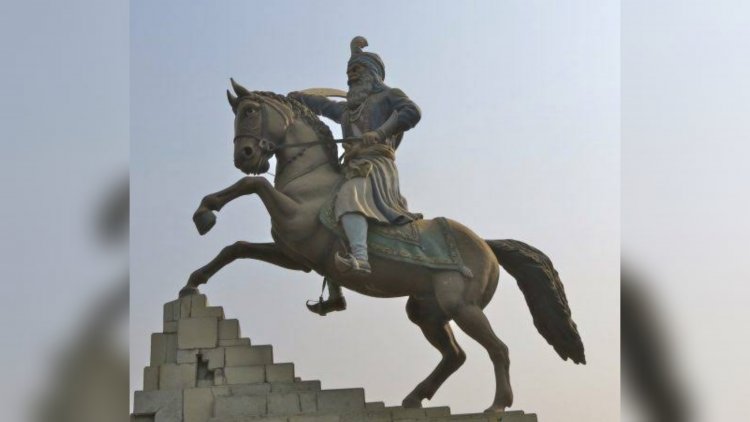
When we look into the background of S. Jassa Singh Ramgarhia, we find that this entire family was dedicated to the Guru Ghar. His grandfather Bhai Hardas Singh took Amrit from Sri Guru Gobind Singh Ji. He first fought as a warrior soldier in the Guru Ji’s army and then joined Banda Singh Bahadur’s army and finally attained martyrdom in the battle of Bajwara of Banda Singh Bahadur.
Hardas Singh had a deep influence on his son Giani Bhagwan Singh. He was a recognized religious preacher of his time. After the death of Abdus Samad in 1727 AD, his son Zakaria Khan became the governor of Lahore, who was much more cruel than his father. At that time, it was very difficult for people like Giani Bhagwan Singh to live. It was during these times that his father Bhai Harnam Singh left his native village of Sur Singh and came to the village of Echo Gill, twelve miles east of Lahore. Bhai Hardas Singh continued to make weapons for the army of Guru Gobind Singh and also performed other services.
Five sons were born to Giani Bhagwan Singh, Jassa Singh, Jai Singh, Khushal Singh, Mali Singh and Tara Singh. Of these, Jassa Singh was the eldest and was born on 5 May 1723 AD. He learned Gurmukhi from his father at home, due to which he soon learned to recite Nitnem and became able to recite Guru Granth Sahib. He took the Pahul from S. Gurdial Singh Panjwar. Jassa Singh was married to Shri Mati Gurdial Kaur, from whom he had two sons, Jodh Singh and Veer Singh.
The clash between the armies of Nadir Shah and Zakaria Khan took place in 1738 AD near Wazirabad (District Gujranwala, Pakistan). In this battle, Bhagwan Singh and Jassa Singh showed great bravery, which had a great impact on Zakaria Khan. In the end, Giani Bhagwan Singh attained martyrdom. Zakaria Khan gave the estate of five villages of Amritsar district – Walla, Verka, Sultanwind, Tung and Chabba to Bhai Bhagwan’s family and gave Jassa Singh the post of Rasaldar. Out of the estate, the village of Walla came to Jassa Singh. While living in this village, he fought with the Faujdar Adina Beg of Jalandhar Doaba over the division of boundaries at the place of Naurangabad, which is famous for the Battle of Walla.
1747 AD. On the occasion of Baisakhi, a huge gathering was held in Amritsar, in which it was unanimously decided to build our own fort. The Gurmata to build a fort ‘Ram Rauni’ in the name of Sri Guru Ramdas Ji in Amritsar was passed. It was built quickly and Jassa Singh was appointed its fortmaster. Later it was named Ramgarh and he was awarded the title of ‘Ramgarhiya’ and the misl established by him became famous as ‘Ramgarhiya Misl’.
The fort of Ramgarh which had become a symbol of the glory and power of the Sikhs in the eighteenth century. The Mughals and Pathans razed this fort to the ground many times, but each time Jassa Singh rebuilt it with complete dedication and love and he got the honor of maintaining its name and existence. Timur also demolished the fort in 1757 AD not only but also carried away the Golden Temple and filled the tank with soil. Jassa Singh rebuilt the fort and built a settlement ‘Katra Ramgarhiya’ near the fort.
After the great battle, the Sikhs prepared for a big battle. On 17 October 1762, Abdali was still in Lahore when about 60 thousand Sikhs gathered in Amritsar and vowed to fight with Abdali. When Abdali received the news, he attacked. A fierce battle took place from morning to evening in which Abdali was defeated and he escaped in the darkness of night. He returned to Kabul in December 1762 AD due to the unrest in Afghanistan.
Jassa Singh Ramgarhia occupied many areas after 1767. First of all, he occupied Batala, Kalanaur, Dinanagar, Sri Hargobindpur, Shahpur Kandi, Qadian and Ghuman. This area was the most fertile among the districts of Gurdaspur and Amritsar and was called Riyarki. He used to get an annual income of six to ten lakh rupees from these areas. After this, he started expanding his foothold towards the areas adjacent to the present Hoshiarpur district. Soon, he brought under his control the areas of Maniwal, Udmar Tanda, Sarhi, Mangewal, Miani, Dipalpur, Rohil and Sharif Jang. With the arrival of these areas, his income increased to more than ten lakh rupees annually.
Kangra and other hill kings accepted the allegiance of Jassa Singh Ramgarh and agreed to pay annual taxes. He brought under his control the small princely states of Jaswan, Dipalpur, Anarpur, Haripur, Datarpur and Jethowal. He used to bring in two lakh rupees annually. With these victories, the boundaries of his kingdom expanded far and wide. The entire area between the Beas and the Ravi and the plains of the Jalandhar Doaba were included in his rule. After careful consideration, he made Sri Hargobindpur his capital, which was right in the middle of the conquered areas. Earlier, Ramgarh was the capital.
The conquest of the hill states of Riarki and Doab brought Jassa Singh’s glory to its peak. But later such circumstances arose that civil wars broke out among the misls. There was discord among them over Pathankot. The Bhangis attacked Pathankot. A fierce battle took place near the Tawi river. The Bhangis, the Ramgarhis. Ranjit Deo and Pir Muhammad Chattha were on one side, the Kanhais on the other, the Ahluwalis and the Sukerchakkis on the other. Finally, the Bhangis were defeated. The worst result of this was that the Ahluwalis and the Sukerchakkis became the sworn enemies of Jassa Singh. Seeing his glory diminishing, Jassa Singh took up the opinion of Kapurthala that he
He refused to pay the tax to Ahluwalia, but this move of Jassa Singh did not succeed because Ahluwalia attacked Kapurthala with his 30 thousand army and brought it under his control.
Jassa Singh Ahluwalia was looking for such an opportunity to take revenge on Ramgarhia. In 1775 AD, a small encounter took place in the village of Zahure on the banks of the Beas in which Jassa Singh Ramgarhia was injured by Ahluwalia’s bullet and this area passed out of Ramgarhia’s hands.
Once Jassa Singh Ahluwalia came near the village of Nangal while hunting. Jassa Singh Ramgarhia’s brother Mali Singh attacked Ahluwalia, injured him, imprisoned him and took him to Sri Hargobindpur. This incident turned all the chiefs against Ramgarhia. In this struggle, a battle broke out between Ramgarhia and Shukerchakia and Jassa Singh defeated Charat Singh and captured his guns and many other war materials.
In 1776 AD, Ahluwalia sought help from the other Sardars to eliminate the Ramgarhia Sardar. Apart from Charat Singh Shukerchakia and Jai Singh Kanhaiya, Bhangi Sardars also came to Ahluwalia’s aid. The combined forces of these four Misls attacked Sri Hargobindpur. Ramgarhia did not submit and he evacuated the city. After this, they captured Batala. After this, they attacked Kalanaur. In this battle, Jassa Singh’s younger brother Tara Singh was killed and its possession was given to Haqiqat Singh Kanhaiya. After this, the combined forces not only expelled him from his territory but also forced him to cross the Sutlej.
The Mughal Emperor Shah Alam attacked the state of Patiala to subdue it. When the royal forces reached near Karnal, many chieftains like Sahib Singh Kandi, Diwan Singh, Baghel Singh and Desa Singh Kaithalia etc. who were close to Raja Amar Singh also came to help the Mughal army. Jassa Singh Ramgarhia and his sons Jodh Singh and Jassa Singh Ahluwalia also came to his aid. Raja Amar Singh’s army won a huge victory and the Sikhs, pursuing the royal forces fleeing towards Panipat, got rich with the loot.
Jassa Singh Ramgarhia, with the help of Baghel Singh and Gurdit Singh, took thirty thousand soldiers and looted the areas of Muzaffarpur and Miranpur and then went to the city of Meerut killing and killing. He besieged Zabita Khan of this area and collected ten thousand rupees as a tax. He also promised to pay tax every year. From here, the armies of Jassa Singh and Baghel Singh attacked the famous trading center of Uttar Pradesh, Chauhansi, from where they got several lakhs of rupees.
After some time, the Sikh chieftains decided to attack Delhi. In March 1783, the Sikhs entered the city of Delhi. The Mughal emperor, Shah Alam II, was not ready to face them. Therefore, the Sikhs remained the masters of Delhi for several days. Jassa Singh Ramgarhia kept attacking separately from the other chieftains. First, he destroyed the Mughalpuri and then entered the Red Fort. From there, apart from the money, he also got four guns of the Mughal artillery and a beautiful pillar of colored stone with the coronation of the Mughals. This pillar, 6 feet long, 4 feet wide and 9 inches thick, is currently lying in the Ramgarhia Bunga.
Jassa Singh Ahluwalia passed away in 1783 AD. Jassa Singh Ramgarhia returned to Punjab and regained his territories. Maharaja Ranjit Singh recaptured Lahore in 1799 AD. Maharaja Ranjit Singh attacked the famous fort of Ramgarhia, Miani, and captured it. Bhag Singh Ahluwalia helped Maharaja Ranjit Singh in this battle. Jassa Singh Ramgarhia attacked the territory of Ahluwalia Sardar to take revenge for this. The Raja of Kangra, Sansar Chand Katoch, also felt threatened by the growing power of Maharaja Ranjit Singh, he also supported Jassa Singh Ramgarhia. Bhag Singh Ahluwalia sent his general Hamir Singh, but Hamir Singh was defeated in this battle and was injured. Ahluwalia Sardar died after a few days of illness after reaching Phagwara. He died in 1803 AD at the age of 80. Maharaja Jassa Singh Ramgarhia passed away in 1816. His son Jodh Singh befriended Maharaja Ranjit Singh and during his lifetime, Maharaja Ranjit Singh never thought of fighting until 1816 AD.