


The Middle East is once again engulfed in war. The ongoing conflict between Israel and Iran has pushed both countries to the brink of destruction and is pushing the world towards a major crisis. Iranian missiles have flattened buildings in Tel Aviv and Haifa, while hundreds have died in Tehran.
The Israeli air force has attacked Iran’s military and nuclear facilities, but Iran’s Fordo nuclear center, hidden in mountain caves, has remained untouched. This war, which began on a local scale, could now take the form of a global war.
Israel, the only undeclared nuclear power in the Middle East, has taken a major risk by attacking Iran recently. Its main objective was to stop Iran’s nuclear program, which is considered a threat to Israel’s security. In particular, the Fordow Nuclear Center in the city of Qom, which is built in a 90-meter-deep mountain cave, was Israel’s main target. Israel targeted Iran’s Defense Ministry, missile launch sites, air defense systems, and weapons manufacturing factories. The attacks confirmed the deaths of nine senior nuclear scientists and engineers, including Fereydoun Abbasi (former head of the Atomic Energy Organization of Iran), Mohammad Mehdi Tehranchi, and Abdul Hamid Minouchehr Hassan. In addition, 20 senior military officers were killed, including Mohammad Bagheri (Chief of Staff of the Iranian Armed Forces) and Hossein Salami (Commander-in-Chief of the IRGC).
According to Iran’s Health Ministry, 224 people were killed, 90% of whom were civilians, and 1,481 were injured. These included 70 women and children, while 10 children were missing under the rubble. The Israeli operation was aimed at weakening Iran’s military and scientific capabilities. However, the Fordow center, which is protected by S-300 air defense systems, electronic jamming, and a multi-layer shield, was spared damage. Israel’s GBU-28 and GBU-31 bunker buster bombs, which can penetrate 6-10 meters of concrete, failed against Fordow’s strong walls. Only the US GBU-57 Massive Ordnance Penetrator, which can break 61 meters of concrete, can damage it. But the US has refused to engage in direct war.
Iranian retaliation:
Iran responded to the Israeli attacks with “Operation True Promise III”. It fired hundreds of ballistic and hypersonic missiles at Tel Aviv, Haifa, and Petah Tikva. Tel Aviv, Israel’s economic capital, was engulfed in fireballs. Fires broke out near the Defense Ministry headquarters, missiles fell on Navatim Airport, and Haifa’s Bazhan oil refinery was completely destroyed. Haifa, Israel’s maritime and commercial center, was reduced to rubble. Millions of people are preparing to evacuate the city. According to the Israeli government, Iran fired 300-400 missiles, some of which penetrated the Iron Dome, David’s Sling, and the Arrow system. 82 people were killed and 1,277 injured in Israel. Iran claims to have shot down two F-35 fighter jets and captured an Israeli pilot. Iran’s hypersonic “Khyber” missiles, which can neutralize Iron Dome, still pose a major threat to Israel. Iran’s missile power The main weapon of Iran’s military capability is its ballistic and hypersonic missiles. According to American and Israeli estimates, Iran has 1,500 to 3,000 missiles, including short-range (Fateh-110), medium-range (Shahab-3, Imad, Ghadr-1), and hypersonic (Fateh-1) missiles. These missiles have a range of 1,000 to 2,000 kilometers and can hit targets with high accuracy. In the past 25-30 years, Iran has advanced its missile technology so much that even Israel’s Iron Dome has failed several times. Iran claims that it can fire 1,000 missiles at once, which could put Israel in a Gaza-like situation.
What is the international perspective on this war?
Israel is supported by the US, Britain, France, and the Gulf countries (Saudi Arabia, UAE). The US has deployed warships, including the USS Nimitz, in the Persian Gulf, but is avoiding direct involvement in the war. Iran is supported by Russia and China, which can provide it with weapons and technical assistance. China has considered an attack on Israel’s nuclear center as a “red line”. India has adopted a neutral stance, but the escalation of the war will affect its oil imports and economy.
Will this become a world war?
This war is still local, but its sparks could take the form of a world war. The Strait of Hormuz, thro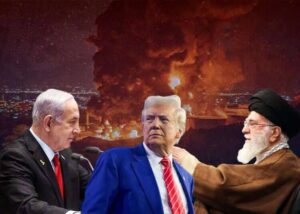 ugh which 20% of the world’s oil passes, is under Iranian control. If Iran shuts it down, oil prices could reach $120 a barrel, potentially destabilizing the global economy. The Russia-Ukraine war has already divided the world into two camps. If the US, China, or Russia were to directly join the war, it could engulf the entire world in flames.
This war between Israel and Iran is not just a local conflict, but a crisis that could affect the political, economic, and military balance of the world. US President Donald Trump’s “America First” policy and Iran’s ceasefire demands have made peace prospects difficult. The situation in the Middle East is so bad that US President Donald Trump had to cancel the G-7 summit in Canada and return home. On his way back from Canada, Trump urged Israel to back off and warned Tehran’s 10 million people to be careful.had advised. America has proposed a nuclear deal to Iran. This tension between Israel and Iran has arisen at a time when America and Iran were discussing a nuclear deal. However, Israel targeted Iran’s nuclear sites in its attack. Along with this, many Iranian nuclear scientists and top commanders were killed. Now Iran has started firing missiles at strategic locations in Israel. Along with this, Iran has also refused to talk about a ceasefire with Israel. Only time will tell what will be the end of this crisis, but one thing is clear – this fire in the Middle East can engulf the whole world.