
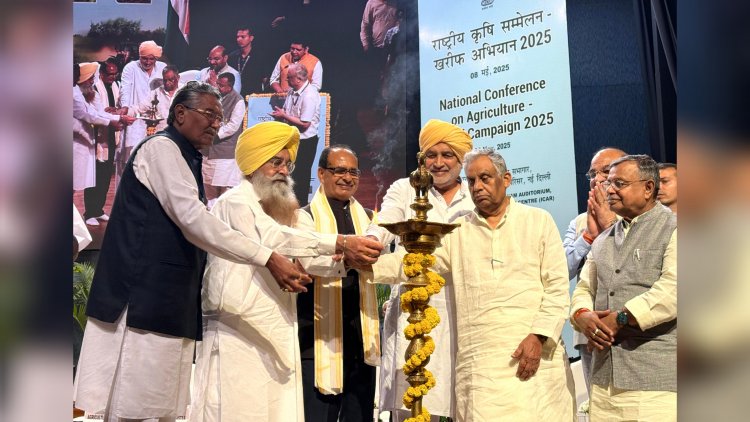
Punjab Agriculture and Farmers Welfare Minister S. Gurmeet Singh Khudian has appealed to the Central Government to provide a cash incentive of Rs 17,500 per hectare to farmers for cultivating alternative crops like maize, cotton etc. as an alternative to paddy during the Kharif season to promote crop diversification. S. Khudian said that the Central Government had issued revised instructions regarding paddy substitution in the state through the Crop Diversification Program (CDP) through a letter issued on June 10, 2024. He said that under this, it was asked to provide a cash incentive of Rs 17,500 per hectare to farmers cultivating any alternative crop instead of paddy during the Kharif season. He said that according to this letter, each farmer can get benefits under this scheme up to 5 hectares. In continuation of this, in two other letters issued in November and December last year, there was no mention of giving cash incentive, which created a situation of uncertainty for the farmers. S. Khudiyan had reached here today to attend the National Agriculture Conference-2025 on Kharif crops organized by the Union Ministry of Agriculture at the Pusa Complex. The conference was inaugurated by Union Agriculture Minister Shri Shivraj Chouhan. The Punjab Agriculture Minister said that the Punjab Government has already requested the Government of India to support and cooperate by providing compensation to the farmers on per acre basis against the additional expenditure incurred on paddy stubble management so that the menace of stubble burning and air pollution in Delhi, Haryana and Punjab can be dealt with. He reiterated that the Punjab Government is committed to make its due contribution in this regard. The Punjab Agriculture Minister demanded that the Central Government should implement the said cash incentive schemes without delay to motivate the farmers towards crop diversification so that the efforts being made by the Punjab Government in this area can be further strengthened.
He said that earlier the area under cotton crop in Punjab was around 8 lakh hectares which has now reduced to around one lakh hectares. He said that with this financial assistance, while the farmers will give a positive response towards sowing alternative crops, this scheme can also prove effective for the state government to save ground water. On the issue of fixed supply of fertilizers, he said that Punjab contributes 21 percent paddy and 46 percent wheat to the central pool which has been possible only due to the continuous supply of required quantity of fertilizers. He said that during the Rabi season, there is usually a shortage of phosphatic fertilizers. Therefore, it is important that the supply of these fertilizers should be maintained continuously from the Kharif season itself. S. Khudiyan has appealed to the Central Government to continue the subsidy on wheat seeds. He said that according to the estimates of the Indian Council of Agricultural Research, the country will require 345 million metric tons of food grains in the coming period, which is currently 298.82 million metric tons. According to these estimates, there is a need to increase the area or production of food grains to meet the required quantity. He said that according to the Council, 33 percent of wheat seeds need to be replaced every year, for which about Rs. 20 crores are required. But the Government of India has stopped the subsidy on wheat seeds under the NFSM and RKVY schemes. Which should be continued in the larger interest of feeding the growing population of the country.