

Milk availability in India is 471 grams per person per day, while milk availability in the world is 329 grams per person per day. The total milk production in the country during the financial year 2023-24 was 239.30 million metric tons, which was 65.56% more than the previous decade. According to the data released by the Central Government in November 2024, India’s milk production has increased by 3.78% during the financial year 2023-24. The state of Uttar Pradesh is the leader in milk production in India, where milk production was 38.78 million metric tons during the financial year 2023-24. Rajasthan is the second largest milk producer in the country, followed by Madhya Pradesh, Gujarat, Andhra Pradesh, Maharashtra and Punjab.
The state of Punjab produced 132.72 lakh tonnes of milk during the financial year 2019-20, which increased to 139.11 lakh tonnes during the financial year 2023-24. During the financial year 2023-24, the Punjab Government’s Milk Fed procured 20.01 lakh litres of milk per day, which was 9.4 percent more than the financial year 2022-23. Similarly, during the financial year 2023-24, the Milk Fed sold 12.66 lakh litres of packaged milk per day, while the daily sales of packaged milk during 2022-23 were 12.01 litres.
In the past, a study was conducted by the Department of Animal Husbandry and Dairying, Government of India under the National Plan Phase-1 on the demand for milk and milk products in India, according to which the demand for milk and milk products in the country for the year 2030 is estimated to be 266.5 million metric tons.
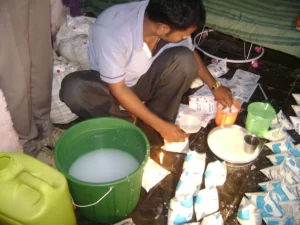
40-50 years ago, milking was common in every rural household in Punjab. Farmers used to keep milk-giving animals for their domestic needs and as a subsidiary business. Buffaloes, indigenous cows and foreign cows are generally kept among the dairy animals, although goat milk is also considered very beneficial and the general public believes that it proves to be very effective in increasing platelet cells. In the year 1992, there were 60.08 lakh buffaloes in Punjab and by the year 1997, their number had increased slightly to 61.71 lakh, after which there has been a continuous decline. In the year 2007, the number of buffaloes in Punjab was 50.01 lakh. At the time of the 20th Livestock Census in 2019, the number of buffaloes in Punjab was 40.15 lakh. But according to the preliminary data of the livestock census conducted in Punjab during the 21st Livestock Census, which began in the country from October 25, 2024, the number of buffaloes in Punjab has now further decreased to around 34.93 lakh. According to the data, from 1997 to the beginning of 2025, the number of buffaloes in Punjab has decreased by 26.78 lakh. According to the preliminary data of the Punjab Animal Husbandry Department, there has been a decrease of 5.78 lakh in the total livestock. Due to the decrease in the number of milch cattle, it is natural that milk production will decline. Milk production decreases further during the summer season. Its consumption is many times more than the production of milk. Punjab is one of the leading states in milk consumption. To fill the gap between milk production and consumption, artificial milk is made, and milk is adulterated by adding various types of adulterations. Various types of chemicals are sprayed on the green fodder used for animal feed. Large quantities of fertilizers are added. The elements of these chemicals and fertilizers reach the animals through the fodder and then those elements are added to the human diet through the milk of the animals. A hormonal injection called oxytocin is used for milking of dairy animals, the effect of which is easily added to the milk of dairy animals.
The problem of milk adulteration has become serious in India for the last several decades. On the one hand, our country is the largest milk producing country in the world and contributes a quarter of the world’s milk production, but on the other hand, the business of adulteration in milk is also flourishing in the country. If we talk about our state Punjab, then 18 percent of the samples of milk and milk products filled during the years 2021-24 did not meet the prescribed standards. The situation in our neighboring state Haryana is even worse. During the same period, 28% of the samples there did not meet the prescribed standards.
In ancient times, only water was adulterated in milk. These lyrics of a popular song of that time. “People’s milk is not sold, your milk is sold, O Lord, let it be sold” bear witness to this. Time passed, the era of materialism prevailed, greed increased among people and then like other professions, people selling milk also started using various methods to increase their profits. Now, to adulterate milk, dishonest and profit-seeking people also use detergents, urea, refined oil, soy powder, starch, glucose sodium carbonate, sodium bicarbonate, a substance called malto dextrin, formalin and hydrogen peroxide in milk. According to the report of the Indian Council of Medical and Research, synthetic milk and products made from it are harmful to health. Due to adulterated milk and milk products, healthy people are beset by many terrible diseases, including liver damage, intestinal and stomach diseases, heart diseases, paralysis, cancer, and brain strokes. The World Health Organization had warned India many years ago that if adulteration of milk and milk products is not stopped, then by 2025 87% of Indians will fall victim to cancer.
Synthetic milk, khoya, butter, cheese are commonly sold in the market. Synth