
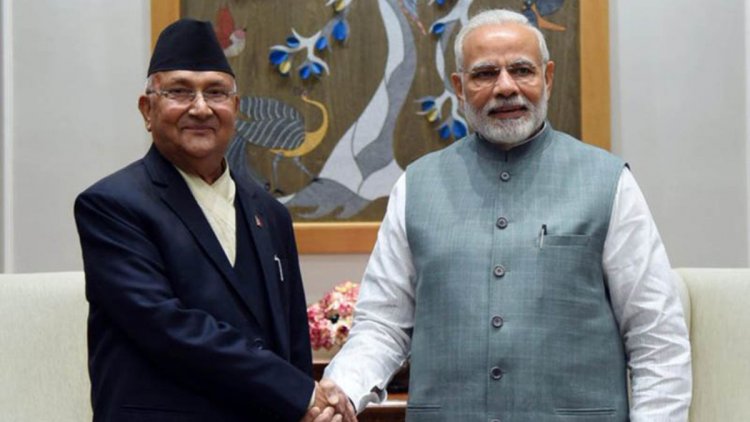
The current situation is that the ruling party is seeing a kind of contagion in the events in Nepal, meaning that the ‘contagion’ of the events that took place in Nepal may also affect or affect the political developments in India. If this happens, then the upheaval that the youth and students have created in Nepal can be repeated in India as well. Such a feeling, such a doubt/fear is also starting to be seen among the BJP leaders.
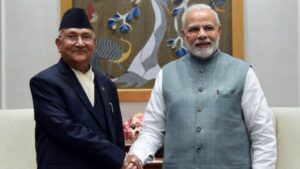
The first evidence of this was found when Modi ji’s most beloved MP Nishikant Dubey sent his suggestion to the government. Recently, Rajiv Pratap Rudy, the BJP’s own Rajiv Pratap Rudy, who defeated Nishikant Dubey in the Constitutional Club Delhi elections, has said in an interview that his (Dubey’s) status has now increased so much that the high command has even given him the opportunity to control the Parliament. But it will be the Modi government’s misfortune if it even thinks of implementing Nishikant’s suggestion. If Nishikant’s suggestion is implemented, the government’s move will be similar to the step taken by Nepal’s Prime Minister Oli before the 8th, that is, to impose restrictions on social media to control it. This is why Oli has been removed from power. I believe that if the government accepts Nishikant’s suggestion, then Nepal-like situations may arise in India as well.
It is noteworthy that this suggestion of Nishikant Dubey has not been given personally, but officially. For which the government may have to respond to it in some form of yes or no. It is worth mentioning that Nishikant Dubey is the Chairman of the Parliamentary Committee (Standing Committee on Communication and Information Technology) and the report submitted by him recently recommends strict laws, mandatory fact-checking, fines and sanctions to prevent fake news, misuse of AI and misinformation. Dubey, linking this to the context of regional instability i.e. Nepal, Bangladesh, Sri Lanka etc., has said that such measures are necessary to save India from the chaotic situation prevailing in these countries. The report, presented on September 10, has described fake news on social media platforms as a ‘threat to public order and democracy’ and has recommended changes in penal arrangements, accountability of editors/publishers, appointment of internal ombudsmen and AI tools as well as strict human monitoring on social media platforms. Dubey’s suggestion is politically motivated and he accuses Rahul Gandhi and opposition leaders of using ‘toolkits’ to create a Nepal-like situation in India. Nishikant’s suggestions are in line with the Modi government’s broader policy that links social media regulation with national security and stability.
Needless to say, the government’s thinking is heavily influenced by the activities of the opposition. All opposition parties in India, including the Congress, are highlighting the similarities between the events in Nepal and the situation in India. Like Nepal, the youth in India are also victims of rising unemployment, widespread corruption and economic inequality. The opposition has been constantly warning the Modi government on such issues that if the systemic problems are not addressed, similar uprisings may take place in India too. According to some reports, these protests are being seen as a ‘wake-up call’ in the ruling circles of India. Now everyone knows that when social media was banned in Nepal, it became a cause for rebellion. The youth raised the slogan ‘Connection, not corruption, end’. If this happens in India, slogans like ‘End misgovernance, not social media’ or ‘End vote theft, not social media’ or ‘End corruption, not social media’ may be raised.
It can be easily concluded that the government had already prepared for such recommendations. Otherwise, how is it possible that on September 8-9-10, there was a youth uprising in Nepal and the parliamentary committee quickly held a meeting and submitted its report to the government. The Modi government never does anything in such a hurry. In fact, the Modi government pays less attention to employment, law and order, education and development and spends more time protecting its dominance. The measures that the government wants to impose include the threat that if anyone writes against the government, it will be termed as an anti-national act and sentenced to life imprisonment. If anyone writes in support of the government’s policies, such YouTubers will get advertisements worth up to 8 lakhs. The government will encourage pro-government writing on X, Facebook, Instagram etc., which is actually a bribe. The opposition and NGOs call this ‘controlling journalism’ because it will allow the government to control digital news portals and OTTs. It also gives the right to monitor platforms. For example, WhatsApp has challenged the traceability rule in court, as it affects the privacy of users. Can a country ever progress where more energy is spent on controlling the public than on welfare schemes?
The Modi government’s Pegasus spying scam was exposed in 2021. India had purchased this spyware called Pegasus from Israel in 2017, which was part of a Rs 15,000 crore defense deal. In fact, the Pegasus controversy is a global spying scam related to the misuse of spyware developed by the Israeli company NSO Group. This software infiltrates the smartphone and records the user’s calls, messages without his knowledge.
, location, camera and microphone access. The controversy emerged in 2021 when The Wire Amnesty International and other international media organizations revealed that Pegasus has been used in India to spy on journalists, opposition leaders, activists and government critics. In the context of the 2025 instability in Nepal and the discussion of social media controls in India, the Pegasus controversy is seen by the opposition and some analysts as part of a broader strategy of government surveillance and control.
Recent recommendations by MPs such as Nishikant Dubey reinforce the suspicion that the government wants to further strengthen digital surveillance and control due to fears of regional instability. Overall, the Pegasus controversy has revived the debate on surveillance, privacy and democratic accountability in India. The list leaked in 2021 contained the numbers of over 300 Indians, including Rahul Gandhi, Prashant Kishor, 40 journalists, two Union ministers (Prahlad Patel, Ashwini Vaishnav) and a Supreme Court judge. Pegasus was targeting human rights activists, lawyers and journalists. The Modi government denied using Pegasus, saying that no unauthorized surveillance was carried out by them. The government had described it as a ‘conspiracy to defame national security’. The Supreme Court had set up an independent inquiry committee headed by Justice Ravindran in 2021, but the government did not fully cooperate with the committee in its work.
The events in Nepal have opened a window that is full of scorpions and snakes that limit freedom of expression and democracy. We all have to be vigilant, keep our eyes open and be ready for struggle, because this time could come at any time.