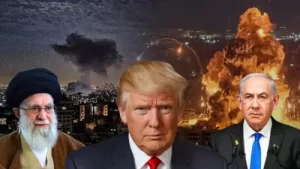


Twelve days, three claims, and a question that is hanging over the entire world – who won the real victory in the war between Israel, Iran, and the US?
Israel raised the alarm of destroying Iran’s nuclear and military sites, Iran waved the flag of protecting its sovereignty, and the US crowned the ceasefire as its diplomatic victory. But the picture of reality is not so clear. As the Punjabi idiom says, “Fire burns both sides” – this war has scorched all sides in one way or another.
Israeli Prime Minister Benjamin Netanyahu launched an airstrike on Iran on June 13, 2025, damaging nuclear and military sites with “Operation Rising Line”. Iran’s retaliatory missile strikes on Tel Aviv and Haifa leveled 61 buildings and damaged an oil refinery that supplied 60% of Israel’s fuel needs.
Iran’s nuclear stockpile secure
According to reports in the New York Times and the Washington Times, the headquarters of Israel’s Mossad spy agency also came under Iranian attack. Iran also suffered losses, but its biggest victory was the safe transfer of 400 kg of 60% enriched uranium from the Fordow nuclear plant before the American and Israeli attacks. This uranium, which can be used to make 10 nuclear bombs, could be Iran’s winning card in future nuclear deals.
How true are America’s claims
US President Donald Trump declared a ceasefire and called it his victory, but according to a Reuters report, the American B-2 stealth bombers did not completely destroy Iran’s nuclear facilities. Iran’s nuclear program was pushed back by only 1-2 months.
According to experts, Iranian missile attacks on US military bases in Qatar and Iraq made Trump think that the war would be expensive. If the war is not stopped, China and Russia may enter this war. Trump had to take this stand due to the fear of economic disaster and being caught in a war.
Mossad’s power – surgical strikes or international crime?
Founded in 1949, Mossad is Israel’s spy agency. This organization specializes in covert operations, surgical strikes, and technological attacks. According to reports by CNN and the Guardian, Mossad kidnapped Nazi officer Adolf Eichmann from Argentina in 1960, stole nuclear documents from Tehran in 2018, and killed Iranian nuclear scientist Mohsen Fakhrizadeh with an AI-operated machine gun in 2020. The assassination of Hamas leader Ismail Haniyeh in Tehran in 2024 and the Hezbollah pager-walkie-talkie explosions in Lebanon brought the power of Mossad to the fore.
But Mossad also suffered losses in the war between Israel and Iran. According to Al Jazeera, Iranian missile attacks targeted Mossad headquarters, raising questions about Israel’s espionage capabilities. Mossad’s actions damaged Iran, but failed to completely stop Iran’s nuclear program. According to the Global Times, Iran strengthened its security systems after recognizing Mossad’s infiltration. Iran, with its strength and indirect support from Russia and China, limited Mossad’s efforts.
The burden of war on the economy – Israel’s roots shaken?
According to the Economic Times and the Times of Israel, Israel’s economy is suffering under the burden of the war. In 2024, Israel’s military spending was $46.5 billion, which was 8.8% of GDP. Of the $215 billion budget for 2025, $38.6 billion is for defense alone. The Iranian attacks damaged Israel’s energy supply by destroying 61 buildings and an oil refinery in Haifa. The cancellation of work permits brought the construction and agricultural sectors to a standstill, and the increase in VAT from 17% to 18% increased the burden on the public.
Iran’s economy was also already under the brunt of sanctions, and this war further damaged it. But Iran’s biggest victory was the preservation of its 400 kg of enriched uranium, which would be its weapon for further political maneuvers.
A major reason for the ceasefire was the increasing pressure on Israel’s economy. According to the Wall Street Journal, the pressure on Israel’s missile defense system and Iron Dome, and the shortage of Aero-3 interceptors, forced Netanyahu to call a ceasefire.
The dream of a united Israel – security or political confusion?
The dream of a united Israel, which is associated with the “Promised Land” of the Hebrew Bible, is a centuries-old aspiration of the Jews. The establishment of Israel in 1948 gave this dream a color of reality, but it gave rise to the Arab-Israeli conflict. According to Al Jazeera and the Guardian, Israeli policies, such as the occupation of the West Bank and Gaza, have entangled this dream in political and religious confusion. The war with Iran has made Israel’s security even more difficult. Despite surgical strikes by the Mossad and American support, Iran’s nuclear program has not been completely stopped. Russia and China have indirectly helped Iran, which has thwarted Israeli and American plans. According to the Global Times, if Russia and China had openly supported each other, the situation could have escalated into a world war. India was not directly involved in the war, but instability in the Middle East has affected India’s energy supplies and trade. India maintained a neutral stance, but its voice on the international stage remained weak by not questioning America’s unilateral policies.
Whose victory will be crowned?
There is no clear winner in this war. Israel damaged Iran, but its economy and security suffered a heavy burden. Iran has asserted its sovereigntyIran has protected its nuclear program and secured its uranium, but its economy has been further weakened. The US has touted the ceasefire as a victory, but opposition to Trump’s unilateral military actions has grown in the US Congress and the public. Russia and China have helped Iran by providing indirect support, but have not come out openly.