
This agreement was signed on 19 September 1960 in Karachi between the then Prime Minister of India, Pandit Jawaharlal Nehru, and Field Marshal Muhammad Ayub Khan of Pakistan, with the mediation of the World Bank. The action taken by the Indian government regarding this 1960 agreement is not sudden and surprising, because there was a long-standing tug-of-war between the two governments regarding the implementation of the provisions of this agreement, under which India was demanding to amend many of the provisions of the agreement. Yes, the inhuman act of killing innocent people by terrorists in Pahalgam on 22 April became the immediate reason for the suspension of this agreement.
The partition of India on 15 August 1947 was done by hastily drawing a line on a large map. The English lawyer who drew this line, Mr. Radcliffe, had never been to India before and was given only five weeks to draw this 3323 km long line. As a result, the partition of the northwestern part of India for a new country became a mere political and administrative event, which resulted in a large-scale division of the population and about one million Punjabis were killed in this partition.
Later, when the situation became complicated and took a dangerous turn on the question of sharing river waters, in 1951 the President of the World Bank offered his services to both countries to resolve this dispute. The World Bank proposed that this agreement be made under the principle of the functionality of river waters, joint use of water resources and considering the basin region of the six rivers as a single unit and its economic development as the main focus. The governments of India and Pakistan accepted the proposal of the World Bank and accepted it as the arbitrator for the agreement.
Based on almost a decade of bilateral talks by the World Bank, expert reports, geographical conditions of the rivers and technical data on water flow and future-oriented proposals for the proper use of river waters, etc., an agreement was reached between the two countries in 1960. It would be appropriate to mention here that this agreement was also opposed by the people of Pakistan at that time and similarly it was opposed in India as well. Muhammad Ali Jinnah’s youngest sister Fatima Jinnah opposed this agreement and termed it as a permanent violation of Pakistan’s rights to the waters of the rivers and some people called it a kind of sale of these rivers to India.
On the other hand, while speaking about the opposition to this agreement in the Lok Sabha of India, Indian Prime Minister Pandit Jawaharlal Nehru showed a big heart and said that some tasks are important, for which something has to be given and something has to be given. He said that through this agreement, peace has been bought by him which is beneficial for both the countries.
According to this agreement, the average amount of water of the six rivers flowing in this region was estimated as follows-
Indus River: 90 million acre feet (MAF)
Jhelum River: 23 MAF
Chenab River: 23 MAF
Ravi River: 7 MAF
Beas River: 14 MAF
Sutlej River: 14 MAF
Total: 171 MAF
Out of the above flowing river waters, India was allotted about 35 MAF of water and Pakistan 132 MAF of water as per the 1960 agreement (4 MAF of water was reserved for Kashmir and Jammu). It was found that at the time of the agreement, about 210 million acres of Pakistan and about 50 lakh acres of India were under irrigation.
Agreement
The main provisions of the agreement signed on 19 September 1960 through the World Bank were as follows:
1. Pakistan will receive the water of the western rivers (Indus, Jhelum and Chenab) flowing from India and it will have full right to use it without restriction.
2. All the water of the eastern rivers (Ravi, Beas and Sutlej) will be available to India for its unrestricted use.
3. It shall be the responsibility of India to keep the waters of the Western Rivers flowing and not to allow anyone to interfere with these waters except for the following uses:
a. For domestic use |
b. For non-consumptive uses (electricity generation etc.), provided that doing so does not cause any change in the flow of the waters of the rivers which is contrary to Pakistan’s right to use the waters.
4. Except in the specific circumstances mentioned in the agreement, India shall neither store the waters of the Western Rivers nor construct any dam for storage.
Under this agreement, a permanent Indus Water Commission was established, in which officials of both countries were included so that the work done by both countries on the rivers as per the said treaty could be monitored and information and data could be shared in this regard. If the Indus Water Commission cannot decide due to a major difference of opinion during the dispute, a provision was made to appoint an “impartial expert” by both countries and if any issue still arises between the two countries in this regard, then the Interstate Arbitration Court, headquartered in Paris, France, has been authorized to decide. No time limit has been set for this agreement, therefore such a treaty is called a permanent treaty of indefinite duration.
This Indus River Waters Treaty, signed in 1960, has been in force for the past 65 years, although during this period, military wars have also taken place between India and Pakistan in 1965, 1971 and 1999.
India’s position regarding the suspension of the treaty: – India has been asking Pakistan for a long time to reconsider this treaty. On the other hand, India
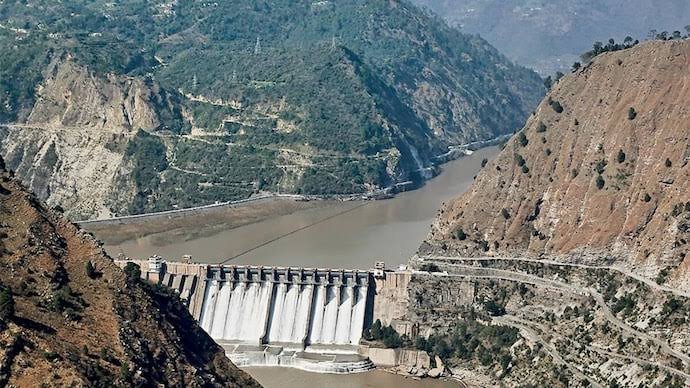
Pakistan has been raising some objections to every project being built as per the terms of the LoC treaty. In India, the Kishan Ganga Power Project (330 MW) on the Jhelum River, the Baglihar Power Project (900 MW) on the Chenab River, and the Dul Hasti Project (390 MW) on the Chenab itself have been built. Apart from this, India is building the Pakal Dal Power Project and Ratal Power Project, Swalkot Power Project and Bursar Power Project on the Chenab River, the design of which has been delayed by Pakistan by continuously raising objections.
All the above projects are based on the continuous flow of river water and not on storage, because as per the terms of the treaty, water cannot be stored in them. The resulting siltation severely reduces the efficiency of these projects. The “Salal Power Project on the Chenab River”, a run-of-river hydropower project built by the Indian government in 1987, became financially unsustainable within just five years due to siltation.
The Indian government maintains that the treaty should be reviewed in light of climate change, the latest technologies developed in the last 65 years, the experience of difficulties in constructing power projects and the growing irrigation needs in the Indian region, but Pakistan has consistently opposed any proposal to change the terms of the treaty.
Pakistan’s position
Pakistan’s position is that it is a lower riparian region and therefore these three rivers empty into its territory. It says that about 170 million people (the total population of Pakistan) living on these western rivers in its western Punjab and Sindh provinces 25 crore) are directly and indirectly dependent, because there is a huge crisis in the quantity and quality of groundwater in a large part of Pakistan. Therefore, only river water is used for agricultural irrigation, drinking water for the population, other domestic needs, and industrial use, etc. They oppose the storage dams and silt removal technologies of dams on these rivers by India so that India cannot use this stored water as a weapon, under which water is stopped in the storage dams during the low flow months of river waters, which will create a water shortage crisis in Pakistan and the water of the dams, including silt, is released suddenly during the monsoon season, which will cause widespread flooding in Pakistan. In both cases, the argument is given for the possibility of economic recession and unrest in Pakistan.
Impact on Indian Punjab
Before the Indus Water Treaty in 1960, in 1952, the then Indian irrigation experts had proposed to take 20,000 cusecs of water from the Chenab River and merge it with the Ravi River through a 42 km long tunnel. This tunnel was proposed to be taken from a place called Tandi on the Chenab River, where two canals “Chandra” and “Bhaga” meet the Chenab River. The capacity of this water was to be around 6 MAF. From which water was to be taken and transported to the Harike Headworks through the Ravi Beas Link. But this proposal was rejected due to the 1960 agreement, under which all the water of the western rivers was reserved for Pakistan.
The second proposal that was considered was to divert 20,000 cusecs of water from the Chenab River through a tunnel near Manali and directly into the Beas River. The amount of 20,000 cusecs of water can be estimated from the fact that 12,500 cusecs of water flows in the Bhakra Canal.
Now that the 1960 agreement has been suspended by the Indian government, a proposal can be prepared to divert 20,000 to 30,000 cusecs of water from the Chenab River to the Ravi or Beas River through a tunnel. It is argued that even after 65 years, Pakistan has not been able to use its full share of water, due to which about 20 MAF of water flows into the sea. Water from the Chenab River can meet the water needs of Indian Punjab to a large extent, but this will require a huge amount of money to strengthen and revive the canal system of Punjab.
In the changed circumstances, it becomes necessary to re-evaluate the 1960 Indus Basin Waters Treaty because generally, the volume of river water, flow, silt, rainfall, the condition of glaciers, changes in snow conditions, the entry of El Nino and La Nino phenomena into the oceans and the progress in science, technology and human understanding over time, the geographical conditions keep changing. But still, temporarily or permanently stopping the waters flowing in the three western rivers or diverting their flow is a very difficult, risky and long-term task technically, politically and financially.