
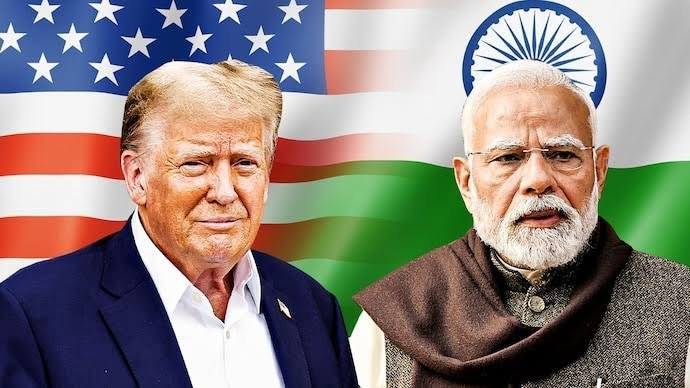
When Donald Trump’s America told these countries that their illegal immigrants who came here would be sent back in military aircraft and handcuffed and shackled, they expressed strong objections. They clearly told America that if they were sent back in this way, they would not take back these illegal immigrants at any cost. They made it a condition that they would send their civilian aircraft to America and through them they would bring back only immigrants without handcuffs and shackles. Couldn’t India have made this condition? Why didn’t Modi ji talk to Trump about this? It seems that our Prime Minister has completely bowed down to Trump. The reality of his American visit is now slowly unfolding. One by one, all the things that were hidden by the pro-government media are coming to light.
When Donald Trump was running for president, it seemed that if he won, he would do something that no one had done before, but there is a big difference between anticipating something new and seeing it disappear in front of you. It has not even been a month and a half since he was sworn in on January 20, and he has created turmoil in the world with his every step, every announcement and every new claim. All the predictions have gone wrong, all the plans have to be remade. The situation has completely changed because of Trump. Let alone other countries in the world, our own country, located 22 thousand kilometers away from the United States, has to prepare for major changes in its economy and foreign policy. In our electoral politics too, the ruling party and the opposition are seen clashing with each other because of Trump. There are headlines about Trump in the newspapers every day. News about Trump is getting a different kind of popularity on TV and social media.
India is trying its best to somehow ease its relations with China despite the sharp border dispute. The wonder of this compulsion arising from the changed situation due to Trump is that China is also eager to take advantage of this opportunity being provided by India. If this were not the case, during the G-20 meeting in Johannesburg, External Affairs Minister Jaishankar and Chinese Foreign Minister Wang Yi would not have been seen holding positive talks on peace on the borders, resumption of the Kailash-Mansarovar Yatra and facilitating air travel between the two countries. If this were not the case, pro-government economists would not have been seen recommending opening the doors of the Indian market to Chinese capital. Who can ignore the recommendation of Arvind Panagariya, former Vice Chairman of NITI Aayog, that cooperation with China should be started in all areas except aspects related to the border dispute. In fact, there is no guarantee that the US will support India if India engages in a military confrontation with China. Trump’s preference is not to back down on India over China, as this could hinder his domestic agenda (Make America Great Again).
Before Trump, India viewed the Russia-Ukraine war as a dispute between the two sides and the need for Narendra Modi to mediate between them. Now, Trump has started talking directly to Putin, declared Zelensky a dictator and stopped all aid to Ukraine. Trump wants to completely change Europe-US relations by including Russia in the G-7. Now India has to withdraw its hand from this policy of mediation, because Trump’s America has changed sides.
The state of the economy is such that during Modi’s visit to the US on February 11-12, Trump told the Prime Minister that he would impose the same import tax (tariff) on Indian goods as India has imposed on American goods. Before the Prime Minister arrived in the US, Trump imposed a tariff on Indian steel and aluminum and after his visit, he imposed a 25 percent tariff on Indian medicine imports. This created a possibility of a loss of two and a half billion dollars to Indian pharmaceutical companies. According to Goldman Sachs, due to this, India’s GDP will also fall slightly. This is just the beginning. Trump is going to treat many other Indian goods in the same way. Now India is thinking of putting a proposal in the bilateral trade agreement between the US and India that instead of getting into a conflict of imposing retaliatory tariffs, India and the US should start a process of bilateral tariff reduction. Will Trump accept this? It is difficult to predict.
The joint statement issued by both the countries is largely biased in favor of America. For example, India will trade $500 billion per year with America by 2030, i.e. in five years. For this, we will have to buy American gas and crude oil. It is likely that American oil may be more expensive than oil from Russia and Arab countries. Apart from this, Trump has also proposed to buy F-35 fighter jets from India. It is ultra-modern, but the cost of one such aircraft is Rs 18,000 crore and this deal will be worth Rs 50 lakh crore. Even the government’s military strategists are not confident about this deal. America has imposed such strict conditions on the use and technology of this aircraft that India may have to ‘give and take’. Our Air Force has been longing for new aircraft squadrons for a long time, but the more expensive the aircraft, the fewer they will be. Will India accept these proposals from Trump?
Can he refuse to do so? The possibility of this is equal to no.
The structure of the interests of the Trump-era America is such that they can only be fulfilled by placing a foot on the feet of other countries like India. India had some idea, but when Trump’s four-pronged actions began, it now seems that the Trump-era world is going to prove to be very different from our expectations.