
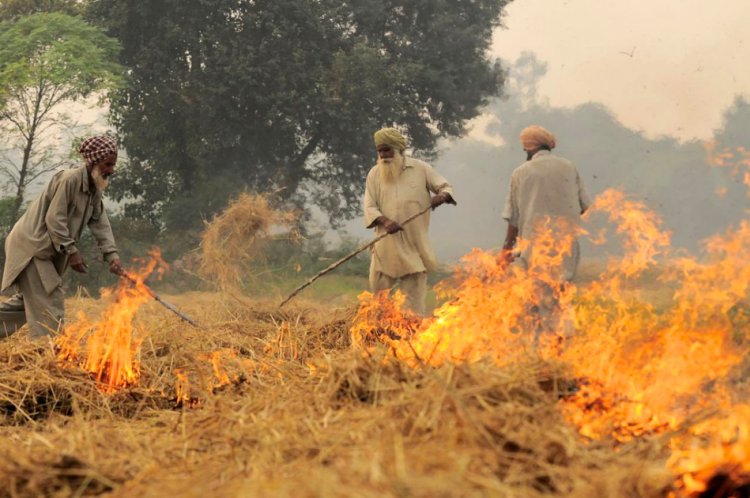
There is an uproar over the issue of stubble burning. The rulers of the country’s capital Delhi sleep like a baby all year round, wake up in a daze, issue decrees, file ‘public interest’ writs in the courts, the Supreme Court issues orders. But the sewerage system remains there.
Undoubtedly, stubble management is a big issue. Many farmers see burning it as an easy solution to prepare for the next crop. This causes great damage. Burning stubble destroys many beneficial microorganisms present in the womb of the soil, which are helpful for agricultural production. According to a study, burning one ton of stubble destroys 5.5 kg of nitrogen, 2.3 kg of phosphorus, 25 kg of potassium, 1.2 kg of sulfur and other beneficial nutrients present in the womb of the soil. According to a report by the International Food Policy Research Institute, stubble burning causes a financial loss of about Rs 2 lakh crore in different states of India.
The country’s highest court, the Supreme Court, on September 24, 2024, sought a response from the Commission for Air Quality Management (CAQM) on the issue of stubble burning and asked why the previous orders were not implemented and why there was an increase in the incidents of stubble burning in the week of September 15 itself. Why did the CAQM Act not take action against the officials responsible for stubble burning under Section 14 of the CAQM Act? The court also slammed the Punjab-Haryana governments for not taking strict action against farmers for stubble burning.
In fact, the governments have been silent for years. They are unable to solve this serious issue of farmers. The small efforts made for stubble management do not reach the farmers in the true sense like ‘government schemes’. While many schemes are made, due to lack of financial resources, they all remain empty.
Stubble burning deteriorates the environment. It pollutes it. It affects health, not only on the human body, but also on other living beings. In the early days of winter, this increase in pollution makes breathing difficult. By 24 September 2024, the air quality index in the Delhi region was recorded at 203. And the reason for this increase is being attributed to the case of stubble burning in Punjab-Haryana. In the early days of paddy harvesting itself, 23 cases were noticed in Punjab and 70 in Haryana.
But it is also worth seeing whether only stubble burning causes air pollution. In Delhi and other big cities, vehicles, cars, trucks, and factories in these areas create pollution without any restrictions. Why do the government, administration, and government institutions remain silent while monitoring them? Religious ceremonies, fireworks during Dussehra, Diwali, and other festivals during these days cause major air pollution. Coal-fired thermal plants cause air pollution.
According to information on the issue of air pollution, Delhi is suffering more from air pollution than other cities. This pollution has reduced the life expectancy of Delhi residents by six and a half years. When air pollution produces toxic gases like carbon monoxide, carbon dioxide, methane, and hydrocarbons, it affects asthma, heart, and cancer patients more and the elderly and children are the most affected.
Scientists say that air pollution is a major health epidemic in the world. Only 7 countries in the world have clean air. These countries include New Zealand and Finland. India is the third most polluted country in the world after Bangladesh and Pakistan among 134 countries, and the country’s capital Delhi is at the top of the top 10 cities with the most air pollution.
Air pollution occurs when harmful gases and dust are released into the atmosphere. Its sources include forest fires, volcanic eruptions, automobiles, and electrical appliances. This pollution has adverse effects on the human body and the environment. According to an international research, 200 studies conducted show that vehicles are the biggest source of pollution, which is extremely dangerous for health. Billions of polluting cars running around the world are the biggest enemies of health. In this air pollution, crop residues, stubble etc. have a major impact on the seasonal level. Since vehicles etc. are accepted by people as ‘pollution’, but the fires that occur due to drains, stubble, residues become a topic of great discussion.
This does not mean that burning crop residues is right, but its management is extremely important so that the dangers facing human life are controlled.
The government has made efforts for the last few years as per the orders of the Honorable Supreme Court to resolve the issue of stubble burning. The government has decided not to give minimum price benefit from the crop to the farmers guilty of stubble burning. However, satellite monitoring is done to reduce the cases of stubble burning. It was also decided that the government will give financial assistance of five thousand rupees per acre to those who do not burn stubble. But all this is not working.
The government alone cannot solve the problem of stubble burning. For this, joint efforts are needed. Farmers will also have to be aware that stubble burning is harmful to their land. Improved varieties of paddy that produce less stubble will need to be planted. Direct sowing of rice can be helpful for this task. By making bundles of stubble, it can be used in thermal plants. Fertilizer can be made by mixing cow dung with this stubble. Its use in cow dung gas plants can prove helpful.
But  Instead of doing politics about burning waste like rice, the main issue of air pollution has to be understood. How good it would be if the number of vehicles was reduced and bicycles were adopted, walking was practiced.
It is necessary to remember the days of the Corona pandemic. When vehicles were not seen on the roads, the pollution-free environment gave relief to humans. Mountains were seen in the plains.
Implementing laws to prevent pollution will make it easier to control this problem. Action is needed against the factories that cause pollution. Pesticides and fertilizers should be used in limited quantities in the fields. While ‘compost biogas’ plants can be helpful for crop waste, by preparing bio-waste decomposers in Punjab-Haryana and other agricultural areas, fertilizer can be prepared from waste, which can increase the fertility of the fields.
Ban on old vehicles, use of solar energy and shared vehicles, buses etc. for transportation can prove helpful.
The government should be serious, make farmer-friendly agricultural policies for farmers, give fair price for crops so that farmers get freedom from loss-making farming and they wholeheartedly accept schemes to get financial benefits from it by managing crop residues.