
In the second half of the 19th century, the construction of canals in Punjab led to a sharp increase in the value of jagirs. As a result, the mahants and their numerous followers, the chatras, started making the common management of the gurdwaras their private property. (Mahinder Singh) Except for a few staunch devotees, only the beard and the name of Sikhism remained for the general administrators. After being defeated by the British, the Gursikh leaders who were supposed to reform them had become somewhat lax. The enthusiasm for maintaining the cleanliness of the gurdwaras, which used to fill their hearts with joy during the rising seasons, had disappeared. The mahants and sadhus in whose hands the gurdwaras had gone at this time, having experienced the fear of the congregation and millions upon millions, started using the income from religious offerings (Guru ki Golak) for such works, the examples of which are shameful. Apart from idol worship, drinking alcohol and disturbing the holy places, other vile misdeeds started happening in the holy shrines, which tormented the hearts of the Guru’s beloved and the devotees. After 1880 AD, some gentlemen came together and started efforts to reform these misdeeds. This new organization was named ‘Singh Sabha Movement’. With this, a new awakening in the Panth began to take place within the nation. The Sangat became filled with Sikh sentiment, devotion and love for Gurbani.
Nanak Dev’s birthplace, Nankana Sahib, holds the greatest importance among the religious places of the Sikhs. In the early decades of the 20th century, the Gurdwara Janam Asthan was occupied by Mahant Sadhu Ram, who was a rascal, drunkard and a womanizer. He soon succumbed to a deadly disease and died. After his death, Mahant Narayan Das ascended the throne. While ascending the throne, Mahant Narayan Das promised the Sikh community in front of the British magistrate that he would abandon the misdeeds of the previous Mahant. He wrote that if any fault was proven against him, he would resign. But he soon broke this promise and started walking on the misdeeds of the previous Mahants again. He brought a concubine into his house inside the Gurdwara, who lived with the previous Mahants and was also the mistress of some other men. Two boys and two girls were born from her womb, for whom he built two houses. The most shameful thing is that in August 1917, he ordered prostitutes from Lahore. He made them dance inside the Janma Asthan and listened to dirty songs.
In 1918, a priest robbed the 13-year-old daughter of a retired civil servant (EAC) who had come to visit the Gurdwara, while the recitation of the Rehras was being done at that place. In the same year, 6 women of Ajdawala (Lyallpur) were forcibly robbed of their wives at night by burchhe priests. In this way, the Nankana Sahib Darbar had become a hotbed of prostitution.
The Mahant’s actions began to be condemned from all sides. A wave of anger erupted against him in the Sikh world. The newspaper strongly condemned the Mahant’s dance in August 1917. Singh Sabhas and Sangats passed resolutions to the government to stop these acts. In early October 1920, a large gathering in Dharowal Nagar passed a resolution asking Mahant Narayan Das to reform, but the Mahant would never listen because he had unaccounted money and some feudal lords, Bedi, who made prostitutes dance at weddings, were behind him. He also had close relations with the government officials. He turned against the Sikhs. The Sri Akal Takht, Harmandir Sahib and other Gurdwaras in Amritsar had been taken away from the Mahants, so he felt that his throne was in danger and he started making preparations to counter the Gurdwara Reform Movement. Baba Kartar Singh Bedi and other people who had close relations with the government officials became his confidants and advisors. He recruited about 400 rascals of ten and started furnaces inside the Gurdwara to make weapons such as axes, axes, and takuyas. He completely fortified the Gurdwara. The gates leading in were made of strong iron and holes were made in them for firing pistols and guns from inside. In this way, a complete arsenal of massacres was created inside and outside the Gurdwara. He met the Commissioner of Lahore Division, Mr. C. M. King, who assured him that if the Akalis attacked his Gurdwara, he would be helped. His fellow Mahants also advised him that if the Akalis came to take possession of the Gurdwara, he should kill and burn them without hesitation. With the advice of Baba Kartar Singh Bedi and other Mahants, he called a meeting at Nankana Sahib in which more than 60 Mahants participated. In this meeting, it was decided that the newly formed Shiromani Gurdwara Parbandhak Committee should not be recognized. An equality committee was formed under the leadership of Mahant Narayan Das. A newspaper called Sant Sewak was also started from Lahore to propagate against the Akali movement.
The Mahant’s intentions to kill the Akalis had been revealed and news about this was coming in the newspapers. On 24 January 1921, the Shiromani Gurdwara Parbandhak Committee called a meeting and passed a resolution that a Khalsa Diwan would be held at Nankana on 4, 5 and 6 March 1921. The Mahant was invited to reform himself and become subordinate to the Panth. A notice was distributed that the Punjab government, Sikh kings and common Sikhs were asked to all come together and use their real influence so that the Gurdwara comes under the Panthic administration. On 6 February, the Shiromani Committee formed a committee for the langar of the Sangat. The Mahant was invited to attend the meeting of the Akalis to be held at Sacha Sauda Sultanpur from 7th February to 9th February 1921.
But he did not come to the meeting. Then on 14 February another meeting was held in Sheikhupura, he did not come to this one either and he asked for the meeting to be held in Lahore, to which the Akali agreed. Instead of meeting the Akali leaders, he started preparations for the clash by adding 28 more Pathans to the army of 400 hired ponies. It seems that by repeatedly postponing the dates of the meeting, he was gaining time for preparation.
The Akali came to know about the murderous plans of the Mahant, who started desperate efforts to get the groups to go to Nankana before the general meeting scheduled for 4 March 1921 and to avoid getting caught in the Mahant’s trap. For this purpose, Harchand Singh, Teja Singh Samundari and Master Tara Singh were sent to Nankana to prevent the groups from going to the Janm Asthan. These leaders reached Nankana on 19 February 1921 and were joined by Sardul Singh Kavishar, Master Sundar Singh, Jaswant Singh Jhabal and Dalip Singh. From here they consulted and sent a strong message to Dalip Singh and Jaswant Singh to meet Jathedar Kartar Singh Jhabbar and persuade him to abandon his plan to capture Nankana Sahib. After informing Jhabbar, Dalip Singh left for Sundar Kot to inform Bhai Lachhman Singh not to leave for Nankana as planned. On learning that Bhai Lachhman Singh and his party had already left, Dalip Singh set off towards Uttam Singh’s factory, which was about a mile away from Nankana.
Bhai Lachhman Singh left his village with some other Akalis in the late evening of 19 February 1921. They had their own wife and a teacher with them. On the way, another woman joined them. They took 19 Akalis from Devi Singh Wala, 11 from Dhanuwal, 7 or 8 from Chelawala, 6 from Thathian, 5 from Mula Singh Wala and other Akalis from some other villages. These Akalis together became a band of 150 brave men. On February 21, at about 5 o’clock in the morning, Bhai Dalip Singh’s man reached them on the Bhattas north of the Janam Asthan with a message, in which it was written that Bhai should return from Nankana Sahib along with the other band and not set foot in Nankana Sahib at all. Bhai Lachhman Singh had great respect for Bhai Dalip Singh, he accepted this order and got ready to go back, but Bhai Tehal Singh Ji said, “Today is the birthday of Guru Har Rai Ji. We have reached here now. Let us go and have darshan of the Gurdwara. The Mahant will kill us, won’t he? No problem. When we are not to carry any weapons, remain peaceful, not to fight and not to say anything to create a stir, and to return after bowing down, then why should there be a quarrel?” But they were not aware of the Mahant’s evil intentions.
Bhai Lachhman Singh Ji agreed and the group set off to have darshan of the Gurdwara Janam Asthan. The women went to have darshan of Gurdwara Tambu Sahib from where they returned home and the Akali started bathing in the pond outside the Janam Asthan. Around six o’clock, they entered the Gurdwara to pay obeisance.
The Mahant’s goons and crooks were sitting ready in front. The Mahant had completed all the preparations. He had already sent his family members to Lahore. He had also handed over the money and necessary documents to them. He had even made arrangements to have the presence of ten number one crooks – Rihana, Amli, Kundi, Vasakha and some others – at the Kasur police station so that he could present an excuse to clear his position that the crooks who are being called murderers were not present at Nankana Sahib that day. Their presence is being recorded at the Kasur police station.
On 19th and 20th February, the Mahants had held their Sanatan Sikh Conference in Lahore. Keeping this conference in mind, the Jhabar Jatha had decided to take control of Nankana Sahib in the absence of the Mahant before the Panth’s March gathering and save the leaders from being killed. But the Shiromani Committee had canceled this decision. On February 19, the Mahant was sitting in the 3.44 pm train to go to the conference when a Muslim woman came to him and told him that the Jatha had arrived in Buchana. The Mahant got down from the train and returned and armed all the goons, crooks and ten numberers with gandas, scythes, swords, guns and pistols. A large quantity of fuel and kerosene had already been stored in the Gurdwara and strong piles of stones, bricks and stones had been kept on the roofs of the houses.
To strengthen the fort, the Mahant divided the bad guys as follows: He appointed the bad guys from Majha to protect himself and his meeting. He stationed some men from the coats in front of the market gate and some near the Darshani Deodhi. Inside the Gurdwara, the Pathans were assigned the task of protecting the two big doors. If there was any trace of religion or morality left in the Gurdwara till now, it was also destroyed. The Gurdwara Janam Asthan was transformed into a fort of war and slaughter.
Before entering the Darshani Deodhi, the Singhs bowed their heads as a sign of respect, then raised slogans of ‘Sat Siri Akal’ and went and sat down in front of the court. Bhai Lachhman Singh sat down under the Guru Granth and all the Singhs became engrossed in reciting the Shabad. The saints slowly slipped away from there. It did not even occur to them that despite being lowly, the Mahant’s lowliness would cross all limits and turn the Darbar Sahib – where Sri Guru Nanak Dev had taken birth and given the message of unity, brotherhood, equality and peace – into a field of massacre. He was careless, forgetting everything, absorbed in reading the Shabad,
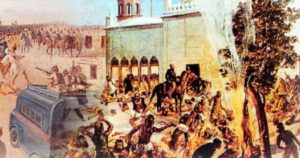
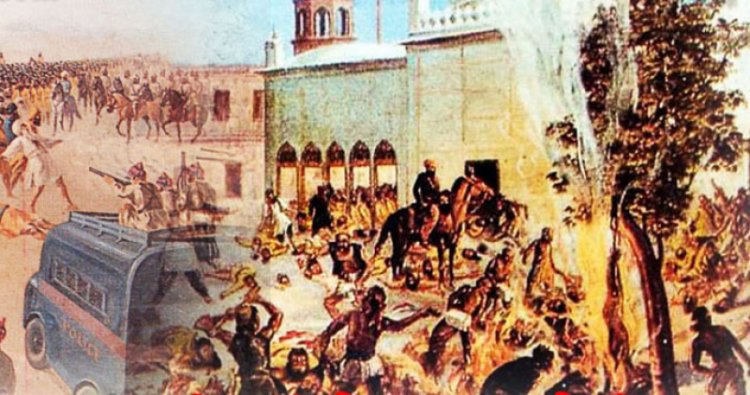
The words were being read when bullets started raining down one after another. The Singhs, wounded and writhing on the ground, began to suffer. There were barricades on the roofs of the houses and the Mahant’s goons were shooting at them, killing the Singhs. The Singhs got up and went towards the defensive positions, but where were the defensive positions? Why were there bullets coming and why was there a barrage of bricks and stones? There was no place to hide. The doors were all closed. There was a barricade all around. Those who remained sitting peacefully became targets of bullets and were martyred there. Some twenty-five or twenty-six Singhs were martyred in the courtyard. Some sixty Singhs went into the courtyard inside the court and they took the guns from inside, but the Mahant’s rascals were covered in blood – they were drunk and full. They first stood at every prominent place and kept firing, then they came to the top of the Darshani Deodhi and targeted several Singhs from there. When they saw that there was no movement below, these rascals of the Mahant came down and at the Darshani and Bazar gates, whoever was alive and wounded, they bit him with their knives and beat him with sticks. Five or six men were standing in a closed verandah, they were roasted with bullets. About 25 Akalis were taking shelter in the rooms of the side rooms, they were also forced to cross by the Mahant’s force with bullets, sticks, sticks and bricks.
At this time, the sound of Singhs shouting came from outside. These goons and rascals opened the Darshani and Bazar gates to attack them and broke open and attacked them. Some climbed onto the roofs and started throwing bullets and bricks. In this chaos, some Singhs came out. They climbed two steps and surrounded the house and from there they were injured with knives and shot outside. The Mahant himself was leading this massacre. He had a sheet wrapped around his face and was riding a horse, sometimes going here and sometimes there, shouting loudly, “Don’t let any hairy Sikh live! Kill them.” To encourage them further and invigorate them, he himself fired a pistol and killed one Singh on the spot. Some six Singhs were killed outside in this way. Some Singhs were chased by some Sadhus of Rehane to the railway tracks where an old Sikh and two other Singhs were killed. Two or three Singhs were killed in the fields. The Mahant seemed bent on destroying the seed of the Akalis.
This great commotion was still going on inside and outside when a goon shouted, “Some Akalis are hiding inside the square. The door is locked from inside. Come this way!” Hearing this, all the killers rushed towards this side. Two of them had guns in their hands and the rest had axes and hatchets etc. A Sikh was hiding in the tomb, he was shot dead there. One started firing inside the square through the silver-studded door, others broke down the door on the north side with axes. Ranjha and another started firing from this side and roasting the Singhs. A Pathan smashed the western door with an axe and made a hole through which two men could shoot. A Singh called out from inside, “Let me come out.” One of the Mahant’s men said in a very sarcastic voice, “We will take you out too, don’t worry.” When he came out, he was shot dead as soon as he came. When everyone inside was killed or injured, the Pathan and other men went inside and brought everyone out in a huff. About 60 Singhs were martyred here. Only a twelve-year-old boy who was hiding under the Guru Granth Sahib survived.
After this, the Mahant himself came and ordered that the dead bodies lying in the courtyard be collected and arrangements be made for their cremation. Only four bodies were left behind. The bodies that were kept behind were: Bhai Mangal Singh, Bhai Hazara Singh, Atma Singh and a sadhu. The sadhu had died after being shot by a miscreant. Mangal Singh was a religious Sikh whom Bhai Laxman Singh had adopted as his son. He was expelled from the army for wearing a kirpan and was given the title of ‘Kirpan Bahadur’. These four bodies were taken out separately.
Before setting the rest of the bodies on fire, the Pathans and miscreants searched them and snatched everything they found there – money, kirpans, blankets, etc. The wood and oil were insufficient to burn so many men. Therefore, more wood and oil were ordered from the market in carts and carts. It was proved from the statements of some of the accused in the trial that many living Sikhs were thrown into the burning mausoleum and burned. Bhai Laxman Singh was hanged from a jund tree and set on fire below and burnt. Those who were killed outside the Gurdwara were thrown into a brick kiln and burned. No Singh who came under the control of the Mahant’s goons could escape.
When Bhai Dalip Singh came to know about this massacre, he went to the Gurdwara to stop it. On the way, Bhai Utam Singh the factory owner and some other people stopped him, but he thought that the Mahant knew him well and would be able to stop him.
He reached Darshani Deori and asked the Mahant to stop the massacre and that he would ask forgiveness from the Panth, but the Mahant shot him dead with pistols, saying that he was also a Sikh. His other Chandals cut Waryam Singh, who had accompanied him, into pieces.
Now there was no Sikh left inside the Gurdwara to kill and they got busy burning the bodies. According to a government secret report, all the Akalis
The Sikhs were brutally murdered and the wounded were beaten to death with axes and sticks. After the massacre was over, the dead Sikhs were collected and the pile of corpses was soaked in kerosene and then they were set on fire.
District Engineer N. S. Sandhu sent a special man on horseback to Deputy Commissioner Karri at 8:15 pm so that he could see the scene himself. Around 9:15 pm, Bhai Uttam Singh sent the news of this tragic incident by wire to the Governor, DC, Superintendent of Police, Shiromani Committee etc. The DC arrived at 12:30 pm and the Sub-Inspector of Police arrived at 2 pm. The DC ordered him to put out the fires and prepare a report on the injuries sustained by the injured and the dead. It is clear from this that the DC Even after the time of the funeral, the Mahant’s goons would burn the bodies for about an hour and a half.
The government prosecutor also confirms that the Mahant tried to erase the names and traces of the dead by burning the bodies. According to the news published in the local newspapers, the injured and dead bodies continued to burn for about an hour and a half even after the arrival of the Deputy Commissioner. Late in the evening, the Commissioner of the Lahore Division, C.M. King, and the Deputy Inspector General of the Central Range also reached Nankana along with a hundred British and a hundred Indian soldiers. Mahant Narayan Das was arrested along with his two followers and 26 Pathans and sent to Lahore, but many of the murderers managed to escape. An army guard was posted at the Gurdwara Janam Asthan.
When this massacre took place, Jathedar Kartar Singh Jhabbar was staying at the Gurdwara Khara Sauda with his group. With his initiative, another group of about 2200 Akalis prepared to march towards Nankana to capture the Gurdwara. This group was stopped near village Khipwara on 21 February 1921 and the order of the Deputy Commissioner was presented, in which the Akalis were prohibited from proceeding towards the Janmashtham. Jhabbar tore up this order in front of everyone and asked him to tell the Deputy Commissioner that he was going with his group, you can do whatever you want. The Deputy Commissioner himself came and stopped the group and warned that if they went ahead, they would be shot. Ignoring this warning, the Jathedar asked the members of the group to move forward. It seems that the Deputy Commissioner relented and after consulting the Commissioner, agreed to give Jhabbar the keys of the Janmashtham on the condition that the Akalis agreed to form a management committee of the Gurdwara. After some deliberation, the Gurdwara was handed over to a 7-member committee. Harbans Singh Attari, Honorary Secretary of the Chief Khalsa Diwan, was made its president. After the arrest of Mahant Narayan Das and the seizure of the birthplace, the Mahants lost their courage and handed over the management of more than half a dozen Gurdwaras to the Shiromani Gurdwara Parbandhak Committee.
This incident severely disturbed Sikhs in different parts of the country and they strongly condemned the Mahant’s action and sent messages of sympathy for the Akali martyrs. Resolutions were passed at various places and demanded the death penalty for the Mahant and his associates. The local newspapers attacked the Mahant with one voice. The newspapers which were also against the Akalis also condemned the cruel and barbaric acts of the Mahant of Nankana and expressed their sympathy with the families of the martyrs of Nankana. National leaders like Mahatma Gandhi, Maulana Shokat Ali, Dr. Saifuddin Kitchlu, Lala Duni Chand and Lala Lajpat Rai reached the site of the massacre and expressed their sympathy with the Akalis. Eminent Sikh leaders, members of the Punjab Legislative Council, Sikh League, Chief Khalsa Diwan and members of other Sikh organizations also reached there. On March 3, 1921, a huge Shaheedi Diwan was held in Nankana, in which Jathedar Kartar Singh Jhabbar, who had played a prominent role in obtaining the keys of the birthplace from the Deputy Commissioner, briefly narrated the entire incident and said, “This incident has awakened the Sikhs from their slumber and has accelerated the march towards Swaraj.” Maulana Shaukat Ali, after mentioning the days of martial law and the terror spread by the government, said, “How futile it is to expect justice from such a government.” In his speech, he held the government responsible for this mischief and rebuked the Pathans for helping the Mahants in this crime.
Mahatma Gandhi reached Nankana on March 3 to express his sympathy with the Akali Sikhs. On the same day, Mahatma Gandhi delivered a brief speech in Hindustani at the Shaheed Diwan, in which he said, “The news of Nankana was so shocking that they could not believe it without confirmation.” Condemning the Mahant’s brutal act and praising the Akalis for enduring torture peacefully, he called the martyrdom of the Akali reformers an ‘act of national heroism’ and he also condemned the foreign rule and said that its rule was the kingdom of Satan. Later, in a message to the Sikhs at Lahore, comparing this massacre with the Jallianwala Bagh massacre of 1919, he said, “Whatever I have heard and seen is another form of tyranny, more blatant, more calculated and more cruel than the tyranny of Jallianwala Bagh.” Mahatma Gandhi also advised the Akalis to refrain from cooperating with the government inquiry into the Nankana massacre and agreed that they could become the chairman of the non-governmental inquiry commission set up by the Sikh League, on the condition that the Sikhs pass a formal resolution affirming their non-cooperation and hold the murderers accountable.
They should agree not to take the path of the courts to get the punishment. His suggestion was very correct, but the Akalis made a big mistake by not accepting it because it would have made the news of this incident known to the world and the whole world would have come to know its reality. The Sikhs were under the illusion that they would get justice from the government but this thinking proved to be wrong, as we will see later.
Now that the facts and figures of the Nankana incident are available to researchers, it has become easier to expose the double standards of the bureaucracy adopted in this matter. On the one hand, the Mahant of Nankana was secretly supported and encouraged to prepare for what the government officials called self-defense and on the other hand, sympathy was expressed for the motives of the Gurdwara Reform Movement. This policy of the Punjab government is mainly responsible for the unfortunate incident of Nankana Sahib. A reading of C.M. King’s letter to Baba Kartar Singh Bedi, his personal statements to the Punjab Legislative Council, various intelligence reports and the long correspondence between the Punjab and Indian Governments on the one hand and the Viceroy and the Head of the Foreign Office on the other, leads one to believe that the massacre of the Akalis at Nankana Sahib was a premeditated and planned conspiracy and that the government officers were not only aware of it but were actively supporting the Mahant. While giving his personal statement in the Council, Mr. King had said, “It is fair to say that for some months before the incident of February 20th – in fact, as early as October – there was a great deal of vague rumours of an attack on Nankana on March 4th, 5th and 6th.” He also admitted that Mr. Curry and other officers working under him had been sending him accurate information about the matter. In addition, the weekly and fortnightly reports sent by local officers to higher authorities also indicated that tensions were rising in Nankana and elsewhere in the Punjab. One report, for the week ending February 15, 1921, exactly six days before the massacre, described the situation in the state as follows: “The Akali Dal movement to take over all the Sikh Gurdwaras is gaining momentum and many Gurdwaras have been taken over by the new party. On January 26, the arrival of the Akali Dal in Tarn Taran led to a serious clash between the Akalis and the priests… Many men on both sides were injured…”
It is clear from the newspaper reports and the statements made by various persons in the courts that the district administration was fully aware of the Mahant’s preparations for the fort and the fight against the Akalis, but they justified these preparations on the grounds that the Mahant had every right to his own security. When the Mahant demanded police protection in December 1920, it was refused on the grounds that the government did not interfere in religious matters, and when the Akalis forcibly occupied the Sri Darbar Sahib in January 1921, the Mahant also sent a telegram to the Deputy Superintendent of Police of Gujranwala seeking assistance, but the authorities did not take any action.
In fact, the British were pursuing a double-edged policy. They wanted to suppress the Akali movement through the Mahants and also wanted to avoid the displeasure of the Sikh community.
The local authorities were strongly criticized by the Executive Council of the Viceroy of India and the Head of the Foreign Office in London for their failure to take precautionary measures to prevent this tragedy. The Viceroy said that the Mahant resorted to violence because he did not have security and that if police protection had been provided, this tragedy would not have happened. But despite this, neither the Punjab Government nor the Viceroy said anything to any official. On the contrary, considering that the bureaucracy was being maligned, the members of the Council suggested that before taking action against the Mahant and his men, the British officials concerned should be exonerated. It was also suggested that statements be made that these officials were not guilty of dereliction of duty and had been keeping the government informed of the latest developments regarding the Gurdwara Reform Movement. Following this tradition, the Home Minister of the Punjab Government repeatedly made statements in the Punjab Legislative Council in support of the action of the local authorities.
The tragedy of Nankana Sahib forced the high-ranking officials sitting in Delhi and London to think that there was an urgent need to change the earlier policy of non-interference in the religious affairs of the minority community.
The unique martyrdom of Nankana Sahib united the Sikhs. The circle of the Akali organization expanded and the Shiromani Gurdwara Parbandhak Committee became the representative of all Sikhs in the matter of the management of the Gurdwaras. All the Gurdwaras of Nankana Sahib came under the management of the Akali Jathas and the British started looking towards the machinery of maximum torture for the stability of the state. The government adopted a two-pronged policy to deal with the Gurdwara movement. First, to enact a law to deal with the Gurdwara movement – a law that would, if not directly, then indirectly, involve government interference. Second, to create an atmosphere of illegality and eliminate the Akali organization with full force.
On 13 March 1921, the Delhi and Indian governments wrote to Governor McClellan that very worrying news of illegality of the Sikhs in the Punjab was coming in. If this was not stopped, it could become a serious threat to the peace and order of the entire state. Therefore, prompt action should be taken. This started a new round of violence and from 15 March 1921, the Akali
The arrests of the accused began. Kartar Singh Jhabbar, under whose leadership the Gurdwara Janam Asthan was occupied, was the one who annoyed the government the most. The police, fully armed and ready, went to Gurdwara Kiara Sahib to arrest Jhabbar and other Akalis. But Jhabbar did not resist and was arrested quietly as per the policy of the Shiromani Committee.
The government attack became more intense and the Punjab government instructed the district magistrates to take the disputed Gurdwaras under government control under Section 145. The Deputy Commissioners were ordered to prosecute those who were in possession of knives, tuk-tuks or other such weapons under the Arms Act.
The Punjab government took control of Gurdwara Manak and another Gurdwara in Lahore, Chumal Sahib, and threw the managing Akalis in jail. The central government was demanded to send military forces to Muktsar on 15 March 1921, Anandpur Sahib and Hoshiarpur on 19 March 1921, so that these Gurdwaras could be prevented from being occupied by the Akalis.
This policy further enraged the Sikhs and the Shiromani Committee called a meeting on 20 March 1921 and demanded that (1) the succession of the Gaddidars or the succession of the Nashinis should be abolished; (2) all the waqf property belonging to the Gurdwaras should be declared the property of the Gurdwaras; and (3) all those Gurdwaras that the Sikhs claim to be Gurdwaras should be recognized.
It is noteworthy that other gurdwaras of Nankana Sahib were raided and Akali administrators were arrested in handcuffs to disrespect them so that pressure could be exerted on the confessional witnesses in the Mahant’s case to take voluntary statements, but the gurdwara of the birthplace was not disturbed. Perhaps this was because its administrator, Harbans Singh Attari, was the Honorary Secretary of the Chief Khalsa Diwan, to whom the King had given the keys, considering him his own man. The role of the Chief Khalsa Diwan in this whole affair was pro-government, which Sohan Singh Josh has discussed in detail in his book History of Akali Morchas.
The Akalis caught in the gurdwaras were given severe punishments. Teja Singh Bhuchar was given a severe sentence of 9 years, Lahora Singh 11 years, Kartar Singh Jhabbar 18 years. The rest of the Akalis were also given severe punishments. The judge gave very unique decisions along with these sentences such as Udasis are not Sikhs and the captured Gurdwaras are not Gurdwaras, they are Udasis camps, although the word ‘Gurdwara’ was mentioned in the property papers about them, but he said that he does not give any importance to it. The Mahant of Manak initially called himself a Sikh but now he started calling himself a Hindu. He said that he has nothing to do with Sikhism.
As far as the Mahant’s case is concerned, the government was standing on his back. In the High Court, the Mahant brought Hasan Imam of Patna to defend his case. He gave very absurd arguments that will always shame the Sikhs. He said about the Mahant’s order to kill all the Sikhs that not 130, even if the number of deaths was 130 thousand, the Mahant would have been right and proper to give this order. The High Court judges wrote in their decision on 3 March 1922 that the Mahant had the right to make arrangements for his own protection since the government did not provide him with protection. They commuted the Mahant’s death sentence to life imprisonment. They upheld the death sentences of Hari Nath (who had fully confessed to the crime), Ranjha and Rihana and of those who had been sentenced to life imprisonment, only 2 were upheld and all the other Pathans were released. This opened the door for the British rule and the Sikhs started struggling to get a meaningful bill passed to manage the Gurdwaras and this incident gave the Sikhs an opportunity to further intensify the date of independence of the Gurdwaras.