
To properly assess his role as the head of the judiciary for the protection of the Constitution and the rights of citizens, one must keep in mind his entire work as Chief Justice. While doing so, one must also keep in mind the background in which Chief Justice Chandrachud discharged his judicial and administrative responsibilities. The Modi government, in its second term, was advancing its aggressive efforts to fulfill the Hindutva agenda, which was in violation of the Constitution and the fundamental rights of citizens. It is in this context that Chief Justice Chandrachud’s judgments on constitutional issues and majoritarian attacks should be seen. Here, two judgments – one as a Supreme Court judge and the other as Chief Justice – present a bitter test of his. Justice Chandrachud was part of the 5-member bench that delivered the verdict on the Ayodhya dispute. The said bench had handed over the entire disputed area of Babri Masjid to Hindus for the construction of Ram temple, a decision based more on religious sentiments and beliefs than on evidence and ground realities and facts. Moreover, despite accepting that the demolition of Babri Masjid was an unconstitutional and heinous act, the bench still gave such a decision. This court decision vindicated the claim of RSS-Vishva Hindu Parishad and fulfilled one of the main agendas of BJP. This was not a one-time blunder (violation of rules), it became clear when Justice Chandrachud, as the Chief Justice of India, paved the way for the reopening of the Gyanvapi Masjid case in Varanasi. Which was in disregard of the Religious Places Protection Act, 1991, which prohibits the reopening of such cases. Realizing that the Hindu side is trying to change the religious character of the said religious place, Chief Justice Chandrachud allowed the trial to continue. This has given license to Hindutva forces to fuel disputes in Varanasi and Mathura.The second major judgment delivered by the bench headed by Chief Justice Chandrachud is on the abrogation of Article 370 and the dissolution of the state of Jammu and Kashmir. This judgment upheld the unilateral executive power exercised to amend Article 370, as the Jammu and Kashmir Constituent Assembly was not in existence at that time. The decision to make Jammu and Kashmir a Union Territory in violation of Article 3 of the Constitution disposed of the issue and accepted the state’s assurance that the statehood of Jammu and Kashmir would be restored in the future. The only implication of this judgment is that the arbitrary action of the executive to abrogate Article 370 was right in any case. It is pertinent to note that the abrogation of Article 370 was another major issue on the BJP-RSS agenda.
Other aspects of Chief Justice Chandrachud’s tenure are about the ‘Master of the Roster’ duties and the functioning of the collegium system. Here too, there is a clear pattern, the allocation of cases that concern the personal liberty of citizens, such as the Bhima Koregaon and the North-East Delhi communal riots, reflecting a deliberate plan to assign the cases of people who have been in jail for a long time to a special bench. Where the judges associated with the bench take a conservative view on matters of civil liberties and granting bail. The main feature of the work of the collegium is that it has been handing over the list of appointments of Chief Justices of High Courts and selection of judges to the executive and preventing the executive from doing anything arbitrarily in this regard, but in this matter too, they appeared to be weak before the executive, but apart from all this, what is more surprising is that a learned judge who was expected to be a staunch defender of individual freedom and constitutional principles, has emerged as a person who has put his religious faith above his loyalty to the Constitution and its values. In the last phase of his tenure, Chandrachud surprised many by admitting that he had prayed to God for a solution to the Ayodhya case. Here the author of the judgment (judge) admitted that this decision was based on ‘Divine’ intervention rather than the Constitution and the law.
Earlier, Justice Chandrachud, while addressing a gathering of lawyers after visiting the Dwarka temple in Gujarat, had said that the saffron flag on the temple symbolizes the flag of justice. This inclination is not only of the Chief Justice of the Supreme Court, but also of the special nature or temperament (ethos) growing within the higher judiciary. During the decade of Modi’s rule, a feeling of Hindutva has spread in the higher judiciary and legal communities. Some glimpses of which have come to the fore in recent days. A judge of the Calcutta High Court on the day of his retirement declared his lifelong association with the RSS and his loyalty to this organization. Another judge of the High Court, Abhijit Gangopadhyay, had resigned a few weeks before the Lok Sabha elections and joined the BJP a few days later and was elected to the Lok Sabha as a BJP candidate.
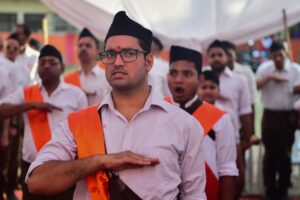
The extent to which some judges’ worldviews are influenced by Hindutva can be seen from the observations made by a two-member bench of the Madhya Pradesh High Court in July this year. They, while disposing of a petition by a retired employee seeking a ban on government employees joining the RSS, after the Centre lifted the ban on the RSS, said in its order that a ‘reputable organisation’ like the RSS had been ‘wrongly included among the banned organisations in the country’. Due to this mistake of the central government in the country, for 5 decades, ‘the aspirations of many central government employees to serve the country have been dampened due to this ban during these 5 decades. Thus, these learned judges are of the opinion that people should join the RSS to serve the country.
Caravan magazine has revealed in its October 2024 issue how the RSS The legal front of the RSS is increasing its influence within the higher judiciary. The Akhil Bharatiya Adhikta Parishad is the front of the RSS lawyers and most of the legal officers like Advocate General and Judges are being appointed from this ranks of the organisation. This article has mentioned that out of the present 33 judges of the Supreme Court, at least 9 have attended the functions of the said Council as chief guests on one or more occasions. The record of Chief Justice Chandrachud is a cautionary tale that majoritarian sentiments are being reflected in judicial decisions at the highest level. Overall, it is a warning of the extent to which the Modi government has helped the RSS to infiltrate the higher judiciary.