
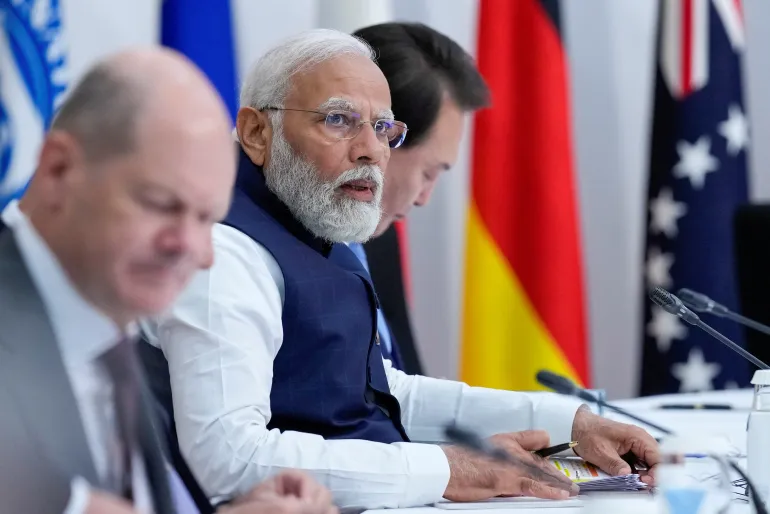
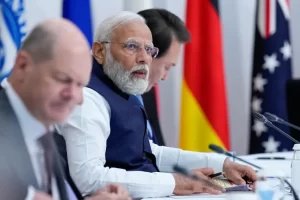
 Indian Prime Minister Narendra Modi is going to Canada in mid-June 2025 to attend the G-7 summit in Kananaskis, Alberta. It is being hosted by Canadian Prime Minister Mark Carney. But there is a lot of opposition among the Sikh community and some Liberal leaders in Canada regarding this invitation. The main reason for this is the murder of pro-Khalistan Sikh leader Bhai Hardeep Singh Nijjar in 2023, in which there were allegations of involvement of Indian agents.
Indian Prime Minister Narendra Modi is going to visit Canada after almost ten years. He last visited Canada in April 2015, when Stephen Harper was the Prime Minister of Canada. This time Modi will reach Kananaskis in June 2025 to attend the G-7 summit. The top leaders of the US, France, Britain, Japan, Italy, Germany and Canada participate in the G-7 summit, but the host country has the right to invite other countries. India, the world’s fifth-largest economy and most populous country, has been invited to the summit. Modi is also likely to hold a bilateral meeting with Canadian Prime Minister Mark Carney, which could discuss trade, security and justice.
Canadian Prime Minister Mark Carney justified the invitation, saying that India is the world’s fastest-growing economy and the hub of many important supply chains. He stressed that India’s participation is essential for discussions on issues such as energy security, the digital future and critical minerals at the G-7 summit. In addition, Carney also advocated for continuing bilateral law enforcement dialogue. But the invitation and Modi’s visit have caused controversy in Canada, especially among the Sikh community and some Liberal leaders. The biggest reason for this is the murder of Hardeep Singh Nijjar, which brought India-Canada relations to an all-time low in 2023. On June 18, 2023, 45-year-old Hardeep Singh Nijjar, a pro-Khalistan Sikh leader, was shot dead by armed assailants in the parking lot of a Gurdwara Sahib in the Canadian city of Surrey. The Indian government had declared him a terrorist.
In September 2023, the then Canadian Prime Minister Justin Trudeau claimed in the Canadian Parliament that there was “credible evidence” of the possible involvement of Indian agents in Nijjar’s murder. This statement created a storm in India-Canada relations. India had termed these allegations as “baseless” and “politically motivated”. Canada’s Royal Canadian Mounted Police has launched an investigation into the case and so far four people – Karan Brar (22), Kamalpreet Singh (22), Karanpreet Singh (28) and Amandeep Singh – have been arrested. But the investigation is still ongoing, and the Sikh community believes that the Indian government has not fully cooperated in this investigation.
Reaction from the Sikh community
Outside Punjab, Canada has the largest Sikh population, which makes the issue more sensitive. The Sikh Federation of Canada has termed the invitation as a “grave insult”. They say that it is wrong to extend such an invitation to Modi until India fully cooperates with the investigation into the Nijjar murder case. They argue that the Canadian government is prioritizing economic and trade relations at the expense of human rights and justice.
“This invitation is a betrayal of trust with Sikhs living in Canada. It is a betrayal not only of the Sikh community but also of the values of Canada,” said Danish Singh, president of the World Sikh Organization (Canada). He also warned of peaceful protests during the G7 summit.
Liberal MP Sukh Dhaliwal, who represents Surrey-Newton (where Nijjar was murdered), also opposed the invitation. He said that people in his constituency are angry with the decision and that he does not support it. Dhaliwal stressed that justice must be done in the investigation into Nijjar’s murder, and that inviting Modi before that is inappropriate.
Potential for Khalistani opposition
Sikh organizations and pro-Khalistan groups have indicated that protests may be held against Modi’s visit during the G7 summit. These demonstrations are likely to take place in cities like Surrey, Vancouver and Toronto, which have large Sikh communities. Even before this, when Indian officials or leaders visited Canada, Sikh organizations have held peaceful rallies and demonstrations. This time too, organizations like the World Sikh Organization and the Sikh Federation have warned the government that they will take to the streets if justice is not served in the Nijjar murder case.
Opinion of international media and Canadian newspapers
Canadian media: Canadian newspapers and media organizations, such as the CBC, the Globe and Mail and the National Post, have covered Modi’s visit and the Nijjar murder case extensively. The CBC reported that the Sikh Federation and other Sikh organizations have called Modi’s invitation an “insult”. They highlighted the concerns of the Sikh community, who believe that the Canadian government is ignoring justice in its investigation into Nijjar’s murder.
The Globe and Mail saw the issue as a turning point in India-Canada relations. They wrote that Modi’s invitation could potentially improve relations between the two countries, but opposition from the Sikh community is complicating matters. The National Post quoted opposition leader Pierre Poiliver as saying:
Rakashit, who supported the government’s decision to invite. He stressed that there is a need to strengthen trade and security ties with India, but also to raise security issues in the Nijjar case.
International media:
International media have also presented different perspectives on the issue. The BBC reported that Modi’s visit to Canada reflects India’s growing international importance, but it has become a source of controversy due to the Nijjar murder case. They presented the concerns of the Sikh diaspora and India’s official statements in a balanced manner. Al Jazeera focused more on the opposition of the Sikh community and wrote that the large Sikh population in Canada sees the invitation as a disregard for human rights. The Guardian discussed India’s economy and geopolitical importance in the context of the G-7 summit, but also called the Nijjar case a “diplomatic challenge”.