
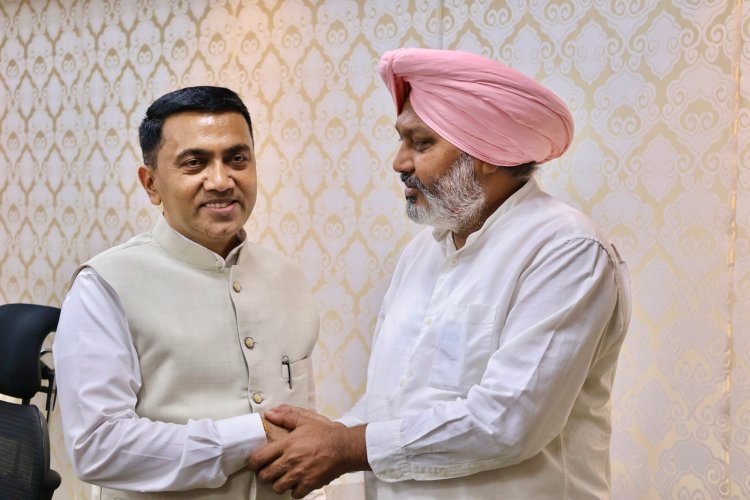
Presenting a comprehensive and concise overview of the state’s revenue after the implementation of GST on July 1, 2017, during the first meeting of the Group of Ministers on Revenue Analysis from Goods and Services Tax (GST) held in New Delhi, Punjab Finance Minister Advocate Harpal Singh Cheema stressed on bringing structural changes in the GST system and proposed policy recommendations to increase revenue, including inclusion of food grains under the GST structure, reduction or abolition of the inverted duty structure, and making e-way bill generation and e-invoicing mandatory, etc. He also suggested that an integrated platform be developed to provide access to all states and the central tax authorities for data analysis and detection of tax evasion and compliance issues. Referring to the significant revenue loss suffered by Punjab due to the subsumption of various taxes after the implementation of GST, Finance Minister Harpal Singh Cheema said that being an agrarian economy, Punjab was heavily dependent on purchase tax and infrastructure development fee (ID fee) on the sale of food grains (wheat and rice) and collected Rs 3,094 crore in 2015-16, which was 16.55% of its total tax revenue, and the subsumption of these taxes in GST resulted in a permanent loss in revenue collection for the state. He also drew attention to the loss incurred due to the abolition of Central Sales Tax (CST), which had contributed Rs 568 crore to Punjab’s revenue in 2015-16. Besides, Finance Minister Cheema said that revenue collections in Punjab were much higher during the VAT regime as compared to the GST regime. The Finance Minister also expressed concern over the persistently lower revenue growth rate of Punjab’s GST revenue since July 2017, compared to the revenue estimated based on a growth rate of 14% in the base year. He said that if GST had not been implemented, Punjab’s revenue position would have been even better with a CAGR growth rate of 10%. He said that Punjab has faced a revenue loss of Rs 47037 crore since July 1, 2022 due to the implementation of the GST system.
He said that agriculture-dependent states, like Punjab, should be compensated for the permanent loss in revenue due to the abolition of purchase tax on food grains. Finance Minister Harpal Singh Cheema said that major industrial sectors of Punjab, such as agricultural implements, bicycles and bicycle parts, and hosiery goods, show high total turnover but do not show a proportionate increase in GST revenue. This is mainly due to GST being a destination-based consumption tax, due to which revenue flows out of Punjab through the provision of SGST input tax credit against IGST liability. Seeking policy intervention to reduce or abolish the inverted duty structure under GST, Finance Minister Harpal Singh Cheema said that due to this the state has to make a lot of returns while cash revenue receipts are low. He said that due to the inverted duty structure and exports, Punjab gets refunds worth about Rs 1,200 crore every year, which affects the revenue. Other recommendations include making e-way bills mandatory for tax evasion-affected goods irrespective of the threshold, mandatory e-invoicing for B2B supplies and B2C supplies for manufacturers, mandatory mapping of IP address with GSTN and e-way bills to track fraudulent taxpayers, and introduction of geo-fencing. Finance Minister Harpal Singh Cheema also advocated for the development of an integrated AI-based platform for data integration from various government portals for both central and state tax authorities, and mandatory biometric authentication for registered taxpayers before its implementation based on risk profiling. Finally, he also proposed to automate ITC claims in GSTR 3B forms, limit the claims to the amount available in GSTR 2B to reduce fraudulent claims. Finance Minister Harpal Singh Cheema concluded by saying that despite maximum efforts by Punjab to increase revenue collections, it is facing continuous challenges. He stressed on the need to consider including food grains under the GST framework to bridge the ongoing revenue gap, given the state’s landlocked and agrarian economy.