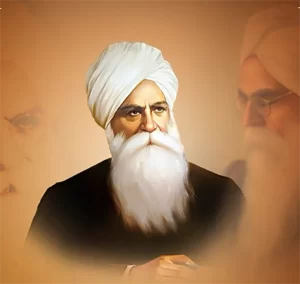

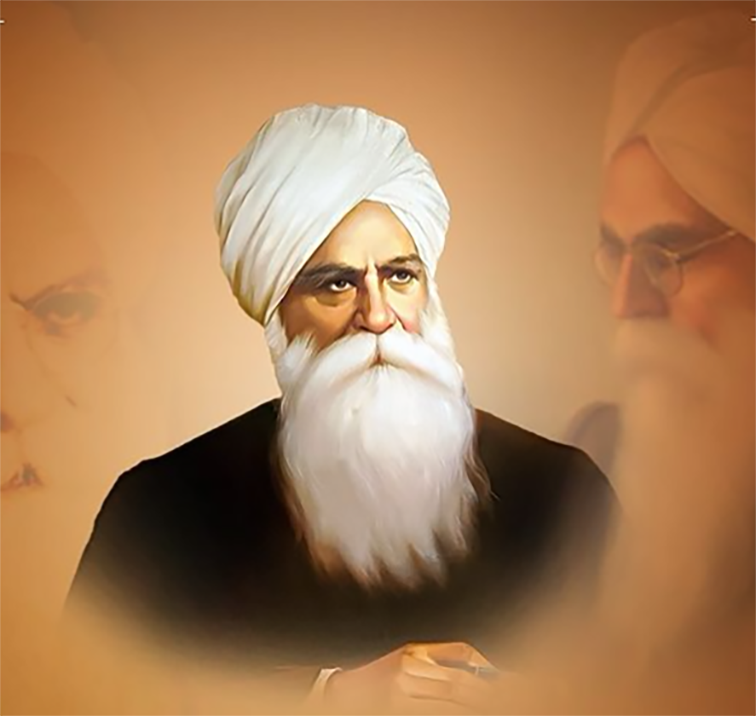
He is considered the father of modern Punjabi literature; because he is the first novelist, playwright, epic poet, great poet of short poems, journalist and many more, but he can also be easily placed in the category of Sikh historians. This is easily proven by the ancient texts and other efforts edited by him. He considered these texts essential for the research of history, selected them and edited them in a suitable manner. Puratan Janamsakhi, Sikhs di Bhagatmala, Prachin Panth Prakash, Malwa Desh Rattan di Sakhi Pothi and Gurpratap Suraj Granth are such texts. Out of these, Puratan Janamsakhi and Prachin Panth Prakash are such texts, whose names were kept by Bhai Vir Singh, and are still being followed in the same form today.
Bhai Vir Singh felt that although other subjects are taught in other colleges, the material related to Sikh history has neither been preserved nor has this history been written in a scientific manner. For this work, his attention was drawn to Khalsa College, Amritsar. Khalsa College was the leading institution of the Sikhs and its management committee included many influential and wealthy Sikhs. He inspired the then president Sundar Singh Majithia and Harbans Singh Attari etc. to open a Sikh History Research Department at Khalsa College, Amritsar. Bhai Vir Singh not only inspired but also provided some funds for the initial expenses. At that time, Karam Singh Historian was doing research on Sikh history, who was traveling and collecting oral Sikh history from old Babas. On the recommendation of Bhai Ji, Karam Singh Historian was appointed in the Sikh History Research Department, but he passed away soon. Later, Dr. Ganda Singh continued to do research on the same post from 1930-1949 AD and then Kirpal Singh was appointed in 1950. With the efforts of Bhai Ji, some grants were also approved for this work from the Punjab University, Chandigarh and the Punjab Government. He continued to take personal interest in the research work being done by this department. In 1947, Punjab was partitioned and the Sikh population had to migrate across the Wahgi. The Sikhs suffered a lot in this partition. Several lakhs of people were killed. Bhai Vir Singh, realizing the severity of this tragedy, assigned Prof. Kirpal Singh and Ganga Singh Beri the task of meeting the victims and the affected people and recording their stories of suffering and pain. Prof. Kirpal Singh did a lot of work in this direction and this work came out in the form of his first two books, Atrocities and Martyrs of the Muslim League. Realizing the scope and need for more work on this subject, Prof. Kirpal Singh continued it and also got it registered as the subject of his doctorate at Punjabi University, Patiala. He also went to London to collect more information. He met military officers, bureaucrats and other responsible officers, recorded their statements and made an effort to reach the truth. This and his research work related to this subject is found in the book ‘Partition of Punjab’. The Punjabi version or translation is, in fact, the form of his research system written in English.
Bhai Vir Singh’s contribution is not limited to this, but he wrote the forewords to the books of many of his contemporary historians and praised their work. He encouraged and inspired the famous historian Bawa Prem Singh Hoti to do this. The reason was that Bhai Sahib met Hoti ji on the occasion of a Sikh educational conference. Prem Singh Hoti took Bhai ji along to show him Peshawar, Multan, Bannu and other places. Seeing Hoti ji’s information, Bhai Vir Singh inspired him that the Sikh kingdom had ended only a short time ago, which is why many monuments are still standing. Why don’t they write Sikh history? It was the result of this inspiration and enthusiasm that Prem Singh Hoti joined this side. Today, more than a dozen books on Sikh history by Bawa Prem Singh Hoti are available, many editions of which have been published. Apart from Hoti ji, Dr. Ganda Singh’s book ‘Banda Bahadur’ and the book ‘Fatehnama Guru Khalsa Ji Ka’ edited by Sita Ram Kohli are the adornments of these books. ‘Fatehnama Guru Khalsa Ji Ka’ is a historical treatise written by Ganesh Das Pingal, which contains a reliable account of the battles fought by Maharaja Ranjit Singh at different times. At the beginning of this Fatehnama, there is a ten-page introduction written by Bhai ji, in which he has evaluated the research work done by Sita Ram Kohli. In the words of Bhai Vir Singh, fortunately, the hard work of Shri Ganesh Das Ji fell into the hands of a historian who is truly well versed in history. Being endowed with a deep knowledge of history over a long period of time, when you took this book in your hands, you did full justice to it too, that is, you edited this book with full literary effort by spending a lot of time and effort. It has been edited in such a convenient way that no other preface is needed for Ganesh Das Ji’s work. Similarly, many books on Sikh history written in English, Punjabi, Urdu and Persian by Sita Ram Kohli are available. Inspired by this enthusiasm, Sita Ram Kohli also edited Shah Muhammad’s Jangnama (War Shah Muhammad), which is considered the best among the editions till date and is a part of the curriculum of many universities.