
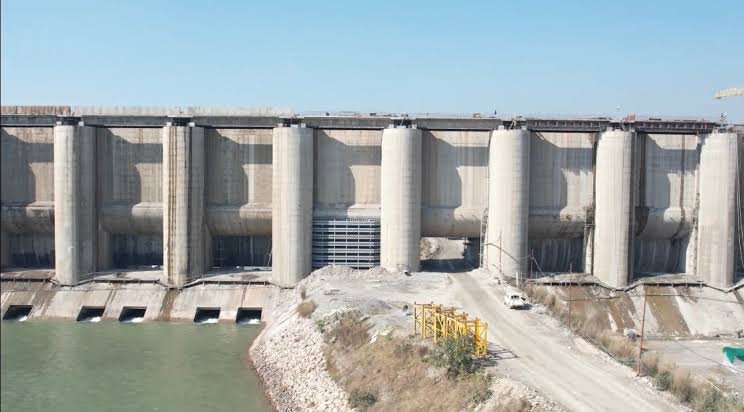
Located on the Punjab-Jammu and Kashmir border, this development marks a significant shift in water sharing, with the Jammu and Kashmir region now set to benefit from the 1150 cusecs of water previously earmarked for Pakistan. The diverted water will serve irrigation purposes, providing a boon to over 32,000 hectares of land in Kathua and Samba districts. Despite facing several challenges over the past three decades, the Shahpur Kandi Barrage project, essential for irrigation and hydroelectricity generation, is on the verge of completion.
Under the 1960 Indus Water Treaty between India and Pakistan, India has exclusive rights over the waters of the Ravi, Sutlej and Beas rivers, while Pakistan controls the Indus, Jhelum and Chenab rivers. The successful implementation of the Shahpur Kandi Barrage will give India the right to make maximum use of the waters of the Ravi River, diverting the previously allocated resources from the old Lakhanpur Dam to Jammu and Kashmir and Punjab.
Former Prime Minister PV Narasimha Rao had laid the foundation stone of the Shahpur Kandi Barrage project in 1995. However, the project was suspended for more than four and a half years due to disputes between the governments of Jammu and Kashmir and Punjab. In 2024, Prime Minister Narendra Modi, while addressing a rally, promised to ensure efficient use of the waters of the Sutlej, Beas and Ravi rivers for Indian farmers. He stressed India’s legitimate claim to these waters and the need to stop their wastage in Pakistan. A task force was later set up to ensure that every drop of water from these rivers reaches Punjab and Jammu and Kashmir.
India has undertaken several water management projects, including the construction of Bhakra Dam on the Sutlej, Pong and Pandoh Dams on the Beas, and storage facilities like Thein (Ranjitsagar) on the Ravi. These initiatives, along with projects like the Beas-Sutlej Link and the Indira Gandhi Nahar Project, have enabled India to utilize almost its entire share (95%) of water from the eastern rivers. However, about 2 million acre feet of water from the Ravi River continues to flow unused downstream to Pakistan from Madhopur. With the completion of the Shahpur Kandi Barrage, India is poised to utilize these water resources, which will boost agricultural and economic development in Jammu and Kashmir and Punjab.
The Indus Water Treaty (IWT), signed in 1960 under the auspices of the World Bank, is a landmark agreement between India and Pakistan regulating the use and sharing of the Indus River system. While India retains full control over the waters of the eastern rivers – Ravi, Sutlej and Beas, Pakistan enjoys unrestricted use of the western rivers – Indus, Jhelum and Chenab. The treaty’s provisions enable India to set up storage facilities on the western rivers, further enhancing its water management capabilities.