
The BJP government led by Prime Minister Narendra Modi has completed 11 years. While this period is full of stories of development, the government is also surrounded by allegations from the opposition. The BJP calls it a ‘golden journey’, but the opposition parties raise questions by calling it a ‘jungle of jumlas’. During this time, the disillusionment with the government in the Sikh community of Punjab also deepened, the main reasons for which are the agricultural laws, communal disputes, and ignoring the problems of the state and the Sikh community.
Achievements of the Modi government
According to BJP national president J.P. Nadda, the Modi government took the country to new heights with historic decisions. Steps like the abrogation of Article 370, ban on triple talaq, Citizenship Amendment Act (CAA), women’s reservation, and demonetization are said to be the big victories of the government. Nadda says that economically, India is the fourth largest economy in the world today. PM The Awas Yojana has provided 4 crore pucca houses, the Ujjwala Yojana has provided 10 crore gas connections, and 50 crore people have received free healthcare under Ayushman Bharat. The Jan Dhan Yojana has connected crores of people to banking, while the Ram temple in Ayodhya has become a lifeline and ‘Operation Sandhur’ has strengthened Modi’s image as a tough leader. ISRO’s space achievements, more than 125 Vande Bharat trains, expansion of the metro, doubling of the number of airports, toilets in 12 crore homes, and piped water in 15 crore homes—all these are the primary achievements of the Modi government, which have given a new direction to India’s infrastructure.
Opposition’s allegations against the Modi government
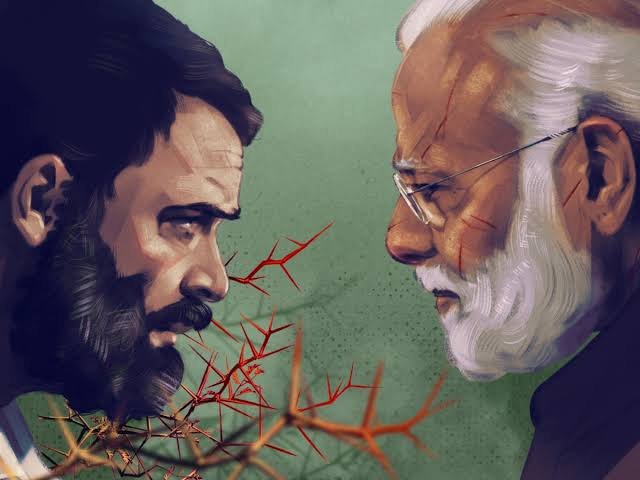
The opposition parties, including the Congress, call the Modi government a ‘government of jumlas’. Rahul Gandhi says that the government has failed to solve inflation, unemployment, and the problems of farmers. Calling demonetisation an ‘economic disaster’, the Congress claims that it increased unemployment instead of stopping black money. The Covid pandemic has further aggravated the economic crisis. According to the Congress, 71% of the government’s 906 schemes failed, and 2.25 crore beneficiaries were delisted from the PM Kisan Yojana. The opposition parties have also accused the government of creating communal divisions in society. The opposition parties believe that the BJP considers the construction of the Ram temple as historic, but dissent has increased among minorities, especially the Muslim community. According to Rahul Gandhi, the violence in Manipur, terrorist attacks, and the return of more than 600 Indians to the US have raised questions about the government’s security policy.
BJP’s micromanagement
The loss of 63 seats in the 2024 Lok Sabha elections taught the BJP a lesson. The party has emphasized micromanagement. As a result, governments were formed in Maharashtra, Haryana, and Delhi, seats increased in Jammu and Kashmir, and only Jharkhand suffered a defeat. For the 2026 assembly elections, the BJP has started preparations in West Bengal, Assam, Tamil Nadu, Kerala, and Puducherry. Modi and Amit Shah’s visits, the alliance with AIADMK in Tamil Nadu, and attempts to target the Mamata government in West Bengal are examples of this.
Why is the Sikh community not satisfied with the Modi government?
The main reasons for the disillusionment of the Sikh community in Punjab with the Modi government are—farm laws, communal disputes, unemployment, drug problem, and unfair distribution of water from Punjab’s rivers. The 2020-21 farm laws created resentment among farmers, which the government withdrew, but could not win the trust of the farmers. Punjab, which is the ‘breadbasket’ of India, has suffered economic losses due to water distribution. The shared water sharing of rivers is considered a violation of international riparian law, which has weakened Punjab’s agricultural economy. Attempts to link the sacrifices of Sikh Gurus with ‘defense of Hinduism’, linking the martyrdom of the younger Sahibzadas with ‘Children’s Day’, and anti-Sikh propaganda on social media have increased the resentment against the Modi government in the Sikh community. The non-predominance of Punjabi language in schools, disputes over religious Sikh shrines, and incidents like sacrilege have increased the resentment in Sikh minds. The wounds of the 1984 anti-Sikh massacre and the release of Sikh prisoners still remain as they are. Although the government has punished some of the culprits, the Sikh community has not received complete justice.
The government needs to take concrete steps to overcome the frustration of the Sikh community. Industrial development in Punjab, establishment of agro-industry information technology hubs (like Bengaluru or Noida), and creation of job opportunities for the youth can reduce the problem of unemployment and drugs. Fair distribution of water from Punjab’s rivers should be ensured. Farmers’ livelihood can be secured by considering legal recognition of Minimum Support Price. Sikh sentiments can be respected by giving prominence to Punjabi language in schools, independence of Sikh religious institutions, and strict action on incidents like sacrilege. Labelling of Sikhs like ‘terrorism’ needs to be stopped.
Greater representation of Punjab in central politics, and recognition of Chandigarh as the full capital of the state can reduce political discontent.
The government should start an open dialogue with the Sikh community, Akal Takht, and farmer organizations. Timely steps will have to be taken to provide complete justice to the victims of the 1984 massacre. If the government takes Punjab’s problems seriously, respects Sikh sentiments, and builds trust through dialogue, then despair can be turned into possibilities.It can come.