
In the south of this state is the Karaidhar mountain range, which separates the Jasrota state from the Bajohli, Bhadu and Mankot states to the north. To its east is Lakhanpur, to the south is the plains and to the west is the state of Samba. The capital of the Jasrota state is the city of Jasrota, after which the state and the dynasty here got their name. The city of Jasrota is situated on the southern side outside the Karaidhar mountains. The state of Jasrota was a prosperous state during the rule of these kings. The land of this state area was very fertile as it was right next to the plains and it was natural for Jasrota to be powerful.
The Jasrota dynasty, like other princely dynasties, was originally from the royal family of Jammu. This early princely state of the 13th century seems to be the oldest of the small hill kingdoms. Bhuj Dev was the last king of the undivided state of Jammu. He had four sons, the eldest of whom became the founder of the Mankotia dynasty, the second became the king of Jammu, the third ‘Karan Dev’, for whom the territory of Jasrota was left, became the king of the new state by merging the territories of the kings adjacent to Jasrota. Later, due to the city of Jasrota being made its capital, the name of this dynasty came to be Jasrota and the name of the state came to be Jasrota. Since the foundation of Jasrota was laid by Jas-dev, it was named Jasrota.
There is nothing in Sanskrit literature about Jasrota, but it is mentioned twice in the Muslim history of Akbar’s time, which shows that this state always had some connection with Jammu. In the books Akbarnama and Ma’sih-ul-Usar, it has also been one of the two major rival hill states of the Mughal Empire.
This state originated during the 13th century and till 1834 it had a total of twenty-seven kings one after the other. No specific information is available about the early history of this state. The names of Karam Dev, Bir Dev, Kalu-Dev, Amil Dev, Balar Dev, Kalas Dev and Pratap Dev etc. are found among the early Jasrota kings. Due to some differences between Raja Pratap Dev and his brother Sangram Dev, the territory of the state of Jasrota was divided into two parts, as a result of which a new state came into existence. The capital of this state was established in ‘Lakhanpur’ and due to this the name of the state was also Lakhanpur. The western boundary of Lakhanpur was considered to be the tributary of the Ravi river ‘Ujj’. Forts were built on a hill at Lakhanpur and Thein for the residence of the king. Therefore, this state is also called Thein state somewhere in the contemporary history of Raja Sangram-Dev. The ruins of the forts built at both these places are still present.
After Pratap Dev, Jatar Dev, Atar Dev or Atal Dev, Sultan Dev, Sagat Dev, Daulat Dev and Bhabu Dev ascended the throne as kings. Among them, Raja Bhabu Dev is said to have been a rival king during the time of Akbar. During the year 1588-89, all the hill states from Jammu to Jaswan revolted, but this revolt was suppressed. About 6 years later, these same kings revolted again, led by Raja Bhabu. The royal forces captured Jammu after a long struggle. After this, it moved towards the east and at the place of Samba, Raja Balabhadra of Lakhanpur and Raja Bhabu of Jasrota had to lay down their arms. After this, to capture Jasrota and also, the Mughal forces had to put up a good fight with the sons and relatives of Raja Bhabu and a fierce battle took place.
After Bhabu Dev, Bhuj Dev, Fateh Dev, Tej Dev, Shiv Dev, Jagdev, Sukhdev and Dhruva-Dev came in succession. No special incident is known about them either. Then came Kiral Dev and Ratan Dev. Ratan Dev was a contemporary of Raja Ranjit Dev of Jammu (1750 AD).
It is estimated by historians that with the decline of Mughal power by the first half of the 18th century, Punjab was occupied by Ahmad Shah Durrani and like the hill states like Basohli, ‘Jasrota’ also came under the control of the Jammu kingdom to a large extent. During the latter half of the 18th century, the Sikhs started moving towards this state. In turn, the hill chiefs also offered to fight in their wars as mercenaries. In this way, the Sikhs established their foothold in these states as well. From 1744 to 1783, Jasrota and Chamba, Basohli and Jammu were attacked by the Sikhs. Historians believe that among the invaders who occupied Pathankot, the chiefs of the Ghanaiya Misl attacked first. During this time (until the beginning of the 19th century), Bhag Singh, Ajaib Singh and Lal Singh sat on the throne of the Jasrota state. By 1801, Ranjit Singh became the Maharaja of Punjab and in 1808, when he advanced towards Jasrota, the Jasrota chiefs offered tribute with patience and accepted the subordination of Sher-e-Punjab Maharaja Ranjit Singh. Similarly, the rest of the states also came under the control of the Sikh power. Maharaja Ranjit Singh appointed his prominent chief Desa Singh Majitha as the Nazam of the hill region. Basauli, Bhadu and Mankot areas also came under his control. At this time, the king of Jasrota was Ranbir Singh, after whose death, as he had no son, his younger brother Bhuri Singh became the king. He was the last king of the Jasrota dynasty and remained completely under the Sikhs.
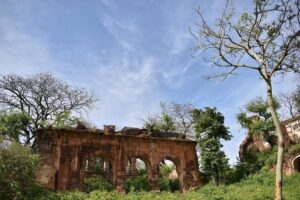
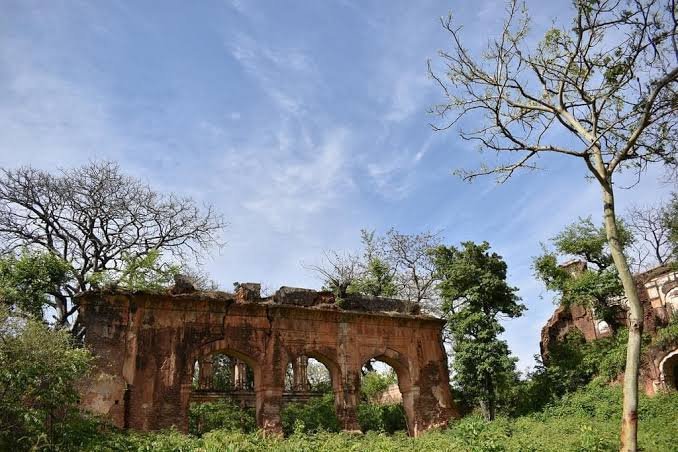
In 1828, Maharaja Ranjit Singh appointed Hira Singh, son of Sikh minister Dhian Singh, as the king and gave him the Jasrota state as a fiefdom. Hira Singh rebuilt the old fort on the Jasrota hill. Built with Nanakshahi bricks, this fort offers a beautiful glimpse of 18th and 19th century Sikh architecture.
A large gate of the fortThe fort, which is now almost collapsed, shows its grandeur. Going ahead of it, there are many ruins and then a large pond and on its banks the ruins of a royal palace are present which show the beauty of this fort even today.