
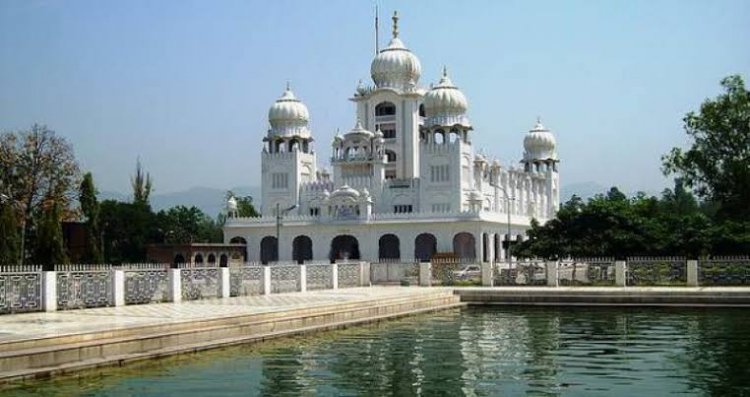
The seventh Guru, Shri Harrai Sahib Ji, was the son of Baba Gurditta Ji and the grandson of Sri Guru Hargobind Sahib Ji. His mother’s name was Mata Nihal Kaur. He was born on 19 Magh Sammat 1686 (16 January 1630) at Kiratpur in the present district of Ropar, Punjab. In 1640, he married Bibi Sulakhni Ji, daughter of Bhai Daya Ram of Anup Shahar, Bulandshahr district of Uttar Pradesh. He was a very pious and pious person. Sri Guru Hargobind Sahib Ji named him Shri Harrai Aap. According to the light shed on various aspects of his life in the Sikh Dharma Vishwakosh published by Punjabi University, Patiala with the references of various historians, it is written in ancient texts that once he was returning home after a horse ride. He saw from a distance that Sri Guru Hargobind Ji was sitting in the garden. He immediately got down from his horse and went and paid homage to the Guru Ji. In his haste, his cloak got caught in a bush and thus some flowers broke off the branch. This hurt Harrai Ji’s heart. He sat there and started crying loudly. Sri Guru Hargobind Ji came and consoled him. The Guru Ji advised him, “Dress however you like but be careful while walking. It is expected of the servants of God that they should love everyone.” Thus, the Guru Ji’s words had deep meanings. A man should live in this world but at the same time should keep complete control over himself.
Sri Guru Hargobind Ji had come to know that Sri Harrai was the most suitable person to attain Guru Jyot. The Guru appointed him as his successor and before his death on 3 March 1644, he applied the tilak of Guruship to him.
Sri Guru Har Rai Ji continued to live the luxurious life started by Sri Guru Hargobind Ji. He had 2200 armed Sikhs but he did not have any conflict with the government. He established three preaching missions called ‘Bakhshishans’ to propagate the Bani of Sri Guru Nanak Dev. The first was Bhagwan Gir which was renamed Bhagwan. The second was Sangatiya which was renamed Bhai Pheru and which propagated Sikhism in Rajasthan and South Punjab. Sri Guru Har Rai Ji sent Bhai Gonda to Kabul, Bhai Natha to Dhaka and Bhai Jodh to Multan for preaching. The ancestors of the present Bagrian and Kaithal families preached in the Malwa region. Sri Guru Har Rai himself also traveled a lot in this area and many people became Sikhs through his preaching. A poor boy Phool was blessed by Sri Guru Hargobind Ji and later he became the founder of Patiala, Nabha and Jind. Till the present day these families have ruled in their respective areas in Punjab.
Kiratpur was the permanent residence of Guru Har Rai Ji. Sikhs and pilgrims used to come here to seek blessings and teachings. Guru Ji continued his daily routine like his predecessors. The institution of Langar flourished further. He used to eat simple food which he earned by working with his own hands. In the mornings he used to sit in the Sangat and explain the Sikh principles. He did not compose any Bani himself but in his discourses he used to give examples from the Bani of the previous Gurus. He often used to repeat the following stanza from Bhai Gurdas’s Vaars ((XXVIII.15)):-
Last night, I woke up and gave him the name of the Lord.
Speaking sweetly, walking with your hands, you will be happy.
Eating a little, speaking a little, you will understand the Gurmat.
Eating a little, I will become rich, and I will not be able to count myself.
Singing in the company of saints, I will sing every night.
I will spread the word of the Lord, I will spread the word of the Lord.
I will be disheartened in hope.
5
Guru Har Rai was at Goindwal when Dara Shukoh, the heir to the Mughal throne, fled from the army of his brother Aurangzeb after being defeated in the Battle of Samugarh on 29 May 1658. He reached Goindwal in the last week of June 1658. He came to see Guru Har Rai and requested his blessings. The prince was of a religious nature and naturally enjoyed the company of saints. He was a particular admirer of the famous Muslim Sufi Mian Mir who had contact with the Sikh Gurus. Sikh tradition relates how Dara Shukoh was once cured of a fatal disease by a medicine prepared from herbs sent by Guru Har Rai. Therefore, he did not miss the opportunity to see the Guru in this hour of his distress. According to Saroop Das Bhalla’s Mahima Prakash, Guru Har Rai Ji stationed his army at Pattan to delay Aurangzeb’s army, which was rapidly pursuing Dara.
Guru Har Rai Ji visited the central districts of Punjab where Sikhism had gained a firm footing due to the preaching of his previous Gurus. He went as far as Kashmir. He celebrated Baisakhi of 1660 at the house of Nand Lal Puri, grandfather of Haqiqat Rai Shaheed, in Sialkot. The journey continued in the company of some Sikhs, such as a Lubana Pawari Makhan Shah and Aaru Ram. Aaru Ram’s son Kirpa Ram Dutt later accompanied Kashmiri Pandits and came to Guru Tegh Bahadur Ji against the royal oppression. Guru Har Rai Ji reached Srinagar on 19 May 1660 after Martand and also went to Mota Tanda. Makhan Shah was a resident of this village. On his way back, he stayed at Akhnoor and Jammu. Local Masand Bhai Kah in Jammu
He did not attend with a company.
The meeting of Guru Har Rai Ji with Dara Shukoh was wrongly reported to Emperor Aurangzeb. The stories were conveyed to him with great spice. His officers and courtiers told him that Guru Har Rai was a rebel and had also helped the fugitive prince Dara. In addition, they told him that there were verses written against Islam in the (Guru) Granth Sahib. The emperor asked Raja Jai Singh of Amber to bring Guru Har Rai Ji to Delhi. The king’s envoy Hari Chand reached Kiratpur on the day of Baisakhi in 1661 and delivered the royal summons. Guru Har Rai Ji accepted the summons and according to the Sri Gur Pratap Suraj Granth of poet Santokh Singh, he said, “I do not rule over any territory, nor do I owe any tax to the emperor, nor do I have to take anything from him. There is no relationship between us, even between Guru and Sikh. Then what will be the benefit of this meeting?” Therefore, Guru Ji sent his elder son Ram Rai in his place and sent him with Diwan Dargah Mall to help him. According to the Guru Kiyan Sakhis, Guru Har Rai Ji blessed his son. When he sat in the vehicle, he gave him the following advice: “Answer the questions asked by the king clearly and clearly without any fear. Do not show any hesitation of any kind. Wherever you stop on the way, recite the Granth with your mind. Wherever you are, the Guru will protect you.” He ordered Gurdas of Bhai Behlo’s family to take the Bir of the (Guru) Granth with Ram Rai. To please the king, Ram Rai deliberately recited verses from the Guru Granth Sahib incorrectly. The Sikhs who had accompanied him reported this to Sri Guru Har Rai Ji, who cursed Ram Rai because he had recited the Bani of Guru Nanak Dev Ji. The Guru ordered Ram Rai not to bow his head, so he went to Dehradun. Guru Har Rai Ji chose his younger son Harikrishna as his successor and handed over the Guruship to him before his death at Kitarpur on 6 October 1661.