
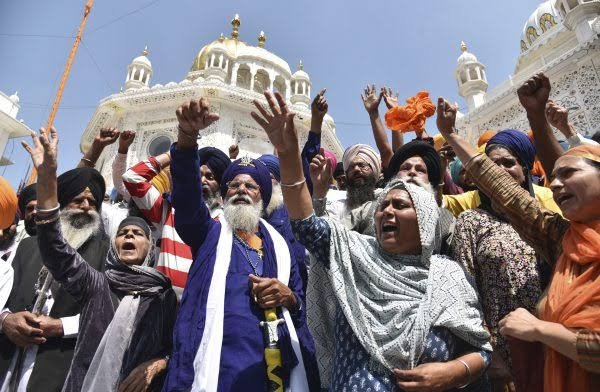
At present, the Sikh community is looking politically weak in Punjab. Therefore, all the Panthic parties need to engage in dialogue with each other and really consider this and come up with an actionable agenda for their sovereignty so that Sikh politics can stand on its own feet. The current division of Sikh politics into divisive groups seems to be pushing the Sikhs towards a deep abyss, far from the concept of ‘Raj Karega Khalsa’. This is not a matter of Akali politics alone, but of the entire Sikh politics. The historical truth is that the Sikh leadership of 1948 and 1966, which was visibly the Akali leadership, kept fighting for the Punjabi state, because after the independence of the country, it was not possible within the constitutional framework to demand a state with a Sikh majority. Therefore, a state was demanded on the basis of the Punjabi language, which was also within the constitutional framework and also increased the proportion of the Sikh population. It is noteworthy that during the partition of India and Pakistan, the Sikhs suffered a lot and were also the victims of a large number of massacres. But one of the advantages of this was that they gathered in a part of Indian Punjab.
In fact, at the time of independence, there were more than 500 states (princes) in India, how to merge them into the Indian Union was a big question, which was solved to a large extent by the diplomacy of the then Home Minister Vallabhbhai Patel. But due to the emergence of the issue of creating language-based states in the country, in 1948, a 4-member commission was formed under the leadership of retired judge S.K. Dhar. But this commission opposed the demand for creating states on the basis of language. After this, a Joint Parliamentary Committee consisting of Pandit Jawaharlal Nehru, Vallabhbhai Patel and Patta Sitaramayya was formed to find a solid basis for the reorganization of the states. It also did not support the creation of language-based states. After this, the Telugu speakers started the agitation. In 1952, Telugu leader Potti Sriramlu fasted for 52 days and died. The agitation took a violent turn. Forced, the Centre made Andhra Pradesh the first language-based state in 1953. After this, agitations in favor of language-based states intensified in other states as well. On December 19, 1953, a 3-member commission consisting of Justice Fazal Ali, Haridya Nath Kunjru and K.M. Panicker was formed. According to the report given by this commission after the investigation, although a total of 844 languages are spoken in India, 91 percent of Indians speak only 14 languages. Therefore, this commission recommended the creation of 14 language-based states. After this, many new states came into existence on the basis of language, but the demand for Punjabi state was not accepted. After this, under the pressure of the movement initiated by the Shiromani Akali Dal, Punjabi Suba was created in 1966, but not only the capital of Punjab, dams, Punjabi-speaking areas were excluded, but by adding completely absurd sections 78, 79, 80 in the Punjab Reorganization Act, the central government took many kinds of powers into its own hands, which it did not have constitutionally.
However, this was a serious blow to Punjab and the Punjabis, but the Sikh leaders were also happy inwardly about one thing that although this state had become small, it was becoming a state with a complete Sikh majority. The Hindu leaders of Punjab at that time and the Hindu press were strategically attacked by the Akali leaders. They should have encouraged Hindus to write their mother tongue Punjabi by campaigning in favor of Punjabi for Hindu interests, so that there would be no Sikh majority in Punjab, but they did the opposite and encouraged most of the Punjabi-speaking Hindus to write their mother tongue Hindi.
It is noteworthy that in the 1991 census, Sikhs were 59.71 percent and in the 2011 census, 57.69 percent, but now when the new census is conducted, it is estimated that Sikhs will be in the minority in this Punjab as well. One estimate is that their number may be between 40 and 48 percent. There are many reasons for this, the main reasons being the increasing population of migrants in Punjab, Punjabis becoming migrants themselves, conversion of Dalit and religious Sikhs, etc. Family planning has also been adopted more by the people of the Sikh community. Therefore, the population of Sikhs in Punjab is sure to decrease in the coming time. The first thing is that the Sikhs are divided into parties like AAP, Congress, BJP and Akali Dal. The second thing is that the split in the Akali Dal, which calls itself the representative of the Sikhs, and the situation of fighting and mutual hostility by forming many Akali Dals is also responsible for the decline in the political influence of the Sikhs.
Even on the occasion of Maghi, a new Akali Dal (Heir of Punjab) has been formed under the leadership of Lok Sabha members Bhai Amritpal Singh and Bhai Sarabjit Singh. In the meantime, although the leaders of the Akali Dal who broke the reform movement are still insisting on implementing the December 2 decision in full by meeting the Jathedar Sri Akal Takht, but from the kind of information that is being received and the kind of twist that the situation is taking, it seems that this party will also eventually move towards forming a new Akali Dal. Although this party wanted Giani Harpreet Singh, the Jathedar of Takht Damdama Sahib, to lead them, but according to information, Jathedar Harpreet Singh is still preferring to run the Panthic movement away from active politics.
In these circumstances, there are chances of the political leadership of this potential Akali Dal being handed over to Gurpartap Singh Wadala or former minister Surjit Singh Rakhra or Ravinder Singh. While this Akali Dal is considering handing over the leadership of the religious wing for the Shiromani Committee elections to Bibi Jagir Kaur.
It is clearly believed that among the Sikhs, that Akali Dal Only the one who wins the Shiromani Committee elections emerges. It cannot be ruled out that after the Shiromani Committee elections are announced, all the anti-Badal Akali Dals will collectively ask Jathedar Giani Harpreet Singh to lead them in the religious field. A meeting has been held between Baba Sarabjot Singh Bedi and Jathedar Harpreet Singh to jointly build a Panthic movement. Baba Bedi Singh Sahib is in favor of uniting Giani Harpreet Singh with Bhai Ranjit Singh so that the religious wing can be strengthened. Religious conversions can be stopped. The tragedy is that at present, all the Akali Dals are in a state of war, the issues of the nation do not hold much importance for them. What is needed is ideological unity.