
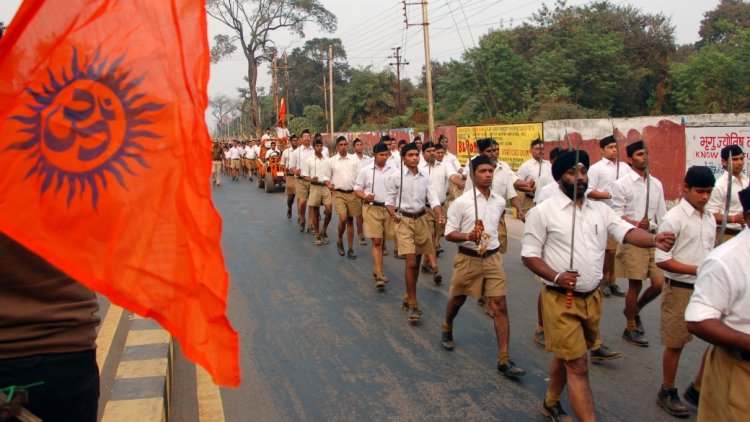
Karnataka Chief Minister Siddaramaiah has decided to ban RSS branches in government school complexes, public grounds and other government lands. The decision has been taken on the application of Minister Priyank Kharge, who has termed the radical ideology of the RSS as a threat. The Karnataka government is considering banning RSS activities in public places as the organisation is working against the provisions of the Constitution and its workers are spreading unrest among children and youth, which is threatening the unity and integrity of India.
Chief Minister Siddaramaiah has asked Chief Secretary Shalini Rajneesh to investigate the matter and take appropriate action after a letter from IT/BT Minister Priyank Kharge. He said that RSS workers are showing their sticks in public places without any permission. Kharge’s letter comes at a time when RSS is celebrating its centenary, when thousands of RSS volunteers took out a padyatra on the occasion.
The opposition BJP has objected to this issue and the minister’s letter and has termed it as an attempt by the Congress to divert public attention from the fall of the regime and to hide the internal power struggle going on within the party over the post of Chief Minister.
BJP state president B. Y. Vijender said that there is not a single instance of indiscipline by RSS workers and it remains a strong nationalist force, but the Congress is deliberately defaming this organisation. He said that the Congress had banned this organisation two-three times before, but it had to be withdrawn.
It is worth mentioning here that the democratic parties have been accusing the RSS of spoiling communal relations for a long time. The organisation’s ideology is based on Hindu nationalism, which spreads hatred towards minority communities like Muslims, Christians, Dalits and Adivasis. History shows that RSS was banned thrice in independent India – after the assassination of Mahatma Gandhi in 1948, when the organisation was found involved in anti-Muslim violence; during the Emergency of 1975, when it was banned for anti-democratic activities; and after the demolition of Babri Masjid in 1992, when its role in communal riots came to light.
These bans were clearly imposed because of the RSS’s racism, hatred towards Muslims, a mentality that justified atrocities against Dalits and other minorities, and policies that marginalised tribal groups. The ideology propagated in the organisation’s branches has sometimes given rise to violent incidents, such as the Gujarat massacre or the recent ‘love jihad’ propaganda, which instills fear among minority communities. Political experts believe that such gatherings on government properties are pushing the youth towards radicalisation, which is a threat to pluralistic India. Siddaramaiah’s directive is a positive step in this direction, which reinforces the spirit of the Constitution.
The RSS has long been accused of not having contributed to India’s freedom struggle. Historians and critics claim that since its inception in 1925, the RSS supported British rule and distanced itself from the freedom movement. The organisation is known for its Hindu nationalist ideology, under which it focused on Hindu organisation and social reform rather than the freedom struggle. For example, RSS founder Keshav Baliram Hedgewar preferred ‘nation building’ over active participation in the freedom movement, which many see as implicit collaboration with British interests.
Scholars such as historian Ramachandra Guha have written that the RSS did not participate in major anti-British movements such as the Swaraj movement or the Quit India movement. On the contrary, the organisation targeted the Muslim community in its publications instead of criticising the British rule, which encouraged racism and communalism.
In addition, the RSS’s stance towards the Constitution of India has also been controversial. When the Constitution of India came into force in 1949, the RSS rejected it, claiming that it did not reflect Indian culture and Hindu roots. The organisation’s mouthpiece, the Organiser, in its 30 November 1949 issue criticised the Constitution and described Manusmriti as a suitable system of governance for India. Such statements portrayed the RSS as opposed to secularism and constitutional values.
Another serious controversy has been over the tricolour flag at the RSS’s Nagpur main temple. For a long time, the RSS refrained from flying the national flag, the tricolour, at its main temple. By 2001, when the RSS started hoisting the tricolour under increasing pressure, the issue had become part of the national debate. The recent decision by Karnataka Chief Minister Siddaramaiah to ban RSS meetings on government land has brought these controversies back into the spotlight, raising questions about the organisation’s ideology and history.