

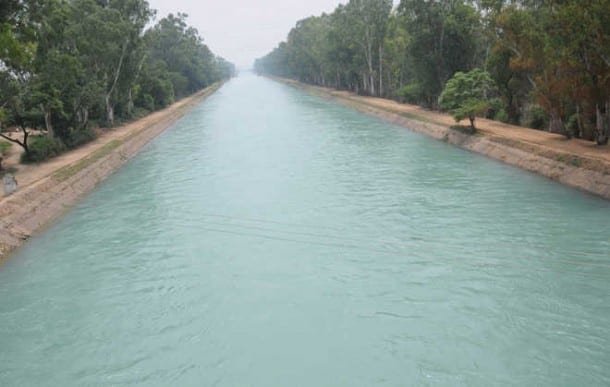
Immediately after the Pahalgam incident, the Indian government decided to suspend the Indus Water Treaty, which had been in force since 1960. At the same time, the leaders of the neighboring country started threatening war; although the world knows that both sides suffer losses in war. It is in the control of one party to start a war, but it is not in its control to stop it. Everyone knows that the war between Russia and Ukraine has gone from a few days to years. Punjab and Haryana have been embroiled in a dispute over water since 1966. Even during the farmers’ agitation, politicians tried to stir up this issue between the farmers of both the states, but the farmers sitting on the bridges of Delhi rejected this move. Now, instead of the farmers, this issue has become the issue of the entire population, that Haryana should be given more water for drinking from Punjab’s share on humanitarian grounds. The political parties of both the states have come together and passed resolutions in favor of their state. Look at the tragedy, the people of Haryana say – we will go to court to get more water than our share. The thing is, governments take up the issue of water whenever necessary to divert people’s attention from real issues.
When there is a clamor, every party has the same slogan – we will not give even a drop of water, but the question here is that 70 percent of Punjab’s water is already going out of the state, so where is the question of the drop left? At present, the 30 percent of water that Punjab has left irrigates only 27 percent of the area; the remaining 73 percent of the area is irrigated with water from tubewells, due to which the upper layer of groundwater has dried up and the water in the lower layer is only good for five to seven years. Justice demands that everyone should get drinking water, but water for agriculture or industries should be given priority where these rivers flow and even further where the production per unit of water is higher. Most of the water that is going to Rajasthan through the Rajasthan Canal is causing harm instead of benefit. The water that was given to the first phase of the canal first brought about the flooding, then to fix the flooding, trees were planted along the canal and forests were established. After this, billions of rupees were spent on putting plastic and concrete in the canal to stop seepage (water erosion). You will stop the seepage, but how will you stop it from evaporating at 45 to 50 degrees Celsius? Couldn’t this water have been transported through closed pipes so that the usable water increases and the remaining water is used only in the state where the water is being transported from. Thus, in the second phase of the Rajasthan Canal, water is being lifted 30-30 feet high by installing motors and released on the dunes. What technology can produce on sand dunes at 45 to 48 degrees Celsius? The biggest thing is, Haryana makes the most noise, but its area under irrigation with canals is 45 percent, while in Punjab only 27 percent of its area is being irrigated with canals. Similarly, Rajasthan, which occupies a large share of Punjab’s waters, also irrigates 25.08 percent of its area with canals. The tragedy is that all political parties do not mention the share given to Rajasthan, even though it cannot legally take even a drop of water. The central government and the state governments do not come to the conclusion that the rains have decreased, due to which the river water has decreased and the need for water has increased. The river water should be re-evaluated and the water should be redistributed according to the law and the state’s needs and the efficiency of water use. Everyone wants to strangle Punjab according to the decisions of 1955 and 1981 because vote politics teaches that do not settle any dispute, keep it hanging so that all parties follow. Leave aside politicians, even the guardians of the Constitution deviate from the law and suppress it. Flood: Every state needs water, but when the rain suddenly becomes more than necessary, these people get canals like rivers closed; the argument is given that the canals get damaged due to silt. If the water is released into the canals and distributed, then the loss to the people will be less. The houses of Punjabis collapse, the crops are destroyed, this is not considered a loss. Is it not the duty of the central government that all the states that benefit from water, together, should compensate the loss to the people of Punjab. It is not about the damage caused by small floods, it is about the damage caused by the release of water from the Bhakra Dam. The reason for the terrible flood of 1988 was that the time for filling the dam with water is till September 30 but the dam was filled to the brim before that; when heavy rains (634 mm) fell in the catchment area on September 23-26, the flood gates of the dam were opened, causing huge loss of life and property. Out of 12989 villages of Punjab, 9000 were flooded. Out of these, 2500 villages were completely destroyed. 34 lakh people were affected. In the year 1993, 25 lakh people were affected in 44 cities/towns and 4741 villages. Crops were damaged in 15 lakh acres of area. The same thing happened in 2023. Punjab on the brink of desertification: Currently, 73 percent of Punjab’s area is irrigated through tubewells, due to which water is being extracted from 76 percent of Punjab’s blocks, due to which the water level is going down by one meter every year. According to the 2022 report of the National Green Tribunal, if the same trend continues, then by 2039 the water level will go below 300 meters (984 feet). Although the water level is currently 30-50 meters, farmers have dug boreholes up to a depth of 200 meters to get good water. If the water level