
CP Radhakrishnan got 452 votes, while Justice Reddy could get only 300 votes. The ruling NDA alliance won this election with a clear majority. But the biggest discussion of this election was not the victory of CP Radhakrishnan, but the decision of the Akali Dal (Badal) and the Waris Punjab group led by Amritpal Singh to boycott the election. This boycott once again made Sikh politics and the problems of Punjab a topic of discussion at the national level.
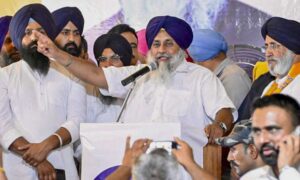
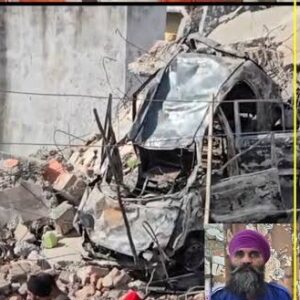
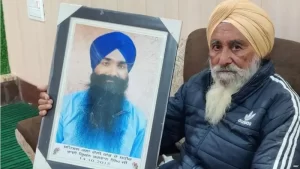
The Akali Dal (Badal) and the Waris Punjab group decided to boycott the Vice Presidential election in protest against the current problems of Punjab and the attitude of the central government. Bapu Tarsem Singh Khalsa, father of Waris Punjab MP Amritpal Singh, who is currently under house arrest, clarified that this boycott was done in protest against the “betrayal” of Punjab. They raised the serious problems caused by floods in Punjab and the non-release of Sikh youths despite completing their sentences as the main issues.
The Akali Dal (Badal) also joined the boycott, saying that the problems of Punjab, especially the farmers’ issues, the release of Sikh prisoners and the demand for an economic package for the state, have been ignored by the central government. Moreover, the Akali Dal believes that by participating in the Vice Presidential election, they will become indirect supporters of the policies of the ruling coalition, which is against their political stand.
The question of whether the decision to boycott was right or not remains a matter of controversy among Sikh politicians and intellectuals. On the one hand, the Akali Dal and the supporters of Waris Punjab believe that the boycott was a right way to raise the issues of Punjab and the Sikhs at the national level. They argue that unless the central government takes Punjab’s demands seriously, participating in such political processes is a waste of time. In particular, the Waris Punjab group believes that ignoring the detention of young leaders like Amritpal Singh and the demand for the release of Sikh prisoners is a violation of Sikh sentiments.
On the other hand, many Sikh intellectuals and political analysts believe that the decision to boycott could prove politically damaging. They say that by not participating in the Vice Presidential election, the Akali Dal and Waris Punjab have reduced their political influence. A section of Sikh intellectuals believes that by voting in the election or supporting the opposition candidate, Punjab’s issues could have been raised forcefully in Parliament. The boycott completely excluded the voice of Sikh politics from the parliamentary process, which could be politically damaging in the long run.
It is worth mentioning here that the NDA alliance won a clear victory in the Vice Presidential election. CP Radhakrishnan’s victory proved that the ruling alliance has a strong hold in Parliament. This victory not only strengthened the NDA politically, but also exposed the weakness of the opposition’s unity. The boycott of the Akali Dal and the Punjab heirs further reduced the opposition’s strength, making the NDA’s victory easier.
The decision to boycott the Akali Dal and the Punjab heirs was a political strategy to highlight the problems of Punjab, but questions arise about its success and impact. If Sikh politics is to be strengthened at the national level, active political engagement and dialogue are needed. Steps like boycotts can have an immediate impact, but in the long run, Sikh politics needs to intervene in politics. Active participation in the political process can be the right way to resolve problems like Punjab’s demands, release of Sikh prisoners and floods.