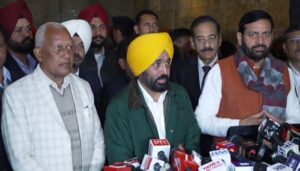


The two factions that were part of the Shiv Sena, led by Uddhav Thackeray and his cousin Raj Thackeray respectively, came close after 20 years. During a joint rally in Worli, Mumbai, the heads of these two parties, Uddhav Thackeray and Raj Thackeray, were seen on the same stage. This development in Maharashtra politics is being watched with great interest not only in Maharashtra but also in political circles across the country.
The controversy that started in the name of Hindi language in the state provided a big opportunity for the two brothers to come together. A few months ago, the (Mahayuti) coalition government led by Maharashtra Chief Minister Fadnavis decided to implement the three-language formula in the state in the name of implementing the New Education Policy-2020 and issued a notification to make Hindi compulsory in government schools in Maharashtra from the first class.
This was strongly opposed in Maharashtra and Shiv Sena (UBT) and Maharashtra Navnirman Sena (MNS) were seen very active among the opponents. These parties are not against the teaching of Hindi but were against making Hindi compulsory from class 1. They also threatened to launch an agitation against it. Keeping this in mind, the Maharashtra government withdrew the decision to make Hindi compulsory from class 1 and constituted a committee to formulate a policy in this regard. Shiv Sena (UBT) and Maharashtra Navnirman Sena (MNS) termed it as their big victory. In this context, a victory rally was organized by these two factions of Shiv Sena in Worli on July 5, which received good support from the people.
Speaking on this occasion, Raj Thackeray said that what Balasaheb Thackeray could not do, the state Chief Minister Fadnavis did by issuing instructions regarding Hindi. They said that they are coming together to protect the interests of Marathi language and Marathi people against the decision of Fadnavis government to impose Hindi in the state. Both their parties will fight the Mumbai Municipal Corporation elections and other local government elections in the state together and they will also struggle together to get power in Maharashtra in the future. The coming close of Shiv Sena (UBT) and Maharashtra Navnirman Sena (MNS) is certainly a big development, but how much support it gets from the people in the upcoming Mumbai Municipal Corporation elections and other local government elections, this will decide the future of these two parties and their top leaders Uddhav Thackeray and Raj Thackeray respectively. Undoubtedly, this will definitely have an impact on the political equations of Maharashtra at this time.
If we look at the current political situation of the country, after Hindi speaking regions, the Bharatiya Janata Party is seen rapidly increasing its influence in non-Hindi speaking regions as well. Although the BJP had hoped to win more than 350 seats in the 2024 Lok Sabha elections, it managed to win only 240 seats and Prime Minister Narendra Modi had to seek support from the Janata Dal (United), Telugu Desam Party and Lok Janshakti Party (Ram Bilas) to form his government. But after the Lok Sabha elections, the BJP made a strong comeback in the assembly elections held in New Delhi, Haryana and Maharashtra and has succeeded in forming governments in these three states as well, although it did not get the expected success in the Jharkhand and Jammu and Kashmir assembly elections. Now the BJP is eyeing the Bihar assembly elections to be held this year and the West Bengal elections to be held next year. The BJP has already started preparations for the assembly elections in these states. The BJP is making special efforts to increase its influence in non-Hindi speaking states, where regional parties are particularly strong. The current BJP president J.P. Nadda had clearly declared during one of his visits to Bihar that BJP is also trying to politically eliminate regional parties.
This makes it clear that BJP is not only targeting the old national party Congress, but also regional parties of different states. Every party has the right to expand its political base. There is nothing objectionable in this, but the objectionable thing is that BJP’s autocratic political style is not only dangerous for democracy, secularism and federal structure, but also a big challenge for communal harmony in the country. BJP is continuously playing the game of communal polarization, due to which bitterness is continuously increasing between the two major communities of the country, Hindus and Muslims. This is not only causing a great harm to peace and harmony within the country, but it may also give opportunities to anti-India forces active in the country and abroad to gain a foothold in India. Its economic policies also serve the interests of big corporates. Regional languages, regional cultures are also considered by the BJP, especially the Rashtriya Swayamsevak Sangh, as a threat to its Hindutva-based nationalism. In these circumstances, if regional parties have to maintain their relevance, they will have to work continuously to strengthen regional cultures, regional languages and regional autonomy (federal structure).
In this context, the old and prominent regional party of Punjab, the Shiromani Akali Dal, also needs to rethink its politics and strategy. It has been out of power since the 2017 assembly elections and its performance has not been better in all the elections that have been held since then. At this time, people
It has only one MP in the state and although it had won 3 seats in the Punjab Vidhan Sabha elections, only 1 MLA (Ganeev Kaur) is with it. In the recent by-election from Ludhiana West, its candidate Parupkar Singh Ghuman (8203) could get only 8203 votes and his deposit was forfeited. After the death of Aam Aadmi Party MLA Kashmir Singh Sohal from Tarn Taran, the Akali Dal will have to face another by-election. There too, considering the ongoing discussion of more than one Akali faction contesting the by-election, there is a possibility of disappointment for the Akali Dal (Badal). There is still about a year and a half left for the Vidhan Sabha elections. Considering the way the Akali Dal is currently divided into different factions, it does not yet seem that it will be able to re-emerge by then and play any important role in the state politics. Although the recruitment committee formed by Sri Akal Takht Sahib is claiming to strengthen the Akali Dal by completing the recruitment process in a transparent manner, there are already talks of a tussle starting within it for the presidency.
The Akali Dal is not only marginalized in the political arena, but it has also lagged badly in the religious politics of the Sikh Panth. Its influence in the administrative board of Takht Sri Hazur Sahib has significantly diminished. It no longer has any authority over the Delhi Sikh Gurdwara Management Committee. There is a sharp clash between the administrative committee of Takht Sri Patna Sahib and the Singh Sahibs of Punjab led by Giani Baldev Singh, the acting Jathedar of the Takht there, and Kuldeep Singh Gargaj, the current Jathedar of Sri Akal Takht Sahib. Both the Takhts are calling each other’s associates as “salaried persons”, and Akali Dal (Badal) President Sukhbir Singh Badal has also been called “salaried persons” by the Panj Pyares led by the acting Jathedar of Takht Sri Patna Sahib. Such a shameful incident has hardly ever happened in the religious history of the Sikh community. The differences between the Shiromani Gurdwara Parbandhak Committee and the newly formed Gurdwara Parbandhak Committee in the neighboring state of Haryana, Punjab, continue. After taking over the work of the historical Gurdwaras of Haryana, the Haryana Gurdwara Committee is now showing activity to take over the Shahbad Markanda Medical College. This college, built by the Shiromani Gurdwara Parbandhak Committee, is currently being run by a trust and this trust is financially supported by the Shiromani Committee. The Haryana Gurdwara Committee wants to take control of it on the pretext of making it a university, which may further increase the conflict between the Shiromani Committee and the Haryana Gurdwara Committee in the coming days. At present, there is neither a major political figure in the Sikh community who can bring all the Akali factions together on one platform or in one organization, nor is there a major religious figure in the Sikh community in the religious field who can create a working relationship between Takht Sri Hazur Sahib, Takht Sri Patna Sahib, Haryana Sikh Gurdwara Management Committee and Delhi Sikh Gurdwara Management Committee for the common religious interests of the Sikh community despite political differences.
The current political situation in the country and the religious concerns of the Sikh community demand that Sikh leaders from Punjab and outside Punjab, leaving aside their personal interests and their egos, come together on one platform to discuss and find a way for mutual unity and harmony. In this context, they also need to learn a lesson from the incident of Shiv Sena (UTB) and Maharashtra Navnirman Sena leaders Udham Thackeray and Raj Thackeray respectively coming together on a platform after 20 years of bitter rivalry. If the leaders of the Akali Dal from different factions succeed in creating such an understanding, then not only can the marginalised Akali Dal make a comeback, but a way can also be found to resolve the religious disputes that have arisen in the Sikh community.