
This independence gave birth to a new country, Pakistan, for the Muslim community by dividing the country on religious grounds. During the partition, the states of Punjab and Bengal were divided. Muslims were displaced from India, especially from the states of Punjab and Bengal, and they were forced to migrate to Pakistan. People of Hindu-Sikh religions from Pakistan were forced to leave their homes and come to India. The transfer of population due to this partition had created a terrible tragedy. Historians have written research-based books and articles about this tragedy and more research is also going on about it. In these researches, information is found about the depth of this tragedy and its causes are being identified. Original literature about this has been written in English and some of its translations have become available in Punjabi. After the passage of a quarter of a century, historical writings based on facts have got a chance to gain a foothold, leaving behind sentimentality. The making of secret records public by governments is bringing new evidence and arguments to light. This helps in understanding the tragedies that have occurred and opens up avenues to prevent them in the future.
In this context, the book ‘Vand Di Akath Katha’ written by Joginder Singh Toor, Lokgeet Prakashan Mohali (2025, price Rs. 400) makes a significant addition to Punjabi historiography. This book has been written focusing on three points. These are: (1) An eye-witness account of the atrocities committed on both sides during the transfer of population during the partition of the country; (2) Historical information about the events in the background of the partition of the country and the reasons for the partition; and (3) Details of the inclusion of 565 princely states in the country at the time of independence. In this regard, the author has recorded details about these three aspects with the help of documents.
The author has started the book with the understanding of the Mughal and British rulers about the Indians. It is recorded that before and after the arrival of the Mughals, India was divided into many kingdoms. Apart from this, the people were also divided into religious communities and castes. Due to these differences, they lacked the understanding and capabilities of the wise. Due to this, raiders came here, committed massacres, looting and oppression and seized power. The British rulers, starting from Bengal, defeated the princely states one by one and occupied the entire country including Burma/Myanmar. They made treaties with 585 princely states in the country and brought them under their control. In this context, an attempt has been made to understand the division of the country.
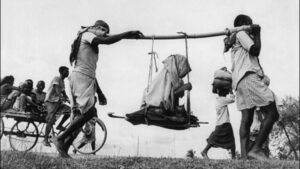
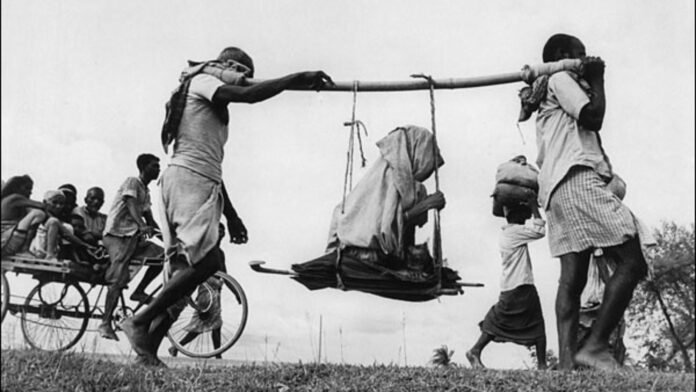
Chapters 2-4 of the book describe the suffering witnessed and experienced by the author. At the time of the partition of the country, the author was studying in the 5th standard at the age of 10. According to him, several months before August 1947, he had heard about leaving the village due to the independence and partition of the country. But as August approached, after communal riots reached the neighboring villages, Muslims started attacking Hindu-Sikh villages. In the author’s village too, it was heard about Muslims from neighboring villages forcibly taking away buffaloes and bulls from the wells of Hindu-Sikhs. During one incident of this bullying, a Muslim attacker was injured and captured when the Sikhs of the village confronted him. Due to this, the atmosphere against Hindu-Sikhs around their village intensified even more. Which was also visible in the general behavior of the young Muslim children of their village. Despite the assurance of support from the Muslims of the village, they soon became unable to stand up to the communal forces in the neighboring villages and those Hindu-Sikh families were advised to leave the village. It was only because of the sympathy of the Muslims of the village that the author’s family and some of his relatives were informed in advance about the possible attack on the convoy gathered in the nearby market and it was possible to save them. They escaped and entered independent India through the border of Ferozepur. The families who were victims of partition were forced to stay in refugee camps after returning home after being looted. After coming to India, I saw that the same thing had been done to Muslims by the Hindus and Sikhs. Innocent people were killed, women were robbed of their dignity and raped. Innocent children were killed. The houses of the opposing communities were looted and religious places were burnt. The naked dance of violence continued unabated for several months and the British government did not make much effort to stop it. This violence was stopped immediately after the Muslim Leagues or the Congress came to power in Pakistan. The story of the life of Baga Pehalwan, narrated by the author, beautifully describes this phenomenon from both sides.
The majority of the book (Chapters 5-43) describes the history of the British Raj, identifies the reasons for the partition of the country and describes the related processes. According to the author, the seeds of the partition of the country were sown during the second and third decades of the 20th century. In 1913, Rahmat Ali and some other Muslim students studying at Cambridge University in Britain proposed to create Pakistan in northwestern India by merging the Muslim-majority states of Punjab, Kashmir, Balochistan and Sindh. Savarkar, the leader of the Hindu Mahasabha, laid the foundation for the theory of two nations based on religion by presenting the theory of Hindu Rashtra in 1923. Earlier in 1922, Lala Lajpat Rai had proposed the idea of forming a Hindu Mahasabha to counter the Muslims and later Savarkar became its president. Lala Lajpat Rai had proposed the partition of Punjab and Bengal on the basis of religion in 1922. He wrote an article in the Tribune newspaper and published this suggestion in 1924.
It was repeated in 1935. After three round table conferences, the Government of India Act was passed in 1935, in which seats were reserved for religious communities (Muslims and Sikhs). It was accepted by the Congress and the Muslim League. This encouraged religious differences in the country. At that time, although the secular Ghadar movement, worker/peasant movements and the Communist Party spread in the country, religious differences only increased instead of decreasing.
The British had recognized the separate religious identity of Muslims in 1909 and legally accepted it by reserving seats for them. Under the Government of India Act 1935, before the elections held in 1937, a formula was decided by the parties that after the elections, all religions would be given due space while forming the government. This was in accordance with the Lucknow Pact of 1916 between the Congress and the Muslim League. But after the elections, when the Congress was more successful, it kept the capable leaders of the minorities away from the key positions in the states of Bihar and Bombay on this basis, because the majority of the winning candidates were Hindus.
In Punjab, the Unionist Party got a majority and the Muslim League got only one seat. Earlier in 1930, the Muslim League had passed a resolution demanding a separate country based on religion, Pakistan.
The phenomenon of the Congress party removing the capable leaders of the minorities from the key positions solidified the idea in the minds of the Muslim Leaguers that even after independence, the Congress would not allow Muslims to become partners in power by seizing power on the strength of the majority Hindu votes. The support of the Muslim League’s demand for a separate Pakistan by the Communist Party of India from 1942-43 helped to strengthen the idea of the partition of India at a critical time.
The independence movement in the country was gaining strength in the 1940s and the British felt that they would not be able to rule here for much longer. At the same time, the demand for a separate country, Pakistan, was also gaining strength. At such a time, the British rulers had started internal discussions about separating Punjab, Sindh, Balochistan and the Frontier Province from India to fulfill their long-term interests and making Pakistan. This is called the ‘Great Power Game’ of Britain. They felt that the leaders of the Congress Party would not become their pawns after independence by remaining under the yoke of Britain, but the leaders of the Muslim League could depend on them. They could maintain their dominance in Central Asia by making the newly proposed country (Pakistan) a ‘frontline state’. This had two objectives: (1) To establish military bases in this region to prevent the growing influence of the Soviet Union from spreading in the Indian subcontinent; and (2) to retain control over the mineral oil reserves in the Gulf countries. In view of the rapidly changing political situation in the country, the British government, despite the opposition of Mahatma Gandhi, had persuaded the Congress leadership to partition the country.
Before the decision to partition the country on communal lines, Muslim and Hindu organizations had prepared the ground for inciting the people and carrying out violent actions. That is why riots had started in the big cities of Punjab several months before the declaration of independence. Its impact had also started spreading to the rural areas. This has been mentioned in the chapters of Aap Handa Santapwale by Joginder Singh Toor. Before independence, the Unionist Party-led government had resigned in February 1947.
This created a political and administrative vacuum in Punjab at the time of partition. The British government made no attempt to fill this vacuum. At this time, the British officers and staff were leaving India, due to which the fire spread in the cities and villages had engulfed the whole of Punjab. Punjab had never seen and experienced such a naked dance of violence on this scale before.
The army and the administration did not intervene for many months, under the impact of partition, Punjab and its people became victims of deadly violence. This tragedy deeply hurt the Punjabi mentality and colored the concept of Punjabiyat in a communal color.
Joginder Singh Toor has tried to capture the tragedy, causes and process of partition with great effort and sensitivity. While writing the original book, he has made many new books and reports the basis of his writing. The detailed introduction of the book has been written by Dr. Swarajbir. It has been marked with historical and literary references that common people were involved in the incidents of massacre, rape, violence and arson during the partition. Muslim, Sikh and Hindu political leaders, the bureaucracy of every sect, kings and princes and local goons played an important role in carrying them out. Neither the governments nor the society have ever repented for these crimes.
Such violent elements were not even brought to justice and criticized. This phenomenon deeply damaged the collective heritage of solidarity in eastern and western Punjab. This process has continued even today on both sides of the Wagah Border after 1947. The author has unfolded the layers of this tragic history and given the message that such work should be done that can establish new standards of solidarity of Punjabiyat, as the farmers’ movement of 2020-21 did. This valuable book is worthy of the attention of Punjabi readers and history students, and is worth reading and considering.