

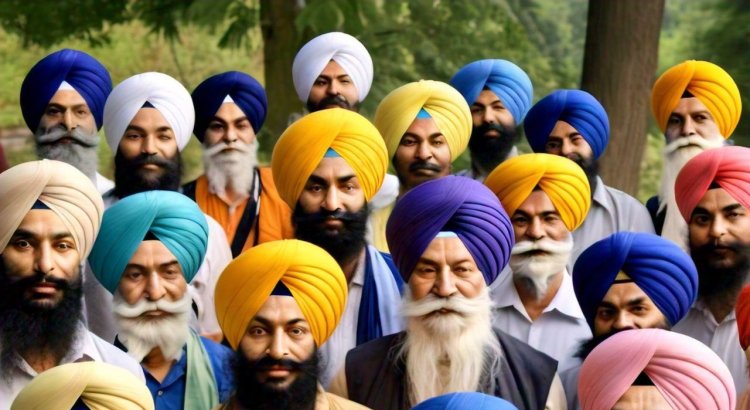
Sikh identity is also getting hidden in the dark layers of Western fashion, ignorance of the youth, and linguistic ignorance. The waves of Western culture are swallowing the mind and thoughts of the Sikh youth. The bright screens of social media, where fashion trends and the ink of tattoos are ruling the minds of the youth, are challenging the simplicity of Sikhism.
The Green Revolution of Punjab, which gave a golden color to agriculture, also brought a storm of cultural crisis. This storm took the form of pornographic films, vulgar songs, and addiction to alcohol, cigarettes and drugs which continues till now in the form of modernity and is swallowing the Sikh youth like a dragon. The youth of rural landlord Sikh families, who were earlier the standard bearers of the Guru’s blessed spirit, are today drowning in the lustful, obscene trends of depravity and social media. By dropping the names ‘Singh’ and ‘Kaur’, they are considering themselves ‘progressive’, but this so-called modernism is only an external gloss, like the shade of a tree without roots. Sikh youth living abroad are cutting their hair under the impact of social pressure and racism. This wave of Western fashion has challenged not only the face of Sikhism, but also its soul.
Punjabi language is the lifeblood of Sikhism. The hymns of Sri Guru Granth Sahib Ji, which are melodious in the Gurmukhi script, unite the hearts of Sikhs. But today, just as the water of a spring dries up, so too is the Punjabi language drying up. We are being separated from our existing Punjabi language. Urban Sikh youth consider English and Hindi as a sign of status. According to a study by Punjabi University, Patiala, Punjabi youth in urban areas feel ashamed to speak Punjabi. Professor Puran Singh had said, “Punjabi is the language in which the melody of the Gurus’ Bani is heard.” If this language itself dies, how will the melody of Sikhism live on?
The neglect of the Punjabi language is weakening the soul of Sikhism. When the youth abandon their mother tongue, they also move away from the philosophy and principles of Gurbani.
Gurdwaras are the source of Sikhism, but Sikh youth are turning away from the Sangat of Gurdwaras. The reason for this is not only the glamour of Punjabi pop culture, but also the songs that are polluting the souls of Sikh youth by promoting drugs, violence, and materialism. The principles of Sikhism—seva, simran, sangat—are fading before this poison.
The responsibility of resolving this crisis also falls on the Shiromani Gurdwara Parbandhak Committee (SGPC). It has not been able to give prominence to Gurmat education in Sikh schools, nor has it been able to open high-level schools with Sikh knowledge syllabus. The SGPC needs to connect the youth with the message of Sikhism by using social media and digital platforms. If the participation of Sikh youth in Gurdwaras is not limited to Sikh youth, then how will the glory of Sikhism return?
The Sikh Panth got rid of the political slavery of the Mughals, but the Brahminical cultural slavery and the new political slavery of the British Empire have gripped the Sikh identity. Just as a snake clings to the claws of a bird, so Sikh politics has become trapped in the cycle of temporary needs. Political control over Sikh institutions has weakened the ideological and spiritual strength of Sikhism. Government encroachment is taking place on Sikh institutions. Sikh history is being distorted by governments and by anti-Panth elements. Some Sikh camps are playing an anti-Sikh role in this. They are mixing the fundamentals and the gutkas in the Bani. The SGPC is not taking any notice. The collapse of ideal Sikh politics is the cause of this crisis. The desire of the political Sikh leadership is limited only to power. They have nothing to do with the Sikh crisis.
After the defeat of the Khalsa Raj, political fear has brought degradation in the hearts of the Sikhs. The failure of the militant movement has deepened this degradation. But Sikh history is a witness that whenever the Sikhs have challenged this fear, the light of their identity has been lit. The first condition for maintaining the spirit of Sikhism is that the Sikhs should not be slaves of anyone, nor should any force make them slaves.
The question of Sikh identity is not just about external symbols or language, but about ideological and spiritual basis. Sikhism is a civilization whose roots are in the teachings of Guru Nanak Dev Ji: service, justice, solidarity, equality, and truth. This civilization can embrace the entire humanity. But for this, the Sikh Panth will have to make organized efforts. The principles of Sikhism need to be reinterpreted according to the needs of today. There is a need for the use of social media, Gurmat education in Sikh schools, and social awareness to connect the youth. Sikhs should come together and perform Gurmat like in the times of Misls, just as in the olden days Sikhs used to face challenges with unity. The Sikh community will have to help each other to keep the pure soul of Sikhism alive. The crisis of Sikh identity is not new, but its solution lies in the soul of Sikhism, i.e. the principles of Guru Granth Sahib. The Sikh Panth will also have to come out of this crisis with ideological and spiritual awareness. To keep the Surat and pure soul of Sikhism alive, Sikhs will have to connect with their mother tongue, the Sangat of Gurdwaras, and the teachings of the Guru. If Sikhs can live a true life according to their principles, then the Sikh way of life can also become a fashion for the world. This is a time of challenges as well as opportunities for the Sikh community.