
After the martyrdom of Baba Banda Singh Bahadur and his fellow Sikhs, the Governor of Lahore, Zakaria Khan, put a price on the heads of the Sikhs and started killing them selectively. Realizing the seriousness of the situation, the Sikhs settled in the forests and started making organizational preparations there. The Sikhs of the area enthusiastically served the warriors living in the forests with langar and water. Bhai Taru Singh, a resident of village Poohla, district Amritsar (now Tarn Taran), was also one of these Siddiqui Sikhs. He was an agriculturalist and whenever he heard about the arrival of a Sikh group, he would get excited. His sister and mother would prepare langar with great love and Bhai Taru Singh would serve to deliver langar to the Sikhs of the group. Harbhagat Niranjaniya of Jandiala complained to Zakaria Khan against Bhai Taru Singh.
Zakaria Khan immediately sent soldiers to arrest Bhai Taru Singh. Bhai Taru Singh was taken prisoner and taken to Lahore and subjected to severe torture, but the Guru’s Singh continued to tolerate all kinds of oppressions of the government with a cheerful face:
Jim-Jim Singh was tortured by the Turks
Tim-Tim Mukh Singh Lali Awai (Ancient Panth Prakash)
Bhai Taru Singh was presented in the court of Zakaria Khan, where he was lured into converting to Islam. Seeing Bhai Sahib’s firm determination towards Gursikhism, the state ordered the execution of Bhai Sahib’s cases. On this, Bhai Sahib said that instead of separating the cases that are entrusted to my Guru, if you want to take my life, then I am ready. On this, the state called the executioner and gave the cruel order to remove Bhai Sahib’s skull. Bhai Sahib has achieved unique achievements for the nation by practicing Sikhism with all his heart. Thus, Bhai Taru Singh, laughing, shaved his head and said that his hair is dearer than life to the Sikhs. Thus, he attained martyrdom in 1745 AD.
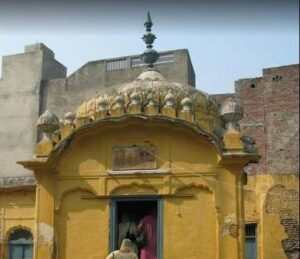
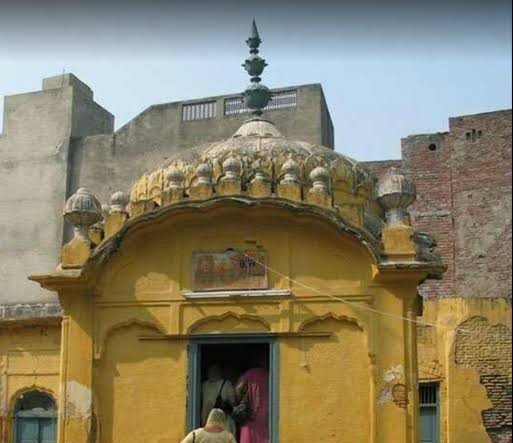
The death anniversary of the idol of benevolence, Bhai Taru Singh, will not be celebrated at the Samadh of Bhai Taru Singh, the martyrdom site in Lahore this time too. The road leading to the martyrdom site of Bhai Taru Singh, located in Naulakha Bazaar, just opposite the railway station in Lahore, was sealed by the Evacuee Trust Property Board 6 years ago. This place is still closed for the congregation of Pakistani Sikhs and foreign pilgrims and they are not allowed to go here, due to which there is a huge protest among the Sikh congregation. Suhail Butt, son of Salahuddin Butt, Raza Butt, Umer and the extremist group Dawat-e-Islami (Barelvi) have created a dispute to seize 4-5 kanals of land allotted by the Hindu Auqaf to the martyrdom site of Bhai Taru Singh and have permanently sealed this place. In Lahore, Pakistan, Gu. Shaheed Ganj Bhai Taru Singh and Gu. Shaheed Singh Singhnia are nearby. A mausoleum of Hazrat Shah Kaku Chishti has been built inside the premises of Gu. Shaheed Ganj Bhai Taru Singh in Lahore. The government has sealed the Gurdwara Sahib so that no untoward incident takes place.
The Sikh community had to struggle for a long time to get this religious place, the final settlement of which was made on 2 May 1940 AD. It is related to Gurdwara ‘Shaheed Ganj’ located in Landa Bazar, Lahore. It is built on the site where Nakhas Chowk used to be and where slaves and cattle were bought and sold. A mosque-like building was built here during the reign of Mir Mannu, where the Qazi and Muftis of the Mughal government used to sit and punish those who did not accept Islam. Thousands of Singhs, Singhanis and children were killed here. Bhai Taru Singh was also martyred here.
When the Dal Khalsa (Buddha Dal) gained power in Punjab, Gurdwara Shaheed Ganj was established here. After the Sikh rule, the Muslims claimed it as a mosque, and the Sikh Gurdwara Tribunal decided on 20 January 1930 that this place belonged to Gurdwara Bhai Taru Singh. Then the Muslims appealed to the High Court, which was rejected in 1934. As a result, the local Gurdwara Management Committee of Lahore acquired the possession of Shaheed Ganj in March 1935. The Sikhs started the demolition of the old building on 8 June 1935 AD, but on 29 June 1935 AD, a mob of Muslims tried to obstruct it. The Deputy Commissioner of Lahore stopped the work after seeing the situation. The Sikhs resumed work on 8 July. On 30 October 1935 AD, the Muslims again claimed to take possession of Shaheed Ganj, which was rejected on 25 May 1936 AD. The Muslims again appealed to the High Court, which was rejected on 26 January 1938 AD. After this, an appeal was made to the Judicial Committee of Prithi Kaushal, which was rejected on 2 May 1940 AD. This decision ended this struggle. But after the partition of 1947, the maintenance that should have been done to this great place could not be done. Even today, some Muslim forces are conspiring to occupy the vacant plot of 4 kanals adjacent to the tomb. The land on which the tomb of Shaheed Bhai Taru Singh and Gurdwara Singh Singhnia are established in front of it, all that land belongs to the tomb of Hazrat Pir Shah Kaku Chishti and the buried tomb of Shaheed Ganj.