
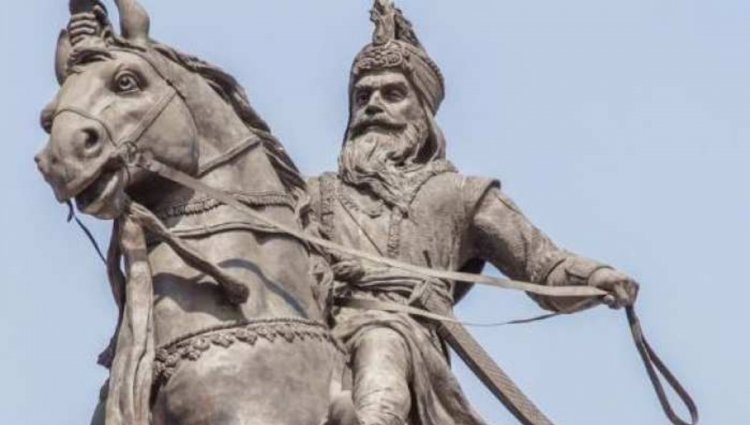
Amritsar, the main pilgrimage site of Sikhism and the cultural centre of Punjab, was once the capital of Sher-e-Punjab Maharaja Ranjit Singh. Maharaja Ranjit Singh had started the construction of a strong defensive wall in 1823 to protect the city and to counter enemy forces. This wall was made of Nanakshahi bricks, with a circumference of 5100 karams and a width of 25 feet. A 10-yard wide and 8724-yard long Dhurkot (raw wall) was also built inside it, filled with sand. The responsibility of constructing this wall was entrusted to Desa Singh Majithia and Lehna Singh Majithia, while Afsar-e-Imarat Ganesh Das and Mistri Mohammad Yar Khan played a key role in its design and construction. During the time of Maharaja Sher Singh too, a huge amount of money was spent on repairing and expanding this wall.
According to historical documents, a total of Rs 7,00,000 was spent on the construction of this wall and Dhurkot during the time of Maharaja Ranjit Singh, while an additional expenditure of Rs 5,70,460 was incurred during the time of Maharaja Sher Singh. In total, the construction of this historic wall cost Rs 1,94,04,601, which is equivalent to crores of rupees in today’s time. This wall was not only a symbol of security, but also a living proof of the power of the Sikh Empire and the Virasat-e-Khalsa Raj.
Today, this protective wall has almost gone underground. Most of the wall has been destroyed due to the ravages of time, urbanization and government neglect. Only a few parts, such as the Hall Gate (Darwaza Ram Bagh di Deori) and the Sultanwind Gate near the Police Station B-Division, have survived in a dilapidated condition. In the name of preserving the remaining part of the wall on the Hall Bazaar side, the Cultural Resource Conservation Initiative Company of Delhi had built a police museum, but it remained closed after the museum was built.
This not only destroyed the old appearance of the wall, but also lost its historical significance. The condition of the remaining part of the wall near Sultanwind Gate is also heartbreaking. A temporary parking lot has been built along it, where vehicles are parked. The concerned departments, such as the Archaeological Department of the Punjab Government or the local administration, have not taken any concrete steps for its conservation or maintenance. This neglect is tantamount to desecration of Sikh history and the legacy of Maharaja Ranjit Singh.
The Shiromani Gurdwara Parbandhak Committee, the Shiromani Akali Dal, and other Panthic organizations have often raised their voices on Sikh matters. However, the silence of these institutions on the poor condition of the Amritsar security wall raises questions. The Shiromani Gurdwara Parbandhak Committee, which is responsible for the preservation of Sikh religious and historical sites including Sri Darbar Sahib, has not taken any campaign or initiative on this issue. Similarly, the Shiromani Akali Dal, whose government had earlier constructed monuments like Virasat-e-Khalsa, is also silent on this issue. Panthic organizations like Damdami Taksal, Akhand Kirtani Jatha, and Sant Samaj, which are active on Sikh issues, have also not raised any big voice for the preservation of this historical wall. It is clear from this that Panthic organizations are not conscious of Sikh heritage.
The Rajasthan government has taken several effective steps for the preservation of its heritage. World-class initiatives have been taken for the preservation and promotion of historical sites like Jantar Mantar, Hawa Mahal, and Amer Fort in Jaipur. The Rajasthan government has created special funds and policies to develop heritage sites as centers of tourism and cultural importance and this heritage is also a source of income for Rajasthan. In contrast, the Punjab government has not adopted any concrete policy for the conservation of the heritage of Sikh history, especially the protective wall of Maharaja Ranjit Singh. There could be several reasons for the negligence of the Punjab government, such as lack of government funds, priority of political interests, or negligence of the Archaeological Department. Such negligence has damaged important places of Sikh heritage. For example, the protective wall built by Guru Hargobind Sahib in 1619 has completely disappeared. Similarly, parts of the walls built by the Bhangi Misl and Ramgarhia Misl have also been destroyed.
The Punjab government needs to formulate a specific policy for the conservation of Sikh heritage. Immediate steps should be taken to preserve the remaining parts of the protective wall, which should include active involvement of the Archaeological Department, funding, and cooperation of local institutions. The government should initiate projects to develop the protective wall as a center for tourism and promotion of Sikh history.
Many of Maharaja Ranjit Singh’s heritage sites have been destroyed by the ravages of time and government neglect. For example, the Gobindgarh Fort in Amritsar, which was a symbol of the Maharaja’s power, remained neglected for a long time. Although it was developed as a tourist destination, its original historical appearance was greatly damaged. The British, after occupying Punjab in 1849, demolished several parts of the protective wall and built a new wall, which has damaged the original structure. After independence, there has been a lack of appropriate policies for heritage conservation even during the Congress and Akali governments.
The Punjab government needs to learn from the initiatives of the Rajasthan government and take concrete steps to preserve Sikh heritage.