

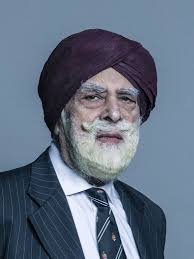
The talk of establishing a Sikh regiment in the British Army is not new. Recently, on 7 July 2025, Lord Inderjit Singh Sahota questioned the Defence Minister Lord Coker in the House of Lords about the possibility of forming a Sikh regiment. Lord Sahota argued that Sikh soldiers had set examples of bravery in the British Army during the British Raj. No one can forget the loyalty and sacrifices of the Sikhs in the First and Second World Wars. He said that the formation of a Sikh regiment would not only honour the Sikh heritage but also encourage Sikh youth to join the British Army.
Lord Coker, while answering this question, said, “Let me think about this matter. I am ready to meet you to discuss what more can be done to recognise the contribution of Sikh soldiers.” This response raised hopes among many Punjabis that the British government might be seriously considering setting up a Sikh regiment. But it is not that simple.
Defence Ministry Clarification: No Plans
As soon as this discussion hit the headlines, the British Ministry of Defence clarified that there are no plans to set up a Sikh regiment. Ministry sources said that setting up a Sikh regiment would violate Britain’s Equality Act. According to this act, no separate institution or regiment can be set up for any group on the basis of religion, race or caste, as it could encourage discrimination.
The ministry said that while there is a desire to recognise the services and contributions of the Sikh community, this does not mean that a separate regiment should be set up.
Lord Sahota argued more strongly against this response. He said that creating a Sikh regiment would not violate equality law, as the British Army already has several regional and cultural regiments. For example, there are organizations like the Brigade of Gurkhas, the Royal Yorkshire Regiment, the Royal Welsh, and the Royal Regiment of Scotland. “You don’t have to be Scottish to serve in the Royal Regiment of Scotland,” he said. “Similarly, the Sikh regiment will also have representation of Sikh culture, but it will not be limited to Sikhs.”
Sahota’s main argument was that the Sikh regiment would give Sikh youth an opportunity to join the army. They would be able to wear a turban, grow a beard, and proudly present their heritage. This would not only honor the Sikh community, but also strengthen Britain’s ties with India and South Asia.
Echoes of History: Military Service of Sikhs
The relationship of Sikhs with the British Army is not new. During the British Raj, Sikh soldiers played an important role not only in India but also in the world wars. In the First World War (1914-1918), about 1.5 lakh Sikh soldiers served in the British army, while in the Second World War (1939-1945), Sikh regiments also set examples of bravery on the fronts of Burma, Italy, and North Africa.
The talk of reviving this history always arouses enthusiasm in the Sikh community. Leaders like Lord Sahota believe that by establishing a Sikh regiment, this heritage can be connected to the new generation. Lord Inderjit Singh Sahota is the first Sikh peer in Britain and often raises the issues of the Sikh community in the House of Lords.
The UK Sikh Federation and other organizations say that the Sikh regiment will give Sikh youth an opportunity to stay connected to their identity.
When and how did the demand start?
The demand for a Sikh regiment is not new. It first came to the fore in 2007, when some leaders of the Sikh community raised it with the British government. Even then, the Ministry of Defence rejected the proposal citing the Equality Act. After this, the issue was discussed in 2015 and 2019 as well, but each time legal and administrative hurdles blocked the way.
The recent discussion came back to the fore with Lord Sahota’s question on 7 July 2025. This time, Lord Coker’s reply raised hopes that the government might give it serious thought, but the ministry’s clarification dashed that hope.
Discussions on the issue continue in the UK newspapers and on social media, but whether this dream will come true or not, only time will tell.
What efforts will the Sikhs have to make
The Sikh community will have to make efforts on many levels to establish a Sikh regiment. First, Sikh organizations will have to unite and put pressure on the British government. For this, they will have to advocate at the political level with leaders like Lord Sahota. To overcome the obstacle of the Equality Act, it will have to be proven with the help of legal experts that the Sikh regiment is not discrimination, but a respect for cultural heritage.
Secondly, it is necessary to gain public support through social media and newspapers. Awareness can be spread by highlighting the historical services of Sikh soldiers and explaining the importance of enlisting in the army to the youth. Thirdly, the policy of supporting cultural aspects like turban and beard will have to be emphasized by directly talking to the British Army. Finally, the Sikh community will have to continue the struggle to realize this dream with patience and continuous efforts.