
Punjab is a highly sensitive border state of India, which shares a 553-km border with Pakistan. The uniqueness of this state is also that the Sikh community lives in the majority here, just like Muslims in Jammu and Kashmir, and Christians in the four eastern states of Mizoram, Nagaland, Meghalaya and Arunachal Pradesh.
Chief Secretary: A political and administrative stab has been stabbed in the chest of Punjab through the Central Government’s Gazette Notification of January 2025. The Central Government has converted the post of Advisor to the Governor of Punjab, who is also the Administrator of Chandigarh, a Union Territory, into the status of Chief Secretary. This step opens the door to converting Chandigarh into a state and appointing a Lieutenant Governor here.
Timing: The BJP-led Narendra Modi government at the Centre has chosen a very opportune time to launch such an attack on Punjab. One, in the assembly elections to be held on February 5, 2025 in Delhi, the entire Bhagwant Mann government of the ruling Aam Aadmi Party, 94 MLAs, Chairman, entire party cadre have been defeated in Delhi. Bullies are looting after the bureaucrats. The government is missing from Punjab. Owls are talking in the secretariat. Second, the main opposition Congress party leaders, MLAs and party cadre have been defeated in the Delhi elections due to the instructions of the high command. Third, the Shiromani Akali Dal, which fights for the rights and interests of Punjab, is currently in a very shameful, unprincipled and extremely humiliating civil war for supremacy within the party. Fourth, the BJP and the BSP have been playing tricks on each other in such a situation. Fifth, the powerful party of Punjab, the farmers, are busy with their demands. The fast to death of farmer leader Jagjit Singh Dallewal has also become a matter of concern for the entire farmer community. So in such a situation of political violence, sabotage, and conflict, no one cares about Punjab. In such a situation, the central government has dealt an unbearable blow to almost eliminate Punjab’s claim to Chandigarh.
Policy: After independence on August 15, 1947, the black rulers of India adopted exactly the policy of their predecessors, the British white rulers, towards Punjab. On April 2, 1849, the British East India Company conquered the Sikh state in Punjab and brought it under its control. They knew that the Sikhs were a warlike nation, that they could rebel again, so to attract them towards agriculture, they laid a network of canals in Punjab and allotted large amounts of land to settle them in south-western Punjab. In 1907, the British also passed three black laws related to agriculture, which had to be withdrawn due to the violent ‘Turban Conservation Jatta’ movement. The state continued to support saints, mahants and deredars to keep the Sikhs religiously confused. The Sikhs had to make a great sacrifice through the Gurdwara Reform Movement. The Shiromani Gurdwara Management Committee on November 15, 1920 and the Shiromani Akali Dal on December 14, 1920 are the products of this.
After the country’s independence, the Indian Home Ministry, through a directive, called the Sikh community using abusive language as criminals and asked them to keep a close watch on them.
To keep the Shiromani Akali Dal, which represented the Panthic forces, politically confused, the Fazal Ali Commission was formed in 1953 to reorganize the states on the basis of language and culture. In 1956, on its recommendations, the states that were divided were given the first capitals to the parent states. The new states made their new capitals. Punjab was not divided so that the Akalis and Punjabis would be busy with it.
Kani Partition: Punjab and Haryana states were formed on November 1, 1966 under the Punjab Reorganization Act. Chandigarh would be kept as a Union Territory for 5 years and later given to Punjab as its capital when Haryana would make its own separate capital. The Centre took control of the head works of the rivers of Punjab. The division of waters was left hanging. This was also done on the basis of British policy to keep the Punjabis constantly confused on these issues and these issues were deliberately created under Articles 78, 79, 80 of the Reorganization Act, contrary to the Indian Constitution.
During the dark period of emergency in the country, the ‘Indira Award’ regarding Punjab waters, the ‘Stop the Canal’ regarding the Sutlej Yamuna Canal, the Kapoori Morcha on August 24, 1982, led to state and non-state bloodshed terrorism in Punjab, military attacks on 37 Gurdwaras including Darbar Sahib, Amritsar by the Indian state under Operation Blue Star, and the genocide of Sikh youth.
Conspiracies: Chandigarh was made a Union Territory and a Chief Commissioner was appointed for its administration. The first Chief Commissioner was Mahendra Singh Randhawa in 1966. Under this arrangement, the Deputy Commissioner of Haryana and the SSP of Punjab continued to be posted. The capital remained shared between Punjab and Haryana. 60 percent of the employees from Punjab and 40 percent from Haryana would be deployed for the administration of Chandigarh. Now, Punjab has only 2 percent. What a spectacle!
During the implementation of the June 84 massacre, the Governor of Punjab, B.D. Pandey was appointed as the Administrator of Chandigarh, which is still the case today. He was appointed as an advisor to him in place of the Chief Commissioner, who would help him in the administration of Chandigarh. This arrangement came into effect on May 1, 1984. On May 3, 1984, the first advisor, Lieutenant General Ranjit Singh Dayal, was appointed. Security was also under this. In fact, Punjab and Chandigarh were completely put under military rule. On the same day, the third Ghallughara Blue Star Operation was launched.
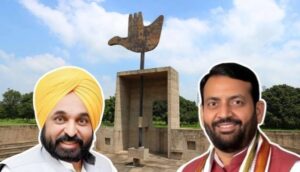
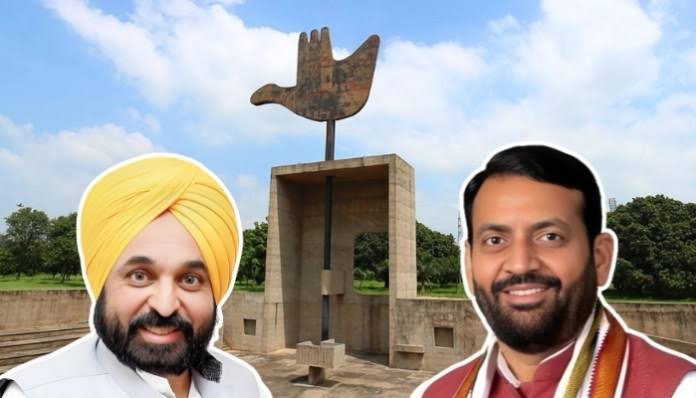
Chandigarh, a modern city built in 114 square kilometers under the planning by the French architect Le Corbusier, was merged with Punjab on October 7, 1953.
became the capital of. Before the partition of the country, the glorious capital of Punjab was Lahore. Chandigarh was built by destroying 27 Punjabi speaking villages, who does not know whose hand it was, it could not become the capital of Punjab after November 1, 1966, nor did the Punjabi language remain a Union Territory here.
Rajiv Longowal Agreement of July 24, 1984 was a historical deception of the Central Government with Punjab. According to this, Chandigarh was to be handed over to Punjab on January 26, 1986, the board was set up, the revenue record was changed, but at that moment, the anti-Punjab, genocidal Prime Minister Rajiv Gandhi refused, saying that since elections were held in some states, we will give it after three months. The weak and power-hungry then Chief Minister of Punjab, Surjit Singh Barnala, remained silent. When the writer told him in the Ropar Guest House that if he had resigned in protest on that day, his name would have been written in golden letters in the history of Punjab. He admitted this historical mistake to the writer. Now what should I regret…
On May 24, 1994, a Municipal Corporation was formed for the democratic administration of Chandigarh. The Panchayat system was introduced in it.
Haryana has shifted government offices to Panchkula and Punjab to Mohali on a large scale. Perhaps they have accepted that Chandigarh is becoming a Union Territory. The leaders of every party in both the states have looted the people and the states and have built warehouses of lands, properties, double and double houses in Chandigarh, Mohali, Panchkula, New Chandigarh. The same is the case with the bureaucracy, gangsters, big black businessmen.
The Modi government at the center has continuously confused Punjab badly. From October 11, 2021, 50 kilometers of the international border will be under BSF security instead of 15, giving 10 acres of land to Haryana for the construction of the assembly in Chandigarh, 12 acres in Panchkula (then why not the assembly building in Panchkula, just a kana in Tind) former governor Banwari Lal Purohit, at the behest of the center, has been the Punjab government and Punjabis.
During the President’s rule in Punjab, the status of the Chandigarh Police Chief was first raised to the status of the entire state, up to the DGP. Now appointing the Chief Secretary means the next step is the entire state. Congress MP Manish Tewari had promised the Chandigarhites the formation of the entire state and a separate assembly while contesting the elections. Now with what face is the leader of the opposition, Partap Singh Bajwa protesting? The Aam Aadmi Party is shaking dust from the Gonglu. The same is the case with Akali leader Sukhbir Badal. During the Akali-BJP government from 2007 to 2017, no one made a peep. If the Bhagwant Mann government was sincere, it would have immediately called an all-party meeting, called a special house of the Vidhan Sabha and passed a resolution to cancel the appointment of the Chief Secretary and put pressure on the Modi government. The all-party committee would have prepared a roadmap for the struggle until the Centre withdraws this order. Look! How does a camel sit?