
Meanwhile, what Vice President Jagdeep Dhankhar has said in front of Agriculture Minister Shivraj Singh Chouhan at an event of the Indian Council of Agricultural Research (ICAR) is certainly like a breath of fresh air. He appealed to the government to consider the farmers’ demand for Minimum Support Price (MSP) positively and said that our mindset should be positive? We should not create obstacles thinking that giving MSP to farmers will have bad results. Whatever price we give to farmers, the country will benefit five times… Those who say that giving fair price to our farmers for their produce will lead to disaster, I do not understand why? He clearly referred to the protesting farmers and said that these people need not be chased away, but embraced. Due to unnecessary obstacles being created at every step, the demands of the farmers remain unresolved for a long time. When Vice President Dhankhar, speaking his mind, asked the Agriculture Minister why the Centre was not talking to farmers, a kind of silence descended on social media. The trolls calmed down, as if a storm had passed. It was a storm. After all, these were the words of a person holding the second highest constitutional office in the country. Whatever the reasons may have been that prompted him (Dhankhar) to speak his mind, it has shaken the conscience of the country.
There are certainly some serious questions that need to be answered, but there are also some serious doubts that need to be dispelled first. These are difficult questions, but only a positive government response can dispel the growing restlessness, frustration and distrust. As a newspaper editorial aptly summed it up, when Dhankhar promises open doors, the roads leading to those doors remain closed, both literally and figuratively, with barricades. Farmers, once the backbone of the country, are now seen as obstacles rather than partners in India’s development. The farmers’ protests have been going on for almost four years and the genuine demands they have certainly raised have gone unheeded, leading to a stalemate in the absence of dialogue. The government’s silence has deepened this distrust, making a peaceful resolution seem a distant dream.
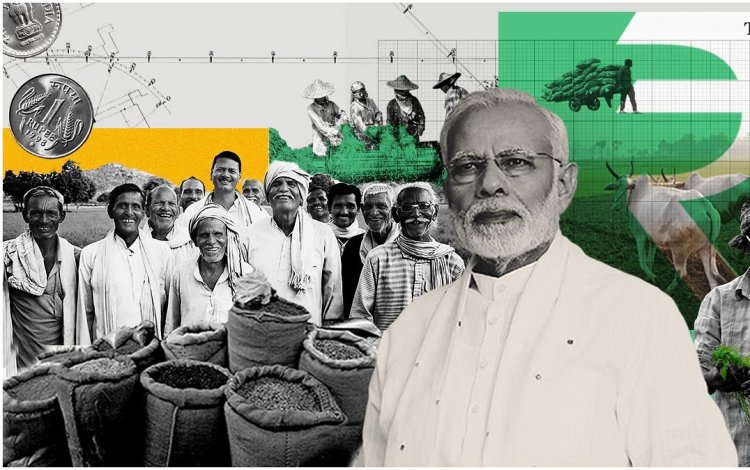
No country can afford to neglect its people. I have often said that farmers are not a burden on society and they are also partners in progress. They are also entrepreneurs who have the potential to boost the country’s economy. They can easily become wealth creators, they only need an enabling environment and full support from the government. The artificial border created between the farming community and the government should be broken as soon as possible. Both physical and mental barricades need to be removed. This is absolutely necessary because as Dhankhar has said, the underlying intention of uniting the country is to bring people together by gradually removing mistrust and demonstrating trust.
Apart from this, we should not forget that when the GDP fell during the pandemic, only agriculture was emerging as a shining star and became the sole savior. At a time when the economic growth rate (GDP) in the second quarter of FY25 had declined to 5.4 per cent, agriculture and allied sectors worked hard with a growth rate of 3.5 per cent, which was much higher than the growth rate at the lower level. Even though the slowdown in the agriculture sector continued, it has registered a growth of 0.4 per cent to 2.0 per cent in FY24-25. Considering agriculture as a burden on the country’s economy and the misleading challenge of reducing or eliminating this burden as soon as possible, has arisen from a faulty economic thinking, which has deliberately pushed agriculture back all these years and brought it to a state of poverty. Now that the world is rethinking its economics, it is certainly retreating from its excessive enthusiasm for globalization and is questioning them by instituting more and more protectionist measures. In which inequality is tossed around, India is still far behind when it comes to pressing the reset button. It has to understand that there is no way forward for business as usual.
As I have written many times before (in 2021), agriculture is definitely demanding change. The farmers opposing the failed agricultural marketing reforms of other countries instead of borrowing them has given us a great opportunity to redesign and introduce an indigenous version of agricultural reforms, where economic policies will have to be tailored to the needs of the country instead of being adopted in a ‘cut and paste’ manner. Moreover, in view of the trend of reverse migration being seen in the country, making agriculture economically viable is the only way to achieve the vision of ‘Sab ka saath sab ka vikas’. This will also reduce the obvious pressure to create more employment opportunities in urban areas. Whether one likes it or not, agriculture alone has the potential to revive the economy. The sooner we realise this fact, the better for the country. I am saying this because economists fail to see that if more income (money) comes into the hands of farmers, rural demand will increase, which will ultimately