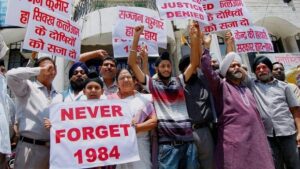

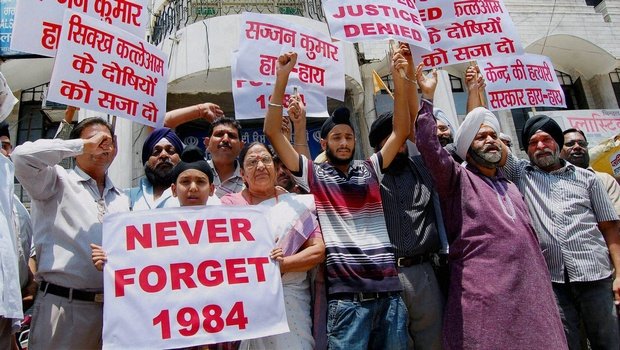
The historic and tragic case of the 1984 anti-Sikh massacre has once again taken a new turn. An eyewitness in the case related to Gurdwara Pul Bangash in North Delhi has come forward in a Delhi court and leveled serious allegations against former Congress leader Jagdish Tytler. 70-year-old Harpal Kaur Bedi told the court that she herself had seen Jagdish Tytler inciting a mob in front of Gurdwara Pul Bangash on November 1, 1984, to loot and kill Sikhs. This testimony may give a new direction to the investigation of the case, but at the same time it raises questions as to why this case has been pending for the last 41 years? What has been the role of the CBI? And why has the Congress party not expelled leaders like Jagdish Tytler and Sajjan Kumar from the party?
The Tragic Incident of 1984 and the Pul Bangash Case
After the assassination of the then Prime Minister of India, Indira Gandhi on 31 October 1984, there were violent attacks on Sikhs in India as part of a conspiracy against them. Gurdwara Pul Bangash located in the Azad Market area of North Delhi also fell victim to this violence. On 1 November 1984, a violent mob set the gurdwara on fire and burnt alive three Sikhs – Gurcharan Singh, Sardar Thakur Singh and Badal Singh. Apart from this, incidents of arson and looting also took place in the nearby Bada Hindu Rao area. According to the CBI chargesheet, Jagdish Tytler, who was a prominent Congress leader and MP at the time, incited the crowd that had gathered in front of Gurdwara Pul Bangash, which resulted in this bloody act.
Harpal Kaur Bedi, who was present near Gurdwara Pul Bangash during the incident in 1984, made serious allegations during her testimony in the court of Special Judge Jitinder Singh. She said, “I was standing on the footpath in front of Gurdwara Pul Bangash on November 1, 1984. I myself saw Jagdish Tytler driving around in a white Ambassador car. Later, he stopped in front of the gurdwara. Tytler and three other persons got out of the car and he incited the crowd that had gathered there to loot and kill Sikhs.”
Harpal Kaur also told the court that she was afraid for the safety of her only son, due to which she kept silent for a long time. It was only after her son’s death in 2016 that she gave a statement against Tytler before the CBI. This testimony could prove crucial in strengthening the case, but the question is, how effective will this testimony prove to be after all these years?
Why is the case pending?
The cases of the 1984 anti-Sikh massacre have been pending in the courts for the last four decades. The CBI started investigating the case involving Jagdish Tytler in 2005, but its progress was very slow. The timeline of the case is as follows:
2000: Nanavati Commission was formed under the leadership of Justice Nanavati to investigate the Sikh massacre.
2005: CBI registered a case against Tytler.
2007: CBI closed the case citing lack of evidence.
December 2007: Delhi court ordered CBI to re-investigate.
2009: CBI gave Tytler a clean chit.
2013: Court rejected CBI report and ordered to continue investigation.
2014: CBI filed a closure report for the third time.
2015: Court again ordered to continue investigation.
2016: CBI interrogates Tytler for over three hours.
2023: CBI files chargesheet in Rouse Avenue court, accusing Tytler of inciting the mob. It is clear from this timeline that the CBI tried to close the case several times, but the court ordered the investigation to continue each time. The CBI has often been questioned for deliberately stalling the case and trying to protect Tytler. The CBI’s closure reports and claims of lack of evidence have further fuelled anger among the victims’ families and the Sikh community.
Reasons for delays in court
The CBI has often claimed that there was no solid evidence against Tytler. The failure of the police and investigating agencies to collect evidence during the 1984 violence weakened the cases. Many witnesses, like Harpal Kaur, did not come forward out of fear. Political pressure and fear of death influenced the testimonies.
The high profile of leaders like Tytler and Sajjan Kumar in the Congress party affected the investigation. There were also allegations of political pressure on the CBI. The slow pace of the Indian judicial system and the backlog of cases also contributed to the delay.