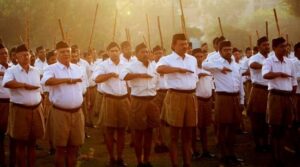

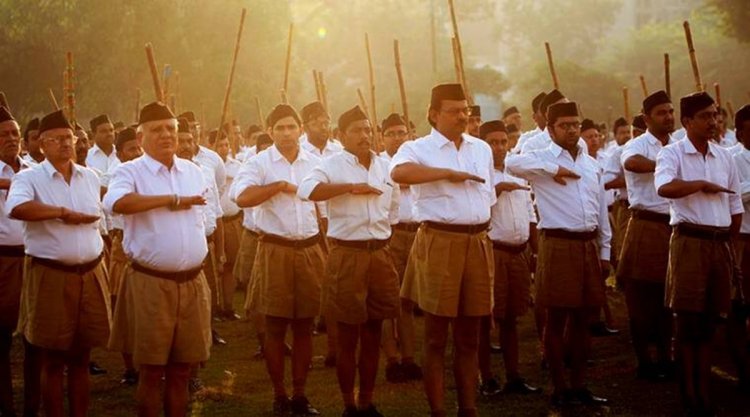
When Nathuram Godse shot Mahatma Gandhi three times in the chest on 30 January 1948, the entire country was in shock. Gandhiji, who had asked the British to leave India through satyagraha and non-violence, was killed by a ‘Hindu nationalist’. Godse was trained in the branches of the Sangh and was a disciple of Hindu Mahasabha leader Veer Savarkar. The Sangh believed that Gandhiji’s ‘Sarba Dharma Sadbhavana’ ideology weakened Hindus. Sardar Vallabhbhai Patel, who was the Home Minister at that time, did not hold the Sangh responsible for the assassination, but he said that the branches of the Sangh were filled with poisonous thoughts, which created such conditions. The first ban on the Sangh was imposed on 4 February 1948. Sardar Patel wrote in his letter, “The words of the Sangh were full of communal poison. After Gandhiji’s death, sweets were distributed in the Sangh offices.” The Sangh claimed that Godse had left the Sangh, but Godse’s brother Gopal Godse said, “Nathuram had never left the Sangh. This was said to save the Sangh.
“How was the ban lifted?
The ban was lifted on 11 July 1949. The Sangh made written promises to the government: The Sangh will remain loyal to the Constitution and the Tricolour. It will not believe in violence. The constitution of the organization will be democratic, and the Sarsanghchalak will be elected. But the Sangh did not fulfill these promises. The Sarsanghchalak is still nominated today, not elected. The Sangh’s mouthpiece ‘Organizer’ wrote articles against the Constitution in 1949, and Golwalkar described the Tricolour as ‘inauspicious’. The Tricolour was not hoisted at the RSS headquarters for 52 years.
Second Ban (1975): Consequences of Emergency
When Indira Gandhi imposed Emergency in 1975, she accused the RSS and Jamaat-e-Islami of inciting communal sentiments. RSS chief Balasaheb Deoras wrote several letters to Indira, saying that the RSS had nothing to do with the anti-Emergency movement. He also offered to cooperate in the government’s 20-point program. But Indira neither met her nor lifted the ban.
How was it lifted?
When the Janata Party government came to power in 1977, the ban was lifted. During this time, many RSS members apologized and were released from jail.
Third Ban (1992): Demolition of Babri Masjid
On December 6, 1992, the Babri Masjid in Ayodhya was demolished by Karsevaks. At that time, U.P. The Chief Minister of the state was Kalyan Singh, who was trained in the Sangh branches. Kalyan Singh had assured the Supreme Court and the Central Government that the mosque would be protected. But all the promises went up in smoke. The mosque was demolished, and the Supreme Court considered it a contempt of court. The Central Government banned the Sangh, VHP and Bajrang Dal on 10 December 1992. The Liberhan Commission of 2009 held Kalyan Singh, L.K. Advani, Murli Manohar Joshi and Uma Bharti responsible.
How was it lifted?
The Sangh challenged the ban in the tribunal. The tribunal headed by Justice P.K. Bahri lifted the ban in June 1993, saying that the government did not have evidence to hold the Sangh responsible.
Which minorities is the Sangh Parivar against?
The Sangh Parivar’s ideology revolves around a ‘Hindu Rashtra’, in which Hindu culture is considered supreme. Sangh thinkers like Golwalkar believed that minorities (especially Muslims and Christians) would have to live as second-class citizens in a Hindu Rashtra. The Sangh’s affiliated organisations (like VHP, Bajrang Dal) have been active in inciting anti-Muslim sentiments. But the Sangh’s ideology is not limited to Muslims or Christians alone. The attempt to portray Sikh identity as part of Hindu culture is also part of the Sangh’s politics. In Sangh’s books, Sikh history is described as part of ‘Hindu history’, which is a point of contention for the Sikh community.
Why is the Sangh Parivar changing Sikh history?
In the Sangh Parivar’s ideology, ‘unity’ means bringing all religions under Hindu culture. The attempt to portray Sikh history as part of ‘Hindu history’ is a result of this ideology of the Sangh. The Sangh believes that the Sikh Gurus sacrificed their lives to protect Hinduism, and that Sikhism is not a separate religion, but a part of Hinduism.
It is taught in the branches of the Sangh that the Sikh Gurus were the protectors of Hindu culture. The Khalsa of Guru Gobind Singh Ji is presented as ‘Hindu soldiers’. Baba Banda Singh Bahadur is presented as a bairagi.
Sangh organizations, such as the VHP, have challenged the separate identity of the Sikhs. They associate the symbols of Sikh culture (such as the kirpan, the five kakars) with Hindu customs and traditions. By describing Sikhs as part of Hinduism, the Sangh aims to weaken the separate identity of the Sikhs, so that the idea of a ‘Hindu nation’ is promoted. The Sangh believes that the Sikh Gurus fought against the Mughals to protect ‘Hinduism’. They ignore the universal thought and unique thought of Guru Nanak Dev Ji.
Viewpoint of Sikh Intellectuals and Panthic Organizations
Sikh intellectuals and Panthic organizations consider the thinking of the Sangh Parivar as a threat to Sikh identity.
Sikh historian and philosopher Sardar Kapur Singh strongly opposed the thinking of the Sangh Parivar that described Sikhs as part of Hinduism. He made it clear in his books, such as “Sikhism and Hinduism: A Comparative Study”” and “Parsar Parsan”, Sikhism and Hinduism: A Comparative Study” that Sikhism is a separate and independent religion, which has its roots in social equality and spiritual freedom. He called the Sangh’s attempt to distort Sikh history “cultural imperialism” and Sikh identity
had stressed the need for awareness to save the Sikhs.
Scholars like Sikh scholar Sardar Gurtej Singh IAS believe that the Sangh distorts Sikh history. The Sangh ignores Guru Nanak Dev Ji’s ‘neither Hindu nor Muslim’ ideology. He also condemned the Sangh’s attempts to control Sikh gurdwaras.
Sikh historian and academic Dr. Dhillon had criticized the policies of the Sangh Parivar, saying that they try to erase the distinct religious and cultural heritage of the Sikhs. In his works, such as “Sikh Struggle”, he condemned the anti-Sikh policies of the Sangh, such as the attempts to link the Sikh Gurus with Hindu incarnations. He inspired the Sikh youth to understand their history and principles.
Shiromani Akali Dal (Amritsar), Sikh Missionary College, Akhand Kirtani Jatha, and other Sikh organizations consider the Sangh’s ‘Hindu Rashtra’ ideology as a threat to Sikh identity and constitutional rights. They see the ‘Sikh history’ taught in Sangh branches as a distortion. Sikh youth on social media raise their voice against the policies of the Sangh. The main objective of the politics of the Sangh family is the establishment of ‘Hindu Rashtra’. Therefore, they try to bring all religions under the Hindu culture.