
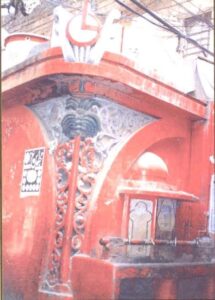
 Gurdwara Lal Khuh, a historical site associated with the martyrdom of Sri Guru Arjan Dev Ji, is known as the well located in Chandu Di Haveli in Lahore city, Pakistan. This well, where Guru Ji used to bathe, has now allegedly been converted into the “Haq Char Yaar Dargah”. Its walls have messages in Urdu like “Jahan Nahan Aur Kandana Dhawana Manha Hai” written on them, confirming its changed religious identity. The government of Pakistan and its agency, the Evacuee Trust Property Board (ETPB), which is responsible for the preservation of religious properties of minorities, have not taken any effective steps to recover the site or preserve its historical significance. The Pakistan Sikh Gurdwara Parbandhak Committee (PSGPC) has also faced failure in this matter, as they have been unable to maintain the existence of the site as a Gurdwara. The small size of the Pakistani Sikh community (about 15,000 Sikhs, which is 0.01% of the total population) and limited political influence have prevented them from effectively raising their voice on this issue.
The Pakistani government’s indifference to this issue has led to resentment among the Sikh community, as it has not only damaged Sikh heritage but also hurt religious sentiments. There is no clear and public record of any steps taken by the SGPC or diaspora Sikh organizations in the case of Gurdwara Lal Khu.
Pakistan Government’s Position: The Pakistan government has made some efforts to preserve Sikh religious sites, such as the renovation of Gurdwara Kartarpur Sahib and the establishment of the Kartarpur Corridor in 2019, which was appreciated by Sikhs around the world. However, no specific action has been taken by the government or the ETPB to preserve lesser-known sites like Gurdwara Lal Khu. This could possibly be due to local administrative negligence, lack of resources, or opposition from local communities who have adopted the site as a shrine.
Historical Background:
The significance of Gurdwara Lal Khuh is linked to the martyrdom of Sri Guru Arjan Dev Ji. The site is located in Chandu’s Haveli near Mochi Darwaza in Lahore, where the Guru was tortured on the orders of the Mughal emperor Jahangir. According to historical records, the Guru was kept in a cell in Chandu’s Haveli, and used to bathe with the water from this well. After the partition of 1947, the site came into the hands of local communities and was eventually converted into a shrine. During the partition, Sikhs and Hindus migrated to India, which led to a decline in the preservation of Sikh shrines in Pakistan.
Sikh organizations need to cooperate and exert pressure at the international level on this issue so that this place can be re-established as a Gurdwara.