
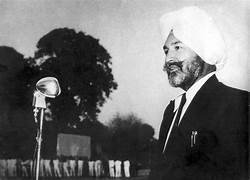
His life story is an example of dedication, bravery, and strategic acumen. The spirit of Sikhism, the good of all, and the protection of truth burned in Subeg Singh’s soul. His life is a saga that began with the thunder of the battlefields and was colored with the color of martyrdom on the holy land of Sri Darbar Sahib.
Subeg Singh was born in 1925 in a Sikh family in Jogian village (Jalandhar) of Punjab. From childhood, the values of Sikhism—truth, service, and justice—resounded in his mind. His education and physical ability gave him the dream of joining the army. In 1942, at the age of 17, he joined the Indian Army by obtaining a King’s Commission. His stories of bravery began on the battlefields of World War II, where he fought shoulder to shoulder with British forces in Singapore and Malaya. As a staff officer to Brigadier Muhammad Usman in the Kashmir War of 1948, in carrying wounded soldiers on his shoulders to hospitals in the Indo-China War of 1962, and with brilliant strategy in the Hajipir Battle of 1965, Subeg Singh rose to the rank of Major General. His proficiency in seven languages—Punjabi, Persian, Urdu, Bengali, Gorkhali, Hindi, and English—, academic aptitude, and physical prowess (an athlete who broke the 100-meter dash record at the age of 18) made him an extraordinary figure.
Training of the Mukti Bahini:
Subeg Singh’s key role in the 1971 warSubeg Singh’s role in the 1971 Indo-Pakistani war is an example that testifies to strategic acumen and dedication. When the Bangladeshi freedom struggle began, Indian Army Chief Sam Manekshaw called Subeg Singh to Delhi. He was tasked with training and organizing the Mukti Bahini. The mission was secret, as India did not want it to be known internationally. Subeg Singh changed his name from Subeg to Beg, cut his hair, and provided such military training to the Mukti Bahini warriors that they could stand strong against the Pakistani army. His tactics played a significant role in breaking the morale of the Pakistani army. General Jagjit Singh Arora, the head of the Eastern Command, acknowledged that Subeg Singh’s tactics played a major role in the success of the Mukti Bahini. He trained warriors like Major Zia-ur-Rehman and Muhammad Mushtaq, who later became the President and Army Chief of Bangladesh. For this achievement, Subeg Singh was awarded the Param Vishisht Seva Medal.
Sikh Genocide June 1984:
Subeg Singh’s rebellion was rooted in government injustice. After the 1971 war, when he was posted in Bareilly, an audit report revealed financial irregularities. Subeg Singh tried to investigate this, which did not go down well with the army’s higher-ups. As a result, in 1976, a day before his retirement, he was dismissed from service without a court martial or trial. His pension was stopped and allegations of corruption were levelled. This injustice created anger and frustration in Subeg Singh’s mind towards the government. He challenged these allegations in court, which found him innocent, but the government did not return his pension. This injustice linked him to the struggle of Sant Bhindranwale, who raised Sikh issues with unwavering determination. In the 1980s, the instability in Punjab and the neglect of Sikh demands prompted Subeg Singh to take charge of the security of Sri Darbar Sahib. He adopted a guerrilla strategy, which included fronting, weapon positioning, and strategic planning.
Senior journalist Shekhar Gupta wrote in the ‘Indian Express’ that Subeg Singh’s strategy turned Sri Darbar Sahib into a ‘killing ground’, where the Indian Army suffered heavy losses. The relationship between Subeg Singh and Sant Bhindranwale was not limited to military strategy. It was a joint fight to protect the identity and self-respect of the Sikh community. Sant Bhindranwale praised Subeg Singh’s military acumen and dedication. On 5 June 1984, when Subeg Singh attained martyrdom, his body was found in the basement of Sri Akal Takht, a carbine in his hand and a walkie-talkie nearby. Sant Bhindranwale prayed for him and cleaned the body and kept it in the basement, where it was buried under the rubble in the artillery attack.
This partnership between Subeg Singh and Sant Bhindranwale was a fight for the sanctity of Sikhism and the protection of truth. Their martyrdom created an immortal example in the minds of the Sikh community, which became a symbol of struggle and the fight for justice.