
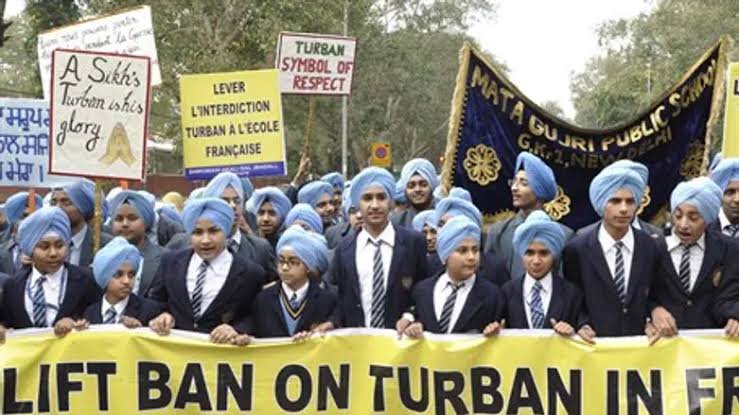
The Sikh community in France may be small, but its presence and influence are strong. There are about 30,000 Sikhs living in France, and their main base is in the city of Bobigny near Paris, where a Gurdwara is also located. The community has maintained its culture and religion over time, especially in 2004 when the French government banned religious symbols like turbans in public schools. Despite this, the Sikh community has never given up and has maintained its identity. Be it their religious places or cultural programs, the Sikh community has carved out a niche for itself in France and has played an important role in the country’s social fabric.
Sikh struggle against turban ban
According to reports, a law passed by the French government in 2004 ordered the removal of religious symbols in public schools. Under this law, Sikh students were not allowed to wear turbans on their heads. This decision came as a big shock to the Sikh community and was strongly opposed. In some schools, especially near Paris, five Sikh students were expelled from classes for wearing turbans. Following this decision, the Sikh community appealed to the authorities to lift the ban on turbans. The Sikh community raised the issue internationally, such as at the United Nations Human Rights Committee. In 2012, the United Nations declared France’s ban a violation of human rights, but France did not fully accept it. The Sikh community continued to engage with local authorities and society, so that the turban would be accepted as a cultural and religious symbol. But no positive results were achieved. After this, the Sikhs established their own private Sikh school, which was named “Sher Punjab Complex”.
“Sher Punjab Complex” is a private Sikh school located in Paris, which was established due to the ban on religious symbols, especially the Sikh turban, by the French authorities. The school was founded by a local Sikh businessman, whose son was expelled from a government school in 2004 for not removing his turban in class. The school cost around 300,000 euros to set up, not including the cost of the building. The school started with 15 students, but has since grown to become an important educational center for children from the Sikh community.
Gurdwaras in France
According to information, there are a total of five Gurdwaras in France, all of which are located in the city of Paris. These Gurdwaras are an important part of the religious and cultural life of the Sikh community. Some of the main names of the Gurdwaras in France are as follows: Gurdwara Singh Sabha Association, Bobigny Gurdwara Sahib, Burgat Gurdwara Guru Teg Bahadur Sahib, Bondi Gurdwara Sahib, Villepinte Apart from this, the Sikh community also has a presence in other cities of France, with areas like Drancy, Bobigny, Bondi, Romainville, Villepinte and Pantin being the main ones. These areas remain the center of Sikh religious and cultural events. The Sikh community runs Sunday schools or social programs in Gurdwaras that teach Gurmukhi and Sikhism. These programs mainly teach children about Sikh culture, history and Gurbani.
Impact of the Turban Ban
The ban on the turban has had a profound social and psychological impact on the Sikh community: Impact on education: The ban on the turban in schools has forced many Sikh students to drop out of school, which has affected their education. The turban is an important part of the Sikh identity. The ban has exacerbated the identity crisis among Sikh youth.
The ban has led to social and cultural isolation for the Sikh community, as they cannot openly express their religious identity. Legal Struggle: Sikh organizations have taken up the issue in courts and international forums (such as the United Nations), but success has been limited. This has given rise to a sense of struggle within the Sikh community.
What do world newspapers say about the matter?
The world media has raised the issue of the Sikh turban ban in France several times. BBC (2004-2012): The BBC reported that the French ban sparked outrage among the Sikh community and the United Nations Human Rights Committee declared it a violation of human rights in 2012. The Guardian UK discussed the tension between France’s principle of secularism and religious freedom, and described the establishment of private Sikh schools as a positive step. The New York Times described the struggle of the Sikh community and the establishment of the Sher Punjab complex as a symbol of the community’s determination.
Al Jazeera portrayed the French ban as discrimination against minority communities and emphasized the international appeal of the Sikh community.
Indian newspapers The Indian Express and The Hindu praised the Sikh community’s courage and efforts to preserve their cultural identity, and presented the UN decision as a victory for the Sikhs. There is a general consensus in the media that France’s strict secularism policy limited the religious freedom of the Sikh community, but the Sikhs’ struggle at the local and international levels strengthened their identity.
Political and administrative achievements
The Sikh community in France has a limited presence in the political and administrative spheres. Due to the small Sikh population and France’s strict secularism policies, Sikhs are underrepresented in high-level government positions.
The Sikh community does not appear to be a religious community. However, the Sikh community has made some efforts to maintain its identity at the local level, such as through Sikh institutions and gurdwaras, which have organized social and cultural activities. Some Sikh youth are active in local social and commercial sectors, but examples of clear political achievements are few.
Contribution to charity
The core teachings of Sikhism are based on the principles of “service” and “sharing”. The Sikh community in France, especially through gurdwaras, is active in charity and social service. Langar services are regularly held in institutions such as the Gurdwara Singh Sabha Bobini, located near Paris, where free meals are provided to people of all religions and backgrounds. In addition, Sikh organizations are also involved in helping and distributing relief materials during disasters (such as floods or other natural disasters). Sikh organizations have also made a huge contribution to alleviating poverty, hunger and social inequality, including providing food and assistance to homeless people.
The Sikh community in France, despite being small, is active in preserving its identity and culture. Their contribution to charity and social service is significant, but achievements in the political and administrative spheres are limited. The ban on turbans and the lack of Sikh schools have had a negative impact on the education and identity of Sikh youth, and the struggle over this issue continues.