
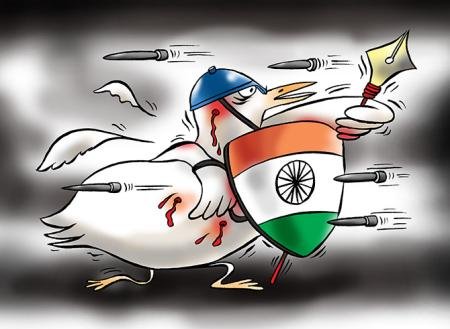
India is the world’s largest democracy and has long been a beacon of democratic ideals. It has provided a strong framework of political freedoms, rights, coalitions and opportunities for participation. But in recent years, Indian democracy has shrunk to become an “electoral democracy” that is turning into a new form of fascism. In this type of democracy, the emphasis is on elections, while the basic principles of democratic governance such as checks and balances, accountability, transparency and protection of fundamental rights are negated from democracy.
A recent report by the V-DEM (Varieties of Democracy) organization sheds light on the growing trend of democratic decline in India, especially in the context of the transition to electoral democracy. According to the report, India has slipped to 104th place in the Democracy Index. In 2018 alone, India moved from the category of liberal democracy to the category of electoral democracy and authoritarian or fascist approaches are on the rise.
The V-Dam Institute is a renowned global think tank based in Sweden. It conducts extensive research on the quality of democracy around the world. In its reports, the V-Dam categorizes countries based on their level of democracy.
The V-Dam report says that India has witnessed a significant change over the past decades
The V-Dam report says that India has witnessed a significant change over the past decades. India is now being categorized as an “electoral democracy” instead of a “liberal democracy”.
One of the most significant aspects of the decline of India’s democracy is the erosion of civil liberties and democratic norms. These include the shrinking space for dissent, restrictions on press freedom, the growing influence of money in politics and the increasing centralization of power in the executive.
A major trend identified by the V-DAM Institute and experts is the centralization of power in the hands of the executive. The role of parliament and the judiciary, which were the basis of a strong democracy, has been weakened. Under this increasing centralization, decision-making power has been concentrated in the office of the Prime Minister and important institutional checks, such as an independent judiciary and a strong opposition, have been eliminated.
This shift in power is allowing the executive to dominate the political scene. The perception of the government escaping judicial review and suppressing dissenting voices has increased, leading to a gradual erosion of democratic norms. The weakening of opposition parties and the neglect of independent institutions have further strengthened the dominance of the ruling party in political affairs.
The V-DAM Institute also points out that populism in India is now associated with the centralization of power and the erosion of political freedoms. This trend has led to an increase in the pressure to centralize power rather than democratic participation in elections. Meanwhile, political leaders often use religious and identity-based politics to appeal to majoritarian sentiments to consolidate their position in power and influence election outcomes. This populist approach is undermining the credibility of institutions such as the media, judiciary and civil society, which are essential to sustaining a pluralistic democracy.
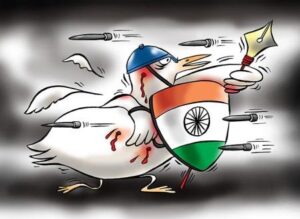
The V-DAM report highlights the growing threats to freedom of expression, assembly and the press in India. Journalists, activists and opposition leaders face threats, harassment and intimidation. The ruling party is being accused of suppressing dissent.
A legal framework exists to protect civil liberties, but these laws are not enforced, leaving many citizens vulnerable to state-sponsored oppression and injustice. These trends have created a climate of fear and self-censorship. It is clear that the vitality of public discourse in India is weakening and political debate is being stifled.
In addition, politically motivated violence, often linked to communalism, has created an environment where democratic norms are being rejected in favor of centralization of power. Due to the criminalization of politics, politicians with criminal backgrounds also benefit from impunity. This is another sign of the decline of democratic norms. According to the V-DAM report, electoral integrity in India has been declining in recent years.
The V-DAM Institute report accurately exposes the shortcomings of Indian democracy. Just as Indian politics has been reduced to a game of numbers and vote bank, it can be easily assumed that there are no citizens left in it. In Indian democracy, parties have been limited to vilifying each other, which has damaged the governments and administration. People win by voting for their leaders, but they only promote free speech. Indian democracy today has become a mere show.