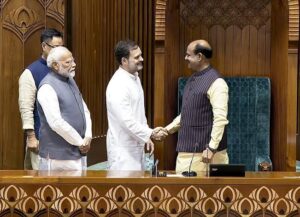

Questions are being raised that they are not accountable to the people by securing their seats for five years by taking votes from the people? Questions are also being raised that what is the fault of the people who, by fulfilling their hopes and dreams, brought them to the Parliament or the Vidhan Sabha, and they are not delivering anything to the people. Have these representatives of the people reached these houses only to tear papers in the Vidhan Sabha or the Parliament, overturn chairs, throw mud at each other, abuse each other and take out their own worms.
The proceedings of the Vidhan Sabha, Lok Sabha, Rajya Sabha are going on, the people watch this proceedings ‘live’. The people are disappointed when none of their problems are discussed in these houses. The ruling party brings bills of its own accord. The opposition tries to defend its position. What is the point of having discussions, their voices are not even heard in the House. Instead of discussions, the only solution is to throw the opposition out of the House so that the ruling party can do its will.
Recently, 21 MLAs of the Aam Aadmi Party were suspended in the Delhi Assembly. In the Rajasthan Assembly, there was a protest against calling Indira Gandhi a grandmother, there was a ruckus, six MLAs were shown the way out of the House. In fact, people sitting in responsible positions consider the opposition to be a nuisance. In the Punjab Assembly, the leader of the opposition and the ruling party along with the Chief Minister were seen getting involved in unnecessary things. It is a common thing to be in a hurry.
The tendency to belittle the opponents and corner them in every way in the current democracy starts from the local governments and panchayat institutions at the very bottom. People elect their representatives in village panchayats, but those who come to power do not even ask the opposition panchayats, do not take their opinion. They hold meetings secretly, on paper, at will, and keep the work going, the government machinery helps them. This same tendency becomes the ruling party’s after the Vidhan Sabha is elected.
At first, there are no meetings of the Vidhan Sabha due to the hype. If they do, then the time is absolutely limited. Methods are used to keep the opposition out of the house to make government bills and laws, and then the bills are passed with their own majority. The government is run. People’s issues remain hidden. There is no opportunity to raise these issues and problems in the Vidhan Sabhas and the Lok Sabha.
However, there is a lack of leaders who raise the people’s issues. Most of the people who reach the Lok Sabha and Vidhan Sabhas are rich people who are not aware of the inner problems of the common people. Along with this, people with criminal background have also entered these democratic constitutional houses in large numbers. Is it possible to talk and listen to the problems of the common people from such people?
According to the ADR report, out of the 514 current members of Parliament, 225 (44 percent) of them have criminal cases registered against them, including cases of rape and murder, and 5 percent of MPs have assets of more than Rs 100 crore. More than half (more than 50 percent) of the leaders of different parties in Uttar Pradesh, Maharashtra, Bihar, Andhra Pradesh, Telangana and Himachal Pradesh are like this, against whom criminal cases are pending in police stations and courts.
According to the ADR survey conducted on 4001 (total 4033) MLAs of 28 Assembly constituencies and two Union Territories, 44% MLAs have criminal cases registered and out of them 1136 (28%) have serious criminal cases. Out of these 4001 MLAs, 88 (2%) have assets exceeding Rs 100 crore per MLA. Out of the MLAs elected to the Delhi Assembly in February 2025, 31 MLAs have criminal cases registered and out of 7 ministers of the elected BJP government, 5 ministers have criminal cases registered.
The elected representatives of the Lok Sabha and Vidhan Sabha are given lakhs of rupees per year in salary, allowances and pensions from the taxes paid by the people. They are also entitled to allowances and other facilities for attending the sessions of the Lok Sabha and Vidhan Sabhas. It is surprising, when many representatives are seen sleeping during the sessions of the Houses. There are many ‘gentlemen’ who rarely attend the Houses, speak very little, that is, they remain silent and complete their term by remaining ‘silent’ for five years. After all, what can the common people expect from such people?
It is worth noting that the cost of running the Parliament is Rs 1.5 crore every hour. During the last Lok Sabha session, only 5 percent of the work was done in the last 5 days and the Lok Sabha lasted for 69 minutes and the Rajya Sabha lasted for 94 minutes. In these meetings, political issues remained separate, which have no concern for the common people.
The way the MPs of our country have hung their responsibilities on the peg of politics, it is a stain on democracy. The three members of the Parliament of India are the President, Lok Sabha, and Rajya Sabha. The current Parliament of India has 790 members. The Indian Parliament has three chambers and has to work for almost 100 days in a year. On which 600 crores are spent, that is, 6 crore rupees per day. If these houses do not work at all, then what is the point of electing these law-making bodies?
If despite spending so much, the discussion in the house is only about finding faults with each other, with the leaders of Indian politics before us, and time and money are wasted, then this cannot be considered suitable for Indian democracy in any way.
Without a doubt, there is a shortage of good leaders in India in the present era. The dynastic leaders
There is a lot of confusion. Conservative leaders are influencing the country’s politics in their efforts to change the country’s constitution. The ruling party is trying to make the leaders with opposing voices disappear in the political corridors. Insulting, arrogant leaders who speak loudly and loudly are seen in the House, spreading their arms, showing bullying, and correcting their wrongdoings. Can leaders who do such politics do people-friendly politics? Probably not.
Over the last two decades, the scene and method of electing people’s representatives has also changed. The purpose of political parties’ work is not to serve the people, but to grab the chair. Lollipops are shown before the elections, people are deceived, promises of providing maximum free facilities are made, and elections are won on this basis. People-friendly slogans, money, and bullying have become the election ornaments of political leaders today.
The trend of vote buying is undermining democracy. Morally, leaders have gone to such a low point that they win elections from one party, and immediately after the elections, to get the ministerial chair, to seize power, to remain enemies in the elections, and later to appear as friends, has become a common thing. This has become the bad color and bad character of the current politics of India. Bihari Babu Nitish and Andhra Pradesh’s Chandrababu Naidu, who were once anti-BJP, have become the scoundrels of the current Indian central government.
Just like in Punjab, the ruling party in the corporation elections, uprooted the councilors of the opposition party, brought them into its party and gave them big positions and then made big claims of victory in the local elections, that was a bad color of the current colorless local government politics.
Today’s Indian society is abhorrent to the people’s representatives, because they claim to represent the people, but are not living up to their promises. The opposition is not raising the voice of the people that should resonate in the House. The ruling party is not serious about solving the problems of the people, it is trying to please its bosses, ‘corporates’, and wealthy people who shower them with wealth.