
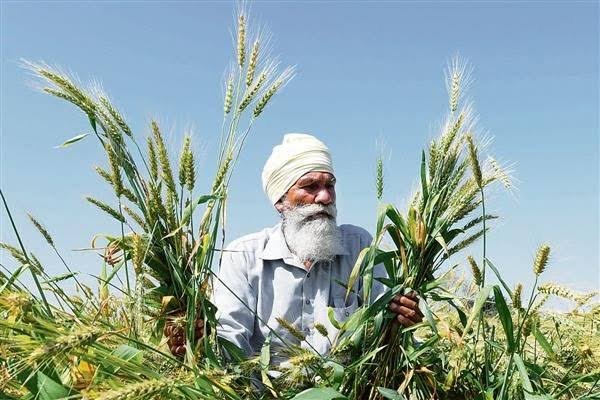
In 1925, English writer M.L. Darling, while explaining the bad situation of debt on the farmers of Punjab, wrote, “The farmer of Punjab is born in debt, grows up in debt and dies leaving debt behind.” Today, after 100 years, the situation has become more dire than ever. According to the report of the National Bank for Agriculture and Rural Development (NABARD), the total institutional debt to farmers in India as of March 31, 2024 is Rs 33,52,646 crore, out of which farmers in Maharashtra have the highest debt of Rs 8,38,249 crore, followed by Tamil Nadu with Rs 3,84,139 crore, Andhra Pradesh with Rs 3,09,809 crore, Uttar Pradesh with Rs 2,29,887 crore and Rajasthan with Rs 1,74,798 crore. Farmers in Punjab have an agricultural debt of Rs 1,04,064 crore, while farmers in our neighboring state of Haryana have a debt of Rs 96,855 crore. Looking at the per account debt of farmers, it is revealed that the per account debt in Punjab is Rs 2.71 lakh, while in Haryana this debt is Rs 2.40 lakh, in Maharashtra it is Rs 5.73 lakh, in Tamil Nadu it is Rs 1.33 lakh, in Rajasthan it is Rs 1.66 lakh, in Uttar Pradesh it is Rs 1.22 lakh. This shows that Punjab is at the top in terms of per account debt. This report also makes it clear that not only Punjab but the entire country is struggling with the debt crisis. This has put a lock on the mouths of those so-called scholars who used to spend the entire amount of debt on the farmers of Punjab for the wasteful expenditure of houses/cars.
What are the reasons for the rapid increase in agricultural debt in Punjab? The first major reason for the increasing debt is the continuous increase in the costs of agriculture, because the rulers of the country have handed over the institutions that manufacture goods used for agricultural production to private hands. Agricultural costs are increasing rapidly, while the income of farmers is either not increasing or has increased very little. Farmers have to take loans to sow the next crop and maintain it. Along with this, the Green Revolution model has changed Punjab’s agriculture from manual labor agriculture to mechanized agriculture. On the one hand, this has greatly reduced employment in agriculture, on the other hand, due to the need for mechanization, farmers have to invest a lot of money and due to this, the burden of debt has increased.
Most of the machinery used in agriculture is not financially viable for small and medium farms, but no solution has been suggested to the small farmers. Neither machinery has been developed to suit the conditions of Punjab nor has mechanization been made available to the farmers through the cooperative sector. Due to which the compulsion to make big investments despite financial constraints pushed the farmers towards debt burden.
Even now, while giving importance to the proposals of Punjab’s new agricultural policy, the government can reduce the huge expenses of farmers by increasing the reach of mechanization through the cooperative sector, but the corporate-friendly models of the governments have to find excuses to make such policies profitable. Similarly, the production and distribution of goods used in agricultural production should be done only through the public sector, so that farmers can get quality and cheap agricultural products on time. Agriculture in the country is not only a means of livelihood for crores of people, but to ensure the food security of the country, it is also necessary to keep the private sector/business houses away from agriculture.
The second major reason for the debt of Punjab’s farmers is not getting the right price for the crops. Therefore, it is very important to provide minimum support price (MSP) to farmers on the basis of the recommendations of Swaminathan Commission of C2+50 percent. The current MSP of the government does not include all agricultural costs, which can be corrected only by adopting the C2 cost formula. According to a study, if the Swaminathan Commission report had been implemented in 2006, the burden of debt on farmers could have been somewhat lighter. Many experts also believe that the loss caused by not getting MSP at C2+50 percent is the same amount of debt on Punjab’s farmers. That is, the implementation of the Swaminathan Commission report and the legal guarantee of MSP will be a big and important step towards the income, crop diversification and debt resolution of the country’s farmers.
The third reason for agricultural debt is the exploitation of moneylenders and other private lenders through high interest rates. It is worth mentioning that according to the report of ‘NABARD’, agricultural credit worth 1,04,064 crore has been taken only from institutional sources. This does not include loans taken from sources like moneylenders, arhtiyas and finance companies. According to a study, 21.3 percent of the total debt of farming families in Punjab has been taken from non-institutional sources, which makes the total agricultural debt in Punjab Rs 1,26,229 crore and this is very worrying. Especially small farmers and farm laborers become victims of this loot, because the access of these sections to institutional credit is very less. Due to which the high interest rates of private loans keep these people trapped in the debt trap. Therefore, access to institutional credit at low interest rates can be increased for such families.
The next reason for agricultural debt is the costliness of other social sectors. Due to the implementation of globalization policies, the health care, education of children and daily expenses of farmers have increased manifold, to meet which they have to take loans. Along with this, the rural youth struggling with unemployment despite getting higher education and taking the path of migration in search of a better life are also major reasons for the increase in debt. Recently, the US
Punjabis who were sent back handcuffed like criminals from Punjab clearly express the tragedy of this region. By making agriculture profitable in Punjab, a decent living income and employment in agriculture can be provided so that Punjabis are not forced to risk their lives and take the path of foreign countries.
Under pressure from the World Trade Organization (WTO), the Indian government is in a hurry to eliminate agricultural subsidies and hand over agriculture to corporates. Although three black agricultural laws were withdrawn under the pressure of people’s struggle in 2021, the draft of the new agricultural marketing policy formulated in 2024 is part of this series. Now it is necessary to implement the new agricultural policy of Punjab prepared by the Farmers’ Commission, under which crop insurance, increasing employment for laborers, compensation for suicides, providing pensions to farmers, and agriculture needs to be developed under the cooperative model. Understanding the condition of farmers, the precarious situation of the country’s economy and the anger of farmers, it is an important need of today’s economy to free farmers/laborers from the burden of debt.
Along with this, the central government should refrain from becoming a pawn of the World Trade Organization and corporates and formulate pro-people policies for agriculture. Farmers should be taken out of the debt trap by giving MSP for crops, so that the country can be taken forward on the path of prosperity.