
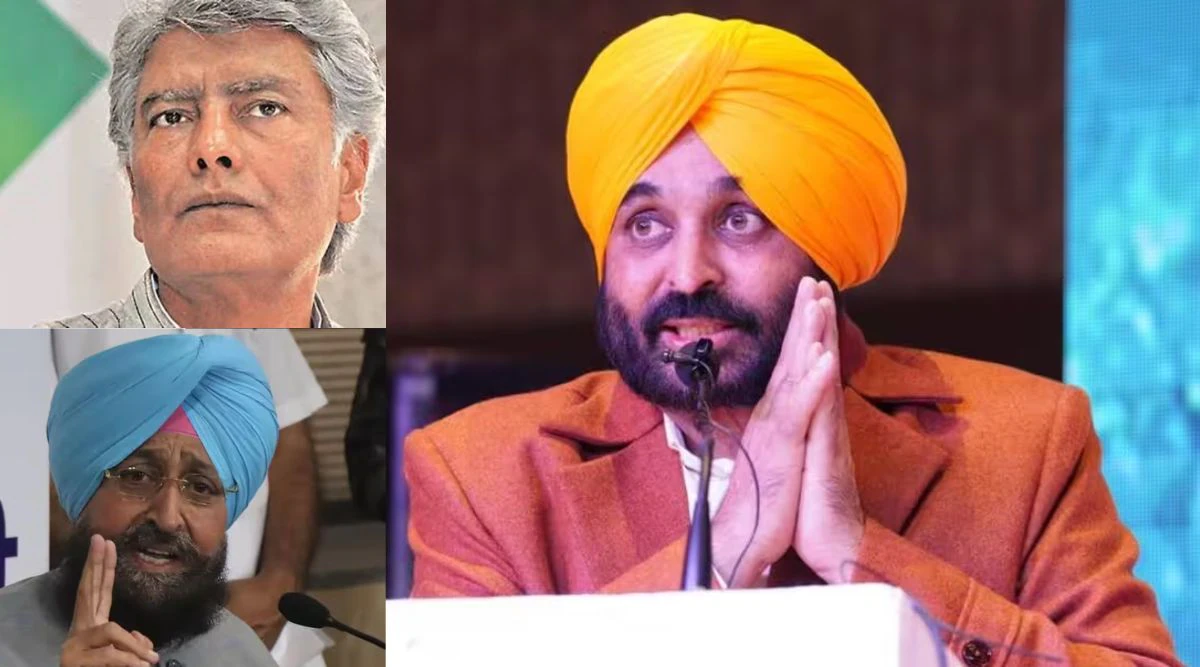
Whenever Punjab faced challenges in the past, the leaders of every region of Punjab correctly identified the challenges and accepted them and tried to solve them with the cooperation of the people. But for the last few decades, our leaders are neither correctly identifying nor accepting the challenges faced by Punjab. The result is clear, instead of being solved, the challenges are becoming more complicated day by day. The first responsibility in this lies with the political parties, the second with the bureaucracy, the third with the academic leaders and intellectuals and the fourth with the entire Punjabis. Political leaders, instead of statesmen, have become involved in only narrow and petty political competition and remain worried from one election to the next, whereas statesmen (far-sighted politicians) are worried for the next generations. The tragedy is that today not a single political leader in Punjab has the vision of a statesman.
Far be it from the statesman, today in Punjab there is no credibility of any political party and any political leader. From the way in which the political changes of politicians have been seen for the last few years, it can be easily inferred that they have no loyalty to any party nor to the fundamental issues of Punjab. If there is any loyalty, it is only to power and the chair. Political parties are making promises and giving guarantees to each other and people are getting caught in the cycle of such deceptions like a fish gets caught in a net after seeing the ‘bait’ (food). Instead of creating opportunities for development and employment, unjustified and irrational freebies and subsidies start and flourish in such an environment. In fact, the demand for such freebies is first created by the political parties (to gain power). Once started, it becomes impossible to withdraw freebies and other unjustified facilities. In such a chaotic environment, the fundamental issues of Punjab have almost disappeared.
The bureaucracy also considers it beneficial to show its commitment to the government of the day instead of fulfilling its constitutional commitment and responsibility. If a few selected officers (sometimes) dare to give good advice, they are sidelined. The increasing bribery and rampant scams in development funds and the deteriorating administrative state are also the result of the collusion of the bureaucracy and political leaders. Most of the bureaucrats, instead of fulfilling their constitutional commitment and taking development-oriented decisions during their service, either keep on retreating or become participants in the wastage and loot of public funds.
Academic leaders and intellectuals have also forgotten their role. A large number of them are limited only to their own comfort. Some are limited to comments and posts on social media and drawing room debates. Most of the ‘intellectuals’ speak and write only after observing the wind. Of the few who, going beyond the above phenomenon, speak and write openly about the fundamental challenges facing Punjab, most of them, exhausted, reach the conclusion that perhaps nothing can happen in Punjab.
As far as the people are concerned, most of them do not get any leisure time except earning a living and dealing with daily problems. Therefore, most of them are neither aware of the fundamental challenges facing Punjab, nor do they understand its complexities. People are happy with a few facilities and small concessions and hand over political power to the political parties that make many promises and guarantees. But when people get fed up and frustrated with the policies and performance of the established political parties, they also bring about political changes, as happened in the 2022 assembly elections. But it seems that that change has also been just a political change, because even the ‘change’ government has not adopted any serious approach towards the fundamental issues and challenges of Punjab. Once again, sadness, helplessness, despair and apathy are visible among the people of Punjab.
From the 1970s to the early 1990s, Punjab was a leading state in growth rate and per capita income, but now it is slipping down in every respect. Punjab’s growth rate has been consistently below the average growth rate of the country since 1992-93. In terms of per capita income, Punjab was ranked first among the 18 major states of the country in 2001-02 (three-year average), which rose to third in 2006-07, sixth in 2012-13, ninth in 2018-19 and tenth in 2022-23. Punjab’s investment and income ratio (investment-GSDP ratio, on which the growth rate depends) has also been consistently lower than the national average since 1994-95. The rate of gross capital formation (which is in a way the investment-income ratio) in Punjab declined from 25 percent during 1995-96 to 13.4 percent in 2011-12, while the average capital formation rate for India in the same year was 39.8 percent. In the subsequent years, Punjab’s capital formation rate remained between 14 and 18 percent.
The low level of capital formation rate and growth rate for a long time has also led to a decrease in employment opportunities. Due to the low capital formation rate, there has been a lack of investment in Punjab every year (compared to the national average). For example, during the first decade of the 21st century, if the capital formation rate of Punjab had remained at the same level as the national average, then Punjab should have received an average of Rs. 17488 crore more investment every year. During the following decade,There should have been an additional investment of Rs. 69806 crore in the year 2016. It is also pertinent to mention here that 72 percent of the annual budget in Punjab was spent on development works during 1975-76, which gradually decreased to 66 percent in 1990-91 and 44.24 percent in 2000-01. During the subsequent years, the expenditure on development works fluctuated between 44 and 50 percent. The reason behind the state’s overall growth rate being low is the low investment rate and low expenditure on development works. Along with this, since the decade of militancy in the 1980s, the state’s focus shifted from development to law and order, which continues till date.